Highlight
- Regular exercise slows age-related cognitive decline in midlife women, particularly processing speed and working memory.
- Resistance training uniquely improves simple reaction time compared to other exercise modalities.
- Working memory benefits from exercise are more pronounced under high cognitive load and increase with age, independent of exercise type.
- Executive planning performance declines with age but is not significantly influenced by exercise or its modality.
Study Background
Midlife, defined roughly between ages 35 to 63, represents a critical period in women’s cognitive aging trajectory. Cognitive decline in domains such as processing speed, working memory, and executive functions can begin subtly during this transitional phase. Such changes can impact daily functioning and quality of life, and may presage more severe deficits later in life. Identifying lifestyle factors that modulate these cognitive trajectories is vital for preventive strategies.
Physical exercise is well recognized as a modifiable factor that benefits brain health. Mechanistic pathways include enhanced cerebral blood flow, increased neurotrophic factors, and reduced inflammation. However, less is known about the specific cognitive domains most sensitive to exercise in midlife women and how different exercise modalities (aerobic, resistance, others) contribute to these effects. Moreover, understanding whether exercise interacts with age to modulate cognitive performance can help tailor interventions.
Study Design
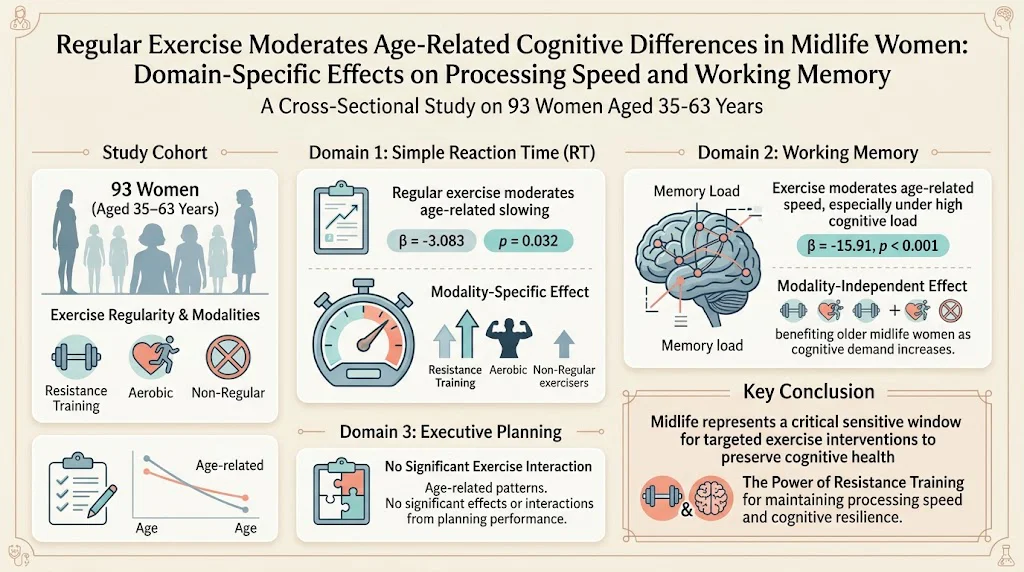
This cross-sectional study enrolled ninety-three women aged 35 to 63 who completed cognitive assessments targeting simple reaction time, working memory, and executive planning. Participants were categorized according to their exercise regularity (regular exercisers versus non-regular exercisers) and by exercise modality (aerobic, resistance training, or other exercise forms).
Cognitive tests included timed reaction tasks, working memory tasks with varying difficulty levels, and executive planning assessments. Outcome measures for time-dependent variables were analyzed with Linear Mixed Models to account for age, exercise category, and their interactions. Accuracy outcomes were evaluated using Generalized Estimating Equations. Pairwise comparisons among exercise modalities employed Welch’s t-tests with false discovery rate correction for multiple comparisons.
Key Findings
The study identified that regular exercise significantly moderated the age-related increase in simple reaction time (β = -3.083, p = 0.032), indicating that women who exercised regularly maintained faster processing speed as they aged compared to non-regular exercisers. Specifically, resistance training participants demonstrated significantly faster reaction times relative to non-regular exercisers, aerobic exercisers, and those engaged in other exercise types.
For working memory, there was a significant three-way moderation: exercise effects on response speed interacted with both age and task difficulty (β = -15.91, p < 0.001). Benefits from exercise became more pronounced as working memory demand increased, primarily driven by older midlife women. This suggests that regular physical activity helps maintain working memory efficiency under high cognitive loads, and this protective effect is independent of exercise modality.
In contrast, executive planning performance declined with age but showed no significant benefit from exercise or differences by exercise type, indicating that this cognitive domain may be less sensitive to midlife exercise interventions.
Expert Commentary
This study contributes valuable insights into domain- and modality-specific cognitive benefits of exercise in midlife women. The stronger effect of resistance training on processing speed may reflect the neuromuscular coordination and neural adaptations unique to strength activities. Meanwhile, the modality-independent benefits in working memory suggest a more generalized exercise effect, possibly mediated by cardiovascular and metabolic improvements.
Recognizing midlife as a sensitive window underscores the potential for targeted exercise interventions to delay age-related cognitive decline. However, the cross-sectional design limits causal inference, and longitudinal studies would enhance understanding of temporal dynamics. Additionally, the relatively small sample size and self-reported exercise modality classification may introduce bias.
Further research should explore neurobiological mechanisms underlying these domain-specific effects and whether tailored exercise prescriptions can optimize cognitive maintenance in at-risk populations.
Conclusion
Regular exercise performed by midlife women offers measurable benefits in maintaining cognitive function, particularly in processing speed and high-demand working memory tasks. Resistance training emerges as a potent modality for preserving reaction time, while working memory gains appear robust across diverse exercise forms. These results support the adoption of structured physical activity programs during midlife to protect cognitive health and potentially delay the progression toward cognitive impairment later in life.
Clinicians and health policymakers should advocate exercise as a non-pharmacologic strategy for cognitive resilience in midlife women, emphasizing resistance training components and recognizing the heightened value of exercise under increased cognitive load conditions.
Funding and ClinicalTrials.gov
The original publication did not report specific funding sources or clinical trial registration for this cross-sectional study.
References
- Wong PL, Chen YL, Juan CH. Regular Exercise Moderates Age-Related Cognitive Differences in Midlife Women: Domain-Specific Effects on Processing Speed and Working Memory. Med Sci Sports Exerc. 2026; PMID: 42934964.
- Erickson KI, Hillman C, Kramer AF. Physical activity, cognition, and brain outcomes: a review of the 2018 Physical Activity Guidelines. Med Sci Sports Exerc. 2019;51(6):1242-1251.
- Voss MW, Nagamatsu LS, Liu-Ambrose T, Kramer AF. Exercise, brain, and cognition across the lifespan. J Appl Physiol. 2011;111(5):1505-1513.
- Williams DM, Gothe NP. The effect of exercise on executive functions in aging: A meta-analytic review. Psychol Aging. 2021;36(7):841-857.
Specialty calculators
For clinical reference; use professional judgment.