Highlight
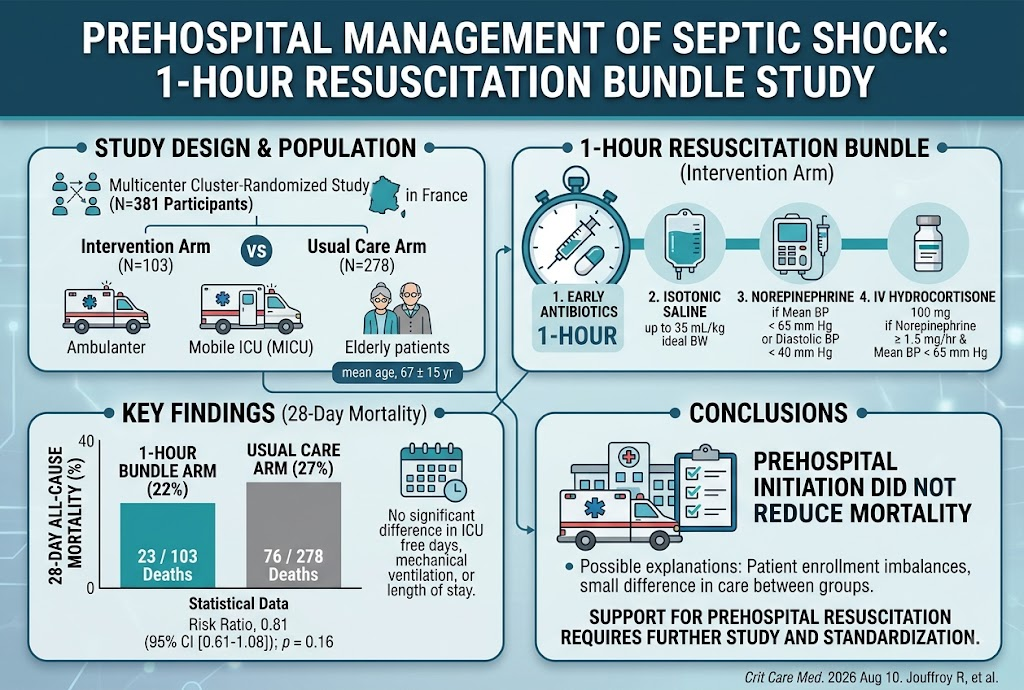
- Implementation of a 1-hour resuscitation bundle in prehospital septic shock management by a mobile ICU (MICU) team was feasible but did not statistically reduce 28-day mortality compared to usual care.
- The bundle included early administration of antibiotics, hemodynamic optimization with fluids and vasopressors, and hydrocortisone when indicated.
- Secondary outcomes, including ICU/hospital mortality, vasopressor-free days, and lengths of stay, showed no significant differences between intervention and control groups.
- Potential confounders included imbalances in center enrollment and marginal differences in treatment intensity between groups.
Study Background
Septic shock remains a critical and common emergency condition with high mortality, requiring prompt recognition and rapid initiation of supportive therapies. Early interventions such as fluid resuscitation, timely antibiotics, and vasopressor support are cornerstones of management and influence patient outcomes significantly. Traditional care pathways often commence these treatments after hospital arrival, but prehospital initiation may reduce delays and improve survival. However, evidence quantifying the benefit of prehospital bundles incorporating antibiotics, fluids, vasopressors, and corticosteroids remains limited. This study addresses an important unmet clinical question: can early, structured resuscitation by prehospital mobile ICU teams influence mortality in adult septic shock patients?
Study Design
This multicenter, open-label, cluster-randomized trial was conducted in France from May 9, 2016, to November 2, 2018. Adult patients with suspected septic shock encountered by MICU teams in the prehospital setting were included. The intervention was a specifically defined 1-hour resuscitation bundle comprising:
- Empirical antibiotics early during prehospital care.
- Up to 35 mL/kg of isotonic saline administered within the first hour.
- Norepinephrine initiation if mean blood pressure (MBP) was <65 mm Hg or diastolic blood pressure <40 mm Hg.
- Hydrocortisone 100 mg intravenously if MBP remained <65 mm Hg despite ≥1.5 mg/hr norepinephrine infusion.
The control arm received usual care, which entailed standard MICU management without a strict protocol for early bundle delivery. The primary endpoint was 28-day all-cause mortality; secondary endpoints included ICU and hospital mortality, lengths of stay, and organ support free days (vasopressors, mechanical ventilation, renal replacement therapy).
Key Findings
Among 398 enrolled patients, 381 consented and were analyzed (mean age, 67 ± 15 years). The 1-hour bundle was associated with a 22% 28-day mortality (23/103 deaths) compared to 27% (76/278 deaths) in the usual care group. Although this suggested a 19% relative reduction in risk (risk ratio 0.81), the difference was not statistically significant (95% CI 0.61–1.08; p=0.16). Intracluster correlation was low (0.005 ± 0.002), indicating minimal cluster effect bias.
Secondary outcome measures, including ICU mortality, hospital discharge mortality, 90-day mortality, vasopressor-free days, invasive mechanical ventilation-free days, renal replacement therapy-free days, and ICU/hospital lengths of stay, were similar between groups with no statistically significant differences.
No safety concerns or adverse events related to the bundle interventions were reported, highlighting the feasibility and relative safety of early antibiotic and hemodynamic support initiation in the prehospital setting.
Expert Commentary
This well-designed multicenter cluster-randomized study addresses a vital gap in prehospital septic shock management literature. The plausible biological rationale supports early antibiotics and hemodynamic optimization to minimize shock duration and organ injury. However, the study did not demonstrate statistically significant mortality reduction at 28 days.
Potential explanations include relatively small sample size affecting statistical power, imbalances in patient recruitment across centers that may introduce bias, and modest differences in care delivered between groups due to crossover or standard practice improvements. Furthermore, hydrocortisone was reserved for refractory hypotension after high-dose norepinephrine, which may have limited its impact.
Current Surviving Sepsis Campaign guidelines recommend early (within 1 hour) antibiotic administration and fluid resuscitation, mostly based on in-hospital data. Extending these practices prehospital is conceptually beneficial but requires logistical considerations. This study highlights operational feasibility but underscores the challenge of demonstrating mortality benefit with bundled interventions in heterogeneous emergency populations.
Additional mechanistic insights are warranted to identify patient subgroups who may derive most benefit from prehospital bundles, such as those with pronounced circulatory failure or high vasopressor requirements. Moreover, integration with prehospital sepsis screening tools and biomarker-guided therapies may enhance targeting.
Conclusion
In adults with suspected septic shock, initiating a 1-hour resuscitation bundle including early antibiotics, fluid resuscitation, vasopressors, and hydrocortisone in the prehospital setting by MICU teams did not significantly reduce 28-day all-cause mortality compared with usual care. Secondary outcomes were also similar.
While the bundle proved feasible and safe, interpretation is limited by sample size, center imbalance, and modest intergroup differences in treatment. These findings suggest that broad implementation of such prehospital protocols requires further evidence demonstrating clear outcome advantages.
Future research should focus on optimizing bundle components, patient selection, and strategies to minimize treatment delays both prehospital and in-hospital to improve septic shock outcomes.
Funding and ClinicalTrials.gov
The study was registered under ClinicalTrials.gov identifier NCT02473263. Funding sources were not detailed in the abstract.
References
1. Jouffroy R, Annane D, Elie C, et al. A 1-Hour Resuscitation Bundle for Prehospital Management of Septic Shock. Crit Care Med. 2026 Aug 10. PMID: 42573415.
2. Evans L, Rhodes A, Alhazzani W, et al. Surviving Sepsis Campaign: International Guidelines for Management of Sepsis and Septic Shock 2021. Crit Care Med. 2021;49(11):e1063-e1143.
3. Seymour CW, Gesten F, Prescott HC, et al. Time to Treatment and Mortality during Mandated Emergency Care for Sepsis. N Engl J Med. 2017;376(23):2235-2244.
4. Rhodes A, Evans LE, Alhazzani W, et al. Surviving Sepsis Campaign: International Guidelines for Management of Sepsis and Septic Shock. Intensive Care Med. 2017;43(3):304-377.