Nurturing Future Researchers: Insights from a National Survey on General Internal Medicine Research Fellowships

Highlight

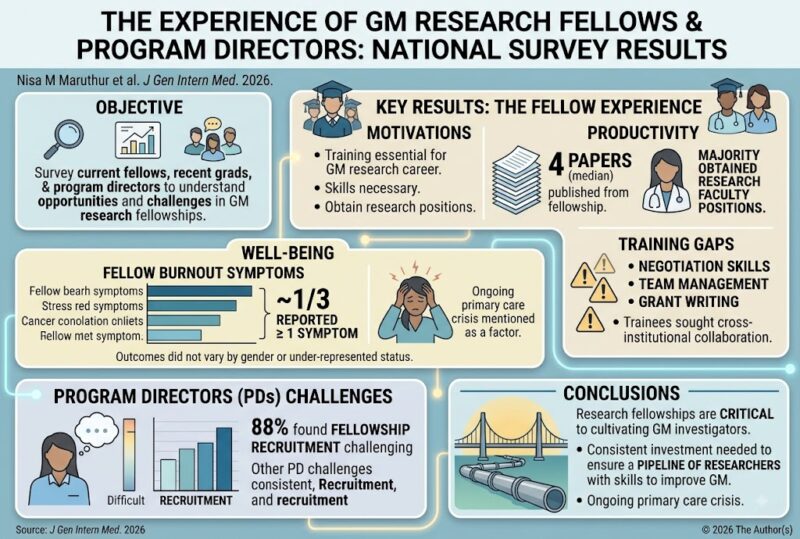
A national survey of general internal medicine (GM) research fellows, graduates, and program directors highlights the critical role of research fellowships in skill development and career progression. Fellows report strong productivity and successful transition to research faculty roles despite notable gaps in training in negotiation, team leadership, and grant writing. Burnout symptoms are prevalent among trainees, and program directors find recruitment particularly challenging. Pursuing cross-institutional collaboration is identified as an important unmet need.


Study Background

General internal medicine is central to patient care and health system improvement, yet advancing the field requires a continuous pipeline of skilled physician-researchers. Research fellowships in GM offer structured opportunities for healthcare professionals to gain essential research skills, mentorship, and experience needed for academic careers. Despite their importance, little published data exist regarding the experiences of fellows and the outcomes of these training programs, creating uncertainty about how well they prepare future investigators and what challenges exist within fellowship structures.

Study Design and Participants

This cross-sectional retrospective survey targeted two groups: (1) individuals who were enrolled in or recently completed GM research fellowships in the United States between 2012 and 2022, and (2) program directors of such fellowships in 2022. Eligibility required fellowships to dedicate at least 50% effort toward research training and conduct. Participants were identified through prior fellow listings, social media and professional society announcements (Society of General Internal Medicine), and direct outreach to fellowship program directors.

Survey Measures

Fellow respondents evaluated their motivations for pursuing fellowship, their training experiences, gaps encountered in skill development, and professional outcomes post-fellowship. Program directors assessed challenges faced during fellowship recruitment and administration, and rated the difficulty of various fellowship activities.

Key Findings

The study achieved a response rate of 42.2% from fellows (160 respondents) and 67.5% from program directors (27 respondents). Key insights emerged:

Importance of Fellowship Training

Fellows overwhelmingly perceived their fellowship as essential for acquiring the research skills required to establish themselves as GM investigators, affirming the pivotal role of these programs in career development.

Research Productivity and Career Outcomes

Fellows demonstrated robust scholarly productivity, reporting a median of four peer-reviewed publications resulting directly from fellowship research (interquartile range [IQR] 3-6). Most graduates successfully transitioned into research faculty positions, underscoring the fellowships’ effectiveness in preparing researchers for academic roles.

Training Gaps and Areas for Improvement

  • Negotiation skills, including securing protected research time and resources.
  • Team management and leadership capabilities necessary for leading research groups.
  • Grant writing expertise, critical for independent funding success.

Fellows expressed a desire for enhanced cross-institutional collaboration during their training, suggesting a need for expanded networking and cooperative research opportunities.

Burnout

Approximately one-third of trainees reported experiencing at least one symptom of burnout, highlighting the personal and professional stresses inherent to intensive research training alongside clinical duties.

Equity and Outcome Consistency

Outcomes including publication output and faculty placement did not show meaningful variation by gender or under-represented in medicine (URiM) status, signaling equitable training benefits across diverse trainee demographics.

Program Directors’ Perspectives

Recruitment was identified by 88% of program directors as a major challenge, reflecting difficulties in attracting suitable candidates for research-intensive tracks. Directors also noted administrative hurdles and resource constraints in managing the fellowship experience effectively.

Expert Commentary

The findings provide valuable insights for stakeholders vested in sustaining and enhancing the GM research workforce. The documented gaps in negotiation, leadership, and grant-writing point to actionable curricular improvements. Integrating formal training modules in these domains could equip fellows with critical ‘soft’ skills needed beyond bench research.

The high rate of burnout symptoms is concerning, emphasizing the necessity for wellness support structures and balanced expectations. Furthermore, program directors’ recruitment challenges may be mitigated by increased institutional incentives, visibility of fellowship benefits, and fostering a culture valuing research alongside clinical excellence.

The study’s cross-sectional design and reliance on self-reported data generate typical limitations including recall bias and selection bias toward respondents with positive experiences. Nevertheless, the sizable sample and national scope enhance generalizability.

Conclusion

General internal medicine research fellowships are indispensable for cultivating the next generation of clinical investigators. Ensuring consistent funding and refining fellowship structures to address identified training gaps and wellness concerns is imperative. Enhancing collaboration networks and recruitment strategies can further strengthen these programs, securing a vibrant research pipeline vital to advancing patient care and healthcare innovation within general medicine.

Funding and Clinical Trials Registration

No specific funding sources or clinical trial registrations were reported for this survey study.

References

Maruthur NM, Ryskina KL, Weerahandi H, et al. The Experience of General Internal Medicine Research Fellows and Program Directors: Results from a National Survey. J Gen Intern Med. 2026 Aug 10. PMID: 42573885. https://pubmed.ncbi.nlm.nih.gov/42573885/

Comments

No comments yet. Why don’t you start the discussion?

Leave a Reply