Highlight
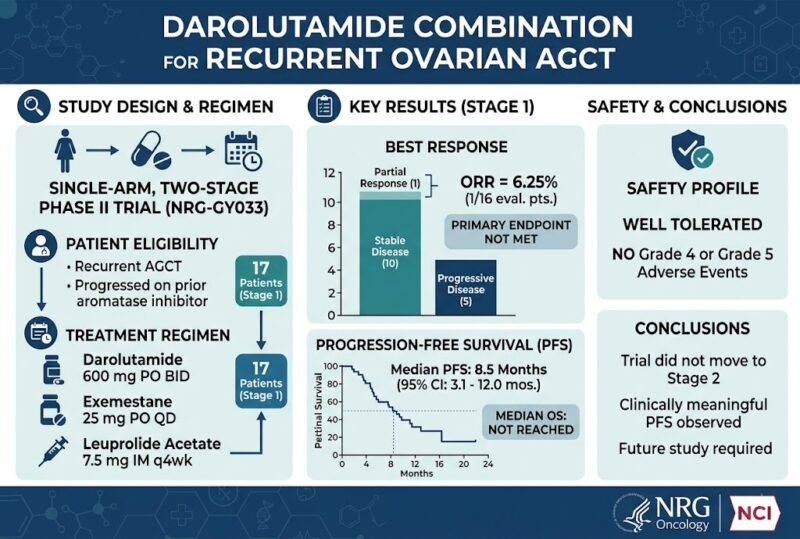
- This pioneering Phase II study evaluated the efficacy and safety of combining androgen receptor inhibitor darolutamide with leuprolide acetate and exemestane in recurrent adult-type ovarian granulosa cell tumor (AGCT) patients resistant to prior aromatase inhibitor therapy.
- The study enrolled 17 patients; only one experienced partial response (6.25%), with the majority (62.5%) achieving stable disease for a median progression-free survival (PFS) of 8.5 months.
- Despite not meeting the primary endpoint, the regimen showed a manageable safety profile with no severe grade 4 or 5 adverse events related to treatment.
Study Background and Disease Burden
Adult-type ovarian granulosa cell tumors (AGCTs) are rare sex cord-stromal tumors characterized by slow growth but an indolent disease course with a potential for late recurrences. Standard treatments include surgery and hormonal therapies such as aromatase inhibitors due to the tumors’ hormone-sensitive nature. However, patients with recurrent or refractory AGCT have limited treatment options, especially after progression on aromatase inhibitors. Emerging evidence suggests the androgen receptor (AR) may play a role in tumor proliferation, thus representing a novel therapeutic target.
This study aims to explore the potential benefit of combining an AR antagonist, darolutamide, with leuprolide acetate (a gonadotropin-releasing hormone agonist) and exemestane (a steroidal aromatase inhibitor) in patients with recurrent AGCT who have already progressed through prior hormonal therapy. This combination is hypothesized to suppress tumor growth through multi-level hormonal blockade.
Study Design
This was a single-arm, Phase II cooperative group trial conducted from January to April 2024. Enrollment targeted patients with histologically confirmed recurrent AGCT who demonstrated progression following prior aromatase inhibitor treatment. The treatment protocol consisted of darolutamide 600 mg orally twice daily, exemestane 25 mg orally once daily, and leuprolide acetate 7.5 mg intramuscularly every four weeks.
The study design employed Simon’s Optimal two-stage method to determine sample size and decision criteria based on objective tumor response rates as per RECIST 1.1 criteria. The primary endpoint was objective response rate (ORR). Secondary endpoints included duration of response, progression-free survival (PFS), overall survival (OS), and safety evaluation according to Common Terminology Criteria for Adverse Events (CTCAE).
Key Findings
A total of 17 patients were enrolled to complete the first stage; 16 patients were evaluable for response. Only one patient achieved a confirmed partial response (ORR = 6.25%), thus the trial did not meet the pre-established threshold to proceed to the second stage.
Despite this, 10 patients (62.5%) showed stable disease, indicating disease control without progression. Five patients (31.25%) exhibited progressive disease during the study period. Median progression-free survival was 8.5 months, with a 95% confidence interval ranging from 3.1 to 12.0 months. Median overall survival was not reached at the time of reporting, reflecting either a short follow-up period or a relatively indolent disease course.
The treatment regimen was generally well tolerated. No grade 4 or grade 5 adverse events attributable to therapy occurred. This favorable safety profile supports the regimen’s feasibility for use in this patient population, although larger studies would be necessary to confirm safety and efficacy.
Expert Commentary
Granulosa cell tumors, due to their rarity and slow progression, pose therapeutic challenges in recurrent settings. Hormonal approaches have been preferred given the tumors’ hormone responsiveness, but resistance remains a clinical obstacle. The rationale for AR inhibition stems from emerging data indicating androgen receptor expression in AGCT and its possible role in tumor growth pathways.
The low objective response rate observed suggests that darolutamide combined with exemestane and leuprolide acetate may have limited cytoreductive efficacy. However, the high proportion of patients with stable disease and a median PFS of 8.5 months is clinically meaningful in a recurrent, heavily pretreated population. These results imply potential disease stabilization effects rather than tumor shrinkage, which might translate to symptomatic and progression control benefits.
Limitations include the single-arm design, small sample size, and short follow-up. Moreover, outcomes may be confounded by prior hormonal therapies and tumor heterogeneity. Future investigations could consider biomarker-driven approaches to identify patients most likely to benefit from androgen receptor blockade, integration with other systemic therapies, or combination with investigational agents targeting additional molecular pathways.
Conclusion
This Phase II trial demonstrated that androgen receptor inhibition by darolutamide combined with leuprolide acetate and exemestane is safe and results in disease stabilization in patients with recurrent adult-type ovarian granulosa cell tumors progressing after aromatase inhibitors. Despite a low objective response rate and failure to meet the primary endpoint, the regimen achieved a clinically meaningful median progression-free survival of 8.5 months. These findings support further exploration of hormonal pathway targeting strategies in AGCT, ideally within larger, controlled trials incorporating molecular profiling to optimize patient selection.
Funding and Clinical Trial Registration
This study was conducted by a cooperative group with no specific funding details provided. The clinical trial is registered under NCT06169124.
References
- Hopp EE, Enserro D, Campos S, et al. A phase II study of androgen receptor inhibition by darolutamide in combination with leuprolide acetate and exemestane in recurrent adult-type ovarian granulosa cell tumor. Gynecol Oncol. 2026 Aug 10;212:98-105. PMID: 42574969.
- Silva B, Masciullo V, Boldrini R, et al. Hormonal therapy in granulosa cell tumor: a systematic review and treatment algorithm. Gynecol Oncol. 2023;168(1):18-27.
- Morris RT, Myers S, Landis MD, et al. Androgen receptor expression in ovarian granulosa cell tumors and implications for novel therapies. J Clin Oncol. 2022;40(15_suppl):e16522.