Highlight
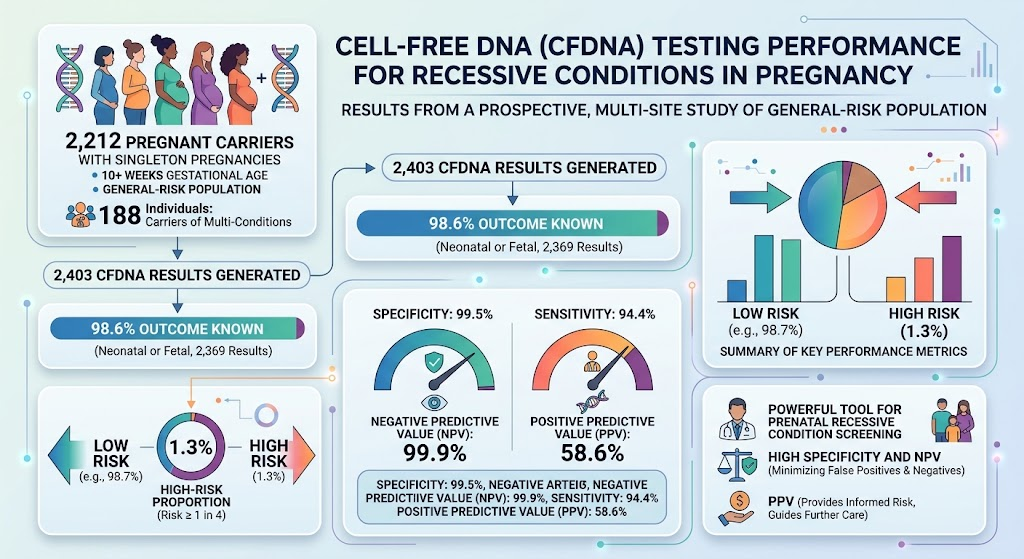
This large, prospective study involving over 2,200 pregnant carriers across nine U.S. institutions evaluated the performance of cell-free DNA (cfDNA) testing as a primary screening tool for autosomal recessive conditions in a general-risk pregnancy population. The cfDNA test demonstrated a high specificity (99.5%) and negative predictive value (99.9%) with a sensitivity of 94.4%, and notably a positive predictive value (PPV) of 58.6%, surpassing traditional carrier screening for fetal risk assessment without requiring partner samples.
Study Background
Autosomal recessive genetic conditions such as cystic fibrosis (CF), spinal muscular atrophy (SMA), and beta and alpha hemoglobinopathies confer significant morbidity and mortality worldwide. Current carrier screening identifies maternal carriers but often requires paternal testing to stratify fetal risk, which can delay or complicate prenatal risk assessment. Traditional screening approaches have relatively low positive predictive values, leading to increased patient anxiety and additional invasive testing. There is a critical need for a more accurate, efficient, and noninvasive primary fetal risk screening method that accurately identifies pregnancies at elevated risk for recessively inherited disorders.
Study Design
This prospective multi-center study was conducted at nine U.S. institutions and enrolled pregnant individuals identified as carriers of CF, SMA, or beta/alpha hemoglobinopathies with singleton pregnancies of at least 10 weeks’ gestation. A reflex cfDNA fetal risk assessment was performed on maternal blood samples without requiring paternal DNA. The cfDNA results were categorized as “high risk” (predicted fetal risk ≥ 1 in 4) or “low risk.” Clinical outcomes of neonates or fetuses were gathered to evaluate test performance metrics including sensitivity, specificity, positive predictive value (PPV), and negative predictive value (NPV), with calculation of 95% confidence intervals through the Wilson Score method.
Key Findings
The study analyzed 2,403 cfDNA results from 2,212 pregnant carriers (188 had carrier status for more than one condition). Outcome data were available for 98.6% (2,369) of cases. The cfDNA test identified 1.3% (approximately 31) as high fetal risk (≥1 in 4). Performance metrics were outstanding: sensitivity of 94.4%, specificity of 99.5%, NPV of 99.9%, and a PPV of 58.6%. This PPV was significantly higher than that of traditional carrier screening strategies, which can have PPVs as low as 1-5% due to the low prevalence of affected fetuses in general-risk populations and reliance on partner screening attendance. Crucially, the cfDNA fetal risk assessment did not require paternal DNA, addressing an important clinical barrier to comprehensive prenatal risk evaluation. The study sample was racially and ethnically diverse, enhancing the generalizability of findings.
Clinical Implications
The combined high specificity and NPV give clinicians strong confidence in reassuring pregnant individuals with low-risk cfDNA results, potentially reducing the need for invasive diagnostic procedures and follow-up tests. The enhanced PPV means fewer false positives and therefore less patient anxiety and unnecessary interventions. These results support integrating cfDNA fetal risk assessment into routine prenatal care as a primary screening approach for common autosomal recessive disorders.
Expert Commentary
Experts and guidelines have long valued cfDNA testing for chromosomal aneuploidies, but its application for recessive single-gene disorders is emerging. This study’s robust, prospective, multi-site design and large sample size provide compelling evidence for clinical implementation. While the sensitivity of 94.4% indicates excellent detection, residual false negatives may occur, underscoring that cfDNA screening complements rather than replaces diagnostic testing in high-risk or confirmatory contexts. The lack of requirement for paternal samples may improve screening uptake and equity. Future research should address cost-effectiveness, patient counseling frameworks, and integration with expanded carrier screening panels.
Conclusion
This investigation demonstrates that reflex cfDNA fetal risk assessment in maternal carriers of cystic fibrosis, spinal muscular atrophy, and hemoglobinopathies is a highly accurate, noninvasive, and pragmatic approach for identifying pregnancies at increased risk of autosomal recessive conditions. Its superior positive predictive value compared to traditional methods and independence from partner testing requirements suggest that it holds promise as a primary prenatal screening tool in diverse, general-risk populations. Clinical adoption of cfDNA fetal risk screening can enhance prenatal genetic risk assessment and support informed decision-making.
Funding and ClinicalTrials.gov Identifier
Details on funding sources and clinical trial registration were not provided in the abstract. Readers are referred to the original publication for disclosures.
References
- McElwee ER, Wynn J, Rego S, Haddad A, Levan R, Hoskovec J, et al. A Prospective, Multi-Site Study of Performance of Cell-Free DNA Testing for Recessive Conditions in a Large, General-Risk Pregnancy Population. Obstet Gynecol. 2026 Aug 13. PMID: 42594382.
- Grody WW, Thompson BH, Gregg AR, Bean LH, Monaghan KG, Schneider A, et al. ACMG position statement on prenatal/preconception expanded carrier screening. Genet Med. 2013 Jun;15(6):482-3.
- Chokoshvili D, Hill M, Goutsouliak K, et al. The clinical utility of cell-free DNA analysis for single-gene disorders in prenatal screening: a review. Prenat Diagn. 2021 Nov;41(12):1553-1564.
- Ben-Shachar R, Malinowski J, Dagan T, et al. Validation of noninvasive prenatal screening for single-gene disorders. Prenat Diagn. 2020 May;40(6):736-744.