Highlight
- Acute normovolemic hemodilution (ANH) did not significantly reduce allogeneic packed red blood cell (pRBC) transfusions among women undergoing cardiac surgery.
- ANH was associated with a higher incidence of intraoperative hypotension and prolonged intensive care unit (ICU) and hospital length of stay in female patients.
- Mortality and other postoperative complication rates were comparable between ANH and usual care groups.
- These findings underscore the importance of sex-specific research and tailored blood conservation strategies in cardiac surgery.
Study Background
Cardiac surgery often involves substantial blood loss that necessitates transfusion of allogeneic blood products, associated with risks such as immunologic reactions and increased morbidity. Women undergoing cardiac surgery have been observed to require transfusions more frequently than men, potentially due to differences in baseline hemoglobin, smaller blood volume, and surgical complexity. Despite this increased transfusion burden, female patients are underrepresented in randomized controlled trials evaluating blood conservation techniques, including acute normovolemic hemodilution (ANH).
ANH involves the withdrawal of a predetermined volume of a patient’s blood immediately before surgery, simultaneous volume replacement with crystalloids, and reinfusion of the autologous blood after cardiopulmonary bypass (CPB). This approach aims to reduce allogeneic transfusions by preserving autologous red blood cells. However, the overall efficacy and safety of ANH specifically in women have remained uncertain.
Study Design
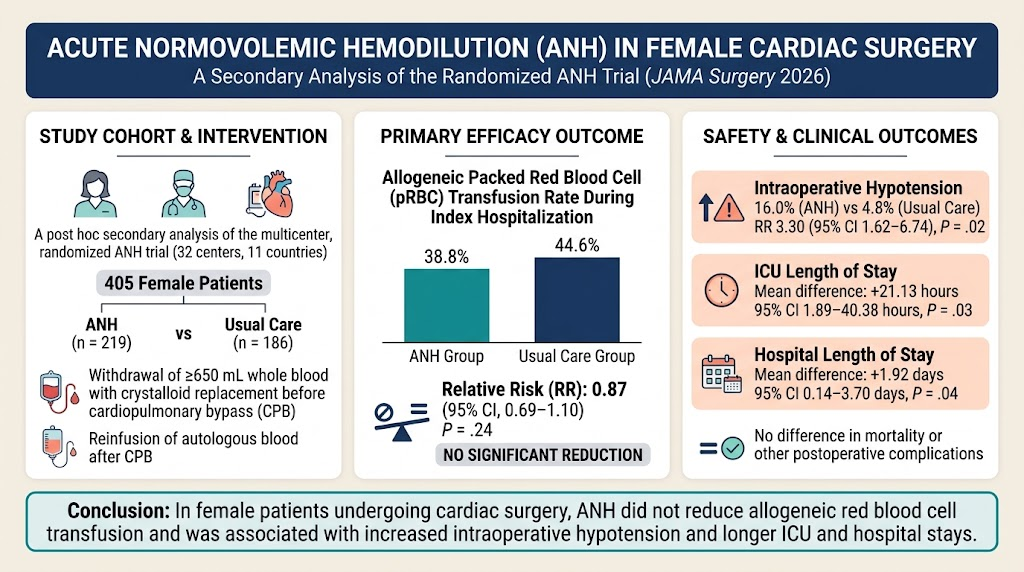
This secondary post hoc analysis was derived from the multicenter, randomized ANH trial conducted across 32 centers in 11 countries between April 2019 and December 2024. Out of 2010 patients in the parent trial, 405 female patients were included in this analysis: 219 randomized to receive ANH and 186 to usual care. The intervention entailed withdrawal of at least 650 mL of whole blood with concurrent crystalloid volume replacement prior to CPB, followed by reinfusion of the collected blood after CPB completion.
The primary outcome was the incidence of patients receiving at least one unit of allogeneic packed red blood cell (pRBC) transfusion during the index hospital stay. Secondary safety outcomes assessed included intraoperative hypotension, length of ICU and hospital stays, perioperative complications, and mortality.
Key Findings
The median age of female participants was 62 years (IQR 54–69). The transfusion rates were comparable between the ANH group (38.8%) and the usual care group (44.6%), yielding a relative risk (RR) of 0.87 (95% CI, 0.69 to 1.10; P=0.24), indicating no statistically significant benefit in reducing allogeneic pRBC transfusions with ANH in women.
Intraoperative hypotension occurred significantly more often in the ANH group (16.0%) compared to usual care (4.8%) with an RR of 3.30 (95% CI, 1.62 to 6.74; P=0.02). This suggests a notable safety signal related to volume shifts or hemodynamic instability during surgery after blood removal and fluid replacement.
Moreover, women in the ANH arm had significantly longer ICU stays by an average of 21.13 hours (95% CI, 1.89 to 40.38; P=0.03) and hospital stays prolonged by 1.92 days (95% CI, 0.14 to 3.70; P=0.04), which may reflect complications or delayed recovery associated with intraoperative hemodynamic challenges.
No statistically significant differences were seen in mortality or other postoperative complications between the groups, indicating that increased hypotension and longer stays did not translate to short-term survival disadvantage but may impact resource utilization and patient morbidity.
Expert Commentary
These exploratory data highlight critical considerations when applying ANH in female cardiac surgery patients. While ANH is a theoretically attractive blood conservation strategy, its benefits appear attenuated in women, possibly due to physiologic differences such as smaller blood volume or cardiovascular reserve impacting tolerance to acute hemodilution.
The increased intraoperative hypotension observed could be mechanistically linked to ANH volume removal and insufficient compensatory vasoconstriction or volume expansion, which may not be adequately captured in usual hemodynamic monitoring protocols. Such hypotensive episodes might contribute to end-organ hypoperfusion, potentially explaining the prolonged ICU and hospital stays despite similar complication and mortality rates.
The study’s post hoc nature and limited power underscore the need for prospective trials specifically powered to evaluate sex-specific outcomes and optimize ANH protocols tailored for female physiology. Additionally, the heterogeneity of cardiac surgery types and comorbidities warrant attention to better delineate which subsets of women may benefit or be harmed by ANH.
Conclusion
In summary, acute normovolemic hemodilution does not reduce allogeneic blood transfusion rates in female patients undergoing elective cardiac surgery and is associated with increased intraoperative hypotension and longer postoperative stays. These findings call for cautious application of ANH in women and reinforce the need for gender-specific research to refine blood management strategies and enhance safety and effectiveness.
Future investigations should prospectively evaluate hemodynamic management protocols during ANH, consider individualized volume targets, and explore alternative techniques to mitigate transfusion risks in women.
Funding and Clinical Trial Registration
The study was conducted under the ANH Trial Group with trial registration ClinicalTrials.gov Identifier: NCT03913481.