Highlight
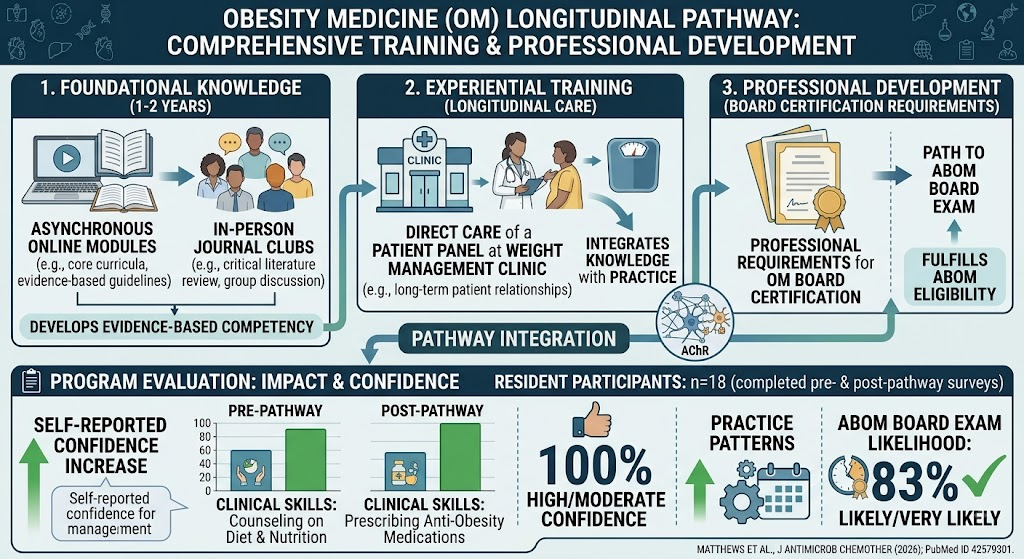
- A 1-2-year obesity medicine (OM) training pathway was developed for internal medicine residents in an underserved urban clinic setting.
- The curriculum combines foundational knowledge, experiential patient care, and professional development geared toward OM board certification.
- Resident self-reported confidence and clinical practice in obesity management significantly improved post-training.
- The pathway addresses critical gaps in obesity education within internal medicine residencies and promotes workforce development.
Study Background: Addressing the Gaps in Obesity Medicine Education
Obesity remains a major global public health challenge and a leading risk factor contributing to diabetes, cardiovascular disease, and many other comorbidities. Despite the high prevalence and significant health burden of obesity, internal medicine (IM) residency programs often inadequately prepare trainees to effectively manage this complex condition. Traditional training tends to emphasize acute care and chronic disease management without robust focus on obesity-specific counseling, pharmacotherapy, or multidisciplinary approaches. Furthermore, underserved populations disproportionately affected by obesity face inequities in access to specialized obesity care.
Given this context, there is a pressing need to expand the capacity of frontline physicians, particularly internists, who are positioned to provide longitudinal comprehensive obesity care. Developing a structured, competency-based obesity medicine pathway during residency offers a promising strategy to improve clinical outcomes and reduce health disparities.
Study Design: Implementation of a Longitudinal Obesity Medicine Pathway
This educational innovation was deployed in a large urban IM residency training program linked to a clinic-based weight management program within a Federally Qualified Health Center (FQHC) serving a diverse, underserved patient population.
Participants included postgraduate year 2 and 3 (PGY2 and PGY3) categorical IM residents. The pathway was structured over 1 to 2 years, consisting of three integrated components:
1. Foundational Knowledge: Residents engaged in asynchronous online modules covering obesity pathophysiology, behavioral counseling, nutrition, pharmacologic therapies, and evidence-based guidelines. This was reinforced by interactive in-person journal clubs to discuss current literature.
2. Experiential Training: Direct longitudinal clinical care was provided to a dedicated panel of patients within the weight management clinic setting. This hands-on experience enabled residents to apply knowledge in real-world contexts, including patient counseling, medication management, and monitoring.
3. Professional Development: The pathway included structured mentorship and support for residents to complete the necessary requirements and prepare for the obesity medicine board certification examination, aiming to foster career advancement.
Pre- and post-pathway surveys captured self-reported confidence in core obesity management skills and clinical behaviors.
Key Findings: Enhanced Confidence and Practice Patterns in Obesity Medicine
Eighteen residents completed the OM pathway and associated surveys. The program led to marked improvements in self-rated confidence across key clinical competencies:
– 100% of participating residents reported high or moderate confidence in counseling patients on diet and nutrition—a foundational skill in obesity management.
– Similarly, 100% indicated improved confidence in the judicious prescribing of anti-obesity medications, reflecting increased familiarity with pharmacologic options.
– Eighty-three percent of residents expressed strong intent to pursue formal obesity medicine board certification, demonstrating the pathway’s success in fostering professional commitment.
Increased practical exposure translated into more frequent incorporation of obesity-related care into routine clinical practice, addressing a previously unmet training need. The multidisciplinary, longitudinal care model of the pathway is aligned with best practice recommendations for obesity treatment.
Expert Commentary: Implications and Considerations for Broader Adoption
This comprehensive resident training pathway uniquely integrates foundational education, experiential clinical training, and professional development in an underserved clinical environment. It addresses critical barriers within IM training programs, including limited curricula on obesity and inadequate clinical exposure.
Experts emphasize that the longitudinal care of patients in a dedicated clinic improves competency and fosters a patient-centered approach necessary for chronic conditions like obesity. The program’s setting within an FQHC is particularly relevant, tackling obesity care disparities in vulnerable populations.
Limitations include the relatively small sample size and reliance on self-reported confidence rather than objective competency measures. Future studies should assess patient-level outcomes and long-term career trajectories to evaluate the program’s full impact. Additionally, scalability and integration into diverse residency settings will require resources and institutional support.
Conclusion: Building a Knowledgeable and Skilled Obesity Medicine Workforce
The implementation of a structured, comprehensive obesity medicine training pathway during internal medicine residency effectively enhances resident confidence and clinical practice behaviors in obesity care within an underserved urban setting. By bridging educational gaps and promoting board certification, such programs have the potential to expand the obesity medicine workforce capable of addressing one of the most pressing chronic health challenges.
As obesity prevalence rises, residency programs should consider adopting similar pathways to equip future internists with essential competencies to improve patient outcomes and reduce health disparities. Ongoing evaluation and dissemination will be key to sustaining and scaling this vital educational innovation.
Funding and Clinical Trials
The study did not report external funding sources or clinical trial registration.
References
1. Shafer R, Shapiro L, Carnavali F, Andrilli J, Lynch R, Goldberg T. Building an Obesity Medicine Workforce: Implementation of a Comprehensive Resident Training Pathway in an Underserved Care Environment. Journal of General Internal Medicine. 2026 Aug 11. PMID: 42581161.
2. Jensen MD et al. 2013 AHA/ACC/TOS Guideline for the Management of Overweight and Obesity in Adults. Circulation. 2014;129(25 Suppl 2):S102-S138.
3. Tsai AG, Wadden TA. Systematic Review: An Evaluation of Major Commercial Weight Loss Programs in the United States. Ann Intern Med. 2005;142(1):56-66.
4. Mechanick JI et al. Clinical Practice Guidelines for the Perioperative Nutritional, Metabolic, and Nonsurgical Support of the Bariatric Surgery Patient. Obesity. 2013;21 Suppl 1:S1-S27.