Highlight
1. A novel patient-facing website significantly improved contraceptive knowledge and perceived access compared to federally mandated consent materials among individuals considering tubal sterilization.
2. Increased awareness of long-acting reversible contraception (LARC) options, particularly implants, was observed three months after exposure to the intervention.
3. Despite improved knowledge and access perceptions, tubal sterilization remained the most preferred contraceptive method three months post-intervention.
4. The patient-centered educational tool addresses important gaps in informed consent practices amid evolving reproductive healthcare landscapes in the US.
Study Background
Permanent contraception via tubal sterilization remains a widely utilized method of birth control, yet one in five patients report later regret or a desire for reversal, reflecting suboptimal informed decision-making. This issue has come into sharper focus following the 2022 Dobbs decision, which reshaped abortion access and intensified interest in permanent contraception methods in the United States. Currently, federal regulations mandate use of a standardized “consent for sterilization” form (HHS-687) to facilitate informed consent; however, challenges persist in effectively educating patients about their contraceptive options and ensuring clear comprehension of the permanence and implications of the procedure. Given that comprehensive contraceptive counseling can increase patient satisfaction and long-term reproductive autonomy, innovative approaches to disseminate actionable contraception knowledge are critical. This study aimed to address these gaps by developing and systematically evaluating the impact of an educational, patient-facing website tailored to individuals considering tubal sterilization.
Study Design
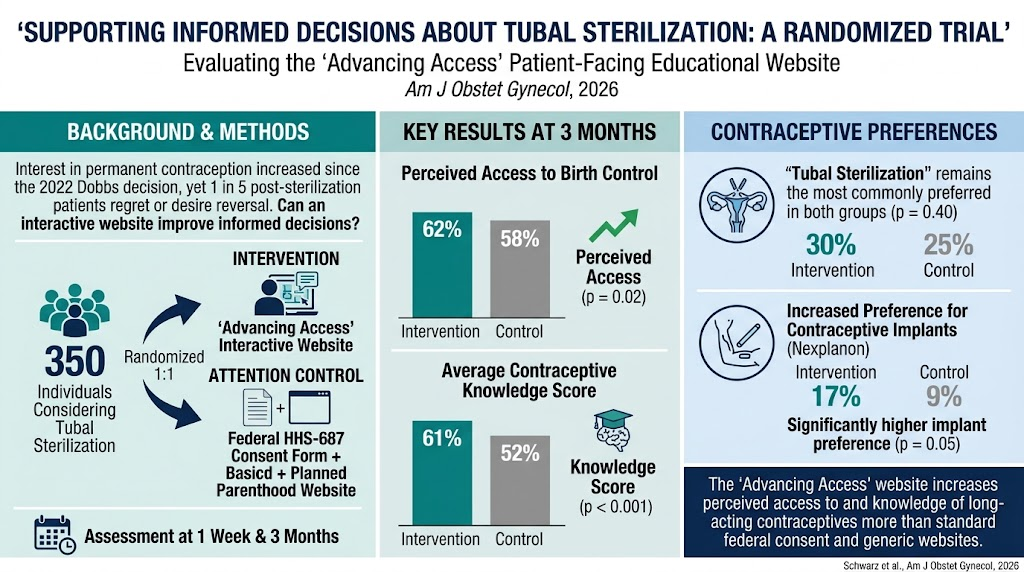
This randomized controlled trial enrolled 350 participants contemplating tubal sterilization, with an average age of 33 years and a majority having publicly funded insurance and lower income levels, which reflects a population vulnerable to disparities in reproductive healthcare. Participants were randomized into two groups: the intervention group reviewed the “Advancing Access” website—a comprehensive patient education platform focused on tubal sterilization and long-acting reversible contraception (LARC) options. The control (attention control) group reviewed the federally mandated sterilization consent form HHS-687 combined with Planned Parenthood’s tubal sterilization webpage. Follow-up data collection occurred within one week and at three months post-intervention to assess sustained outcomes.
The primary endpoint was a multidimensional measure of access to reproductive health services at three months assessing awareness, availability, affordability, acceptability, and safety perceptions for six methods: tubal sterilization, vasectomy, intrauterine device (IUD), implant, emergency contraception, and abortion pills. Secondary outcomes included scores of contraceptive knowledge and expressed contraceptive preferences. Statistical analyses involved chi-square and t-tests for between-group comparisons and multivariable linear regression adjusted for demographics and reproductive history.
Key Findings
At baseline, perceptions of access and contraceptive knowledge were comparably low across both study arms, with approximately half of participants perceiving adequate access and only about 40% answering contraceptive knowledge questions correctly.
One week following the intervention, participants engaging with the “Advancing Access” website showed a marked increase in contraceptive knowledge, correctly answering 68% of questions compared to 52% in the control group (P < 0.001). This knowledge improvement persisted at three months (61% vs 52%, P < 0.001) after adjusting for potential confounders.
Three months post-intervention, the intervention group reported significantly higher perceived access to birth control methods (62% vs 58%, P = 0.02; adjusted mean difference 3.24, 95% CI: 1.81-4.67). Notably, preferences for LARC, particularly implants, rose in the intervention group (17% vs 9%, P = 0.05). However, tubal sterilization remained the predominant preferred contraceptive method in both groups (30% intervention vs 25% control, P = 0.40), indicating selective shifts in contraceptive preferences but reassurance in procedural decisional stability.
Safety data on adverse outcomes related to the educational intervention were not reported, consistent with the nature of the intervention being informational.
Expert Commentary
This pragmatic trial addresses a critical need for enhancing informed consent quality in permanent contraception. The use of a patient-centered digital tool effectively enriched participants’ contraceptive knowledge and perceived accessibility to reproductive options beyond what is achievable via standard consent forms and static educational websites. The rise in LARC preference following intervention suggests that improved informational access may broaden contraceptive method consideration, aligning with prior literature advocating for comprehensive counseling to reduce unintended pregnancies and post-procedure regret.
Limitations include potential selection bias toward digitally literate individuals, the single geographical region recruitment limiting generalizability, and the short duration of follow-up for clinical outcomes such as actual contraceptive uptake or long-term decisional regret. Further studies should explore integration of such tools into clinical workflows and assess impacts on real-world contraceptive behaviors and patient satisfaction over extended periods.
Conclusion
The “Advancing Access” patient-facing website significantly enhances contraceptive knowledge and perceived access among individuals considering tubal sterilization when compared to federally mandated consent materials. This digital educational approach can support more informed, autonomous reproductive health decisions and potentially reduce post-sterilization regret. Implementation of similar patient-centered, accessible tools could be prioritized to improve contraceptive counseling quality, especially in settings with constrained provider time and resources.
Funding and ClinicalTrials.gov
The study was published in the American Journal of Obstetrics and Gynecology (PMID: 42849808). Specific funding sources and clinical trial registration details were not reported in the abstract.
References
1. Schwarz EB, Begna H, Okobi A, Chiang A, Treder K, Sudore RL. Supporting informed decisions about tubal sterilization with a patient-facing website: a randomized trial. Am J Obstet Gynecol. 2026 Oct 8. PMID: 42849808.
2. Sonfield A, Hasstedt K. Behind the Counter: The Current Landscape of Access to Contraceptive Sterilization. Guttmacher Institute. 2023.
3. Foster DG, et al. Regret after tubal sterilization: findings from the Turnaway Study. Contraception. 2021;104(4):414-420.
4. Polis CB, et al. Comparative effectiveness of contraception: a systematic review and network meta-analysis. Lancet Glob Health. 2023;11(2):e139-e148.
5. American College of Obstetricians and Gynecologists. Permanent contraception. Practice Bulletin No. 217. Obstet Gynecol. 2020;135(5):e217-e232.