Highlight
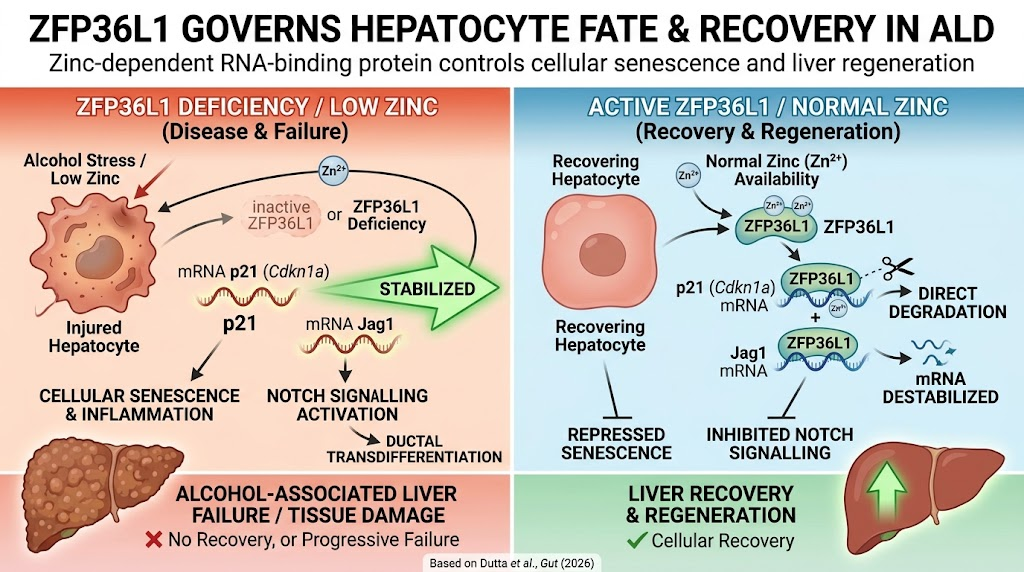
- ZFP36L1, a zinc-dependent RNA-binding protein, regulates hepatocyte senescence and recovery from alcohol-associated liver disease (ALD).
- Deletion of ZFP36L1 in hepatocytes exacerbates ALD by triggering inflammatory and senescence-related transcriptional programs.
- ZFP36L1 destabilizes mRNAs encoding p21 (Cdkn1a) and JAG1, suppressing senescence and NOTCH pathway activation.
- Human liver explants show reduced ZFP36L1 activity correlating with increased hepatocyte senescence and disease severity, linked to impaired zinc-dependent signaling.
Study Background
Alcohol-associated liver disease (ALD) remains a major global cause of morbidity and mortality, with a disease spectrum ranging from steatosis to cirrhosis and acute liver failure. While most individuals experience liver recovery upon alcohol abstinence, a subset progresses to severe liver failure. The molecular mechanisms dictating divergence between recovery and progression are incompletely understood. Proinflammatory cytokines, particularly tumour necrosis factor alpha (TNFα), are implicated in ALD pathogenesis, but clinical trials targeting these cytokines have yielded disappointing results, indicating the need to identify alternative regulatory mechanisms controlling hepatocyte fate.
Zinc finger proteins of the zinc finger protein 36 (ZFP36) family are RNA-binding proteins that modulate inflammatory responses by destabilizing target mRNAs post-transcriptionally. ZFP36L1, a member of this family, is inducible by TNFα and has been linked to controlling biological outcomes through mRNA turnover. Its role in ALD hepatocyte biology, particularly in senescence regulation and disease progression, has not been fully characterized.
Study Design
This study utilized a hepatocyte-specific ZFP36L1 knockout mouse model to investigate the impact of ZFP36L1 deletion on ALD progression induced experimentally. The design included:
- Selective deletion of ZFP36L1 in mouse hepatocytes.
- Induction of experimental ALD through appropriate animal models mimicking chronic alcohol exposure.
- Assessment of liver pathology, inflammation, transcriptional reprogramming including senescence and ductal transdifferentiation markers.
- Identification of direct mRNA targets of ZFP36L1 through molecular assays.
- Analysis of human liver explants from ALD patients for ZFP36L1 expression, hepatocyte senescence markers, and zinc-dependent functional assays.
Key Findings
Deletion of ZFP36L1 in hepatocytes significantly aggravated experimental ALD, characterized by enhanced inflammation, hepatocyte senescence, and ductal transdifferentiation. Transcriptomic profiles demonstrated activation of senescence-associated gene signatures, increased expression of Cdkn1a (encoding p21), and upregulation of JAG1-NOTCH signalling components.
Mechanistically, ZFP36L1 was found to bind directly to mRNAs of cyclin-dependent kinase inhibitor 1A (Cdkn1a/p21) and jagged canonical notch ligand 1 (Jag1), promoting their degradation. This post-transcriptional regulation suppresses the induction of hepatocyte senescence and NOTCH pathway activation, thereby preventing maladaptive liver remodeling.
In human ALD liver explants, a progressive decline in ZFP36L1 activity was correlated with increased hepatocyte senescence and worsening disease severity. Importantly, zinc availability emerged as a critical factor modulating ZFP36L1 function. Zinc supplementation in vitro altered ZFP36L1 activity and expression levels of its mRNA targets, underscoring the importance of zinc-dependent regulatory mechanisms in ALD pathophysiology.
Expert Commentary
This study provides compelling evidence that the zinc-dependent RNA-binding protein ZFP36L1 acts as a molecular gatekeeper of hepatocyte fate by controlling senescence and NOTCH signalling pathways pivotal in ALD progression. The findings offer novel mechanistic insight into why therapeutic targeting of TNFα alone has been disappointing: it is the RNA-level regulation downstream of TNFα signalling that critically determines outcomes.
The direct targeting of key senescence and differentiation pathways by ZFP36L1 suggests therapeutic opportunities to enhance hepatocyte resilience and recovery. Moreover, the zinc-dependency of this regulatory axis aligns with epidemiological data linking zinc deficiency to poor outcomes in chronic liver diseases, providing a translational rationale for zinc supplementation strategies in ALD.
Notably, while the mouse model recapitulates key features of ALD, human liver disease is heterogeneous, and additional modulators may influence ZFP36L1 function. Future research to validate these mechanisms in larger human cohorts and clinical trials testing interventions that modulate ZFP36L1 or zinc homeostasis is warranted.
Conclusion
This study identifies ZFP36L1 as a pivotal zinc-dependent RNA-binding protein that governs hepatocyte senescence and liver regeneration following alcohol-induced injury. By directly destabilizing mRNAs encoding p21 and JAG1, ZFP36L1 suppresses detrimental senescence and aberrant NOTCH signalling, thereby limiting ALD progression. The decline of ZFP36L1 activity in advanced human ALD and its regulation by zinc highlight a promising therapeutic target. Restoring or enhancing ZFP36L1 function, potentially via zinc modulation, may represent a novel strategy to improve outcomes in patients suffering from alcohol-related liver failure.
Funding and Clinical Trials
Details regarding funding and clinical trial registration were not provided in the source abstract. Interested readers should consult the original publication for specific disclosures.
References
1. Dutta RK, Du K, Ren N, et al. Zinc-dependent RNA-binding protein controls hepatocyte senescence and recovery from alcohol-related liver failure. Gut. 2026 Oct 7;75(11):2241-2255. PMID: 41534893.
2. Gao B, Bataller R. Alcoholic liver disease: Pathogenesis and new therapeutic targets. Gastroenterology. 2011;141(5):1572-85.
3. Blackshear PJ. Tristetraprolin and other CCCH tandem zinc-finger proteins in the regulation of mRNA turnover. Biochem Soc Trans. 2002;30(Pt 6):945-52.
4. McClain CJ, Su L, et al. Zinc supplementation in alcoholic liver disease: A review. Alcohol Clin Exp Res. 2020;44(7):1288-1300.