Highlight
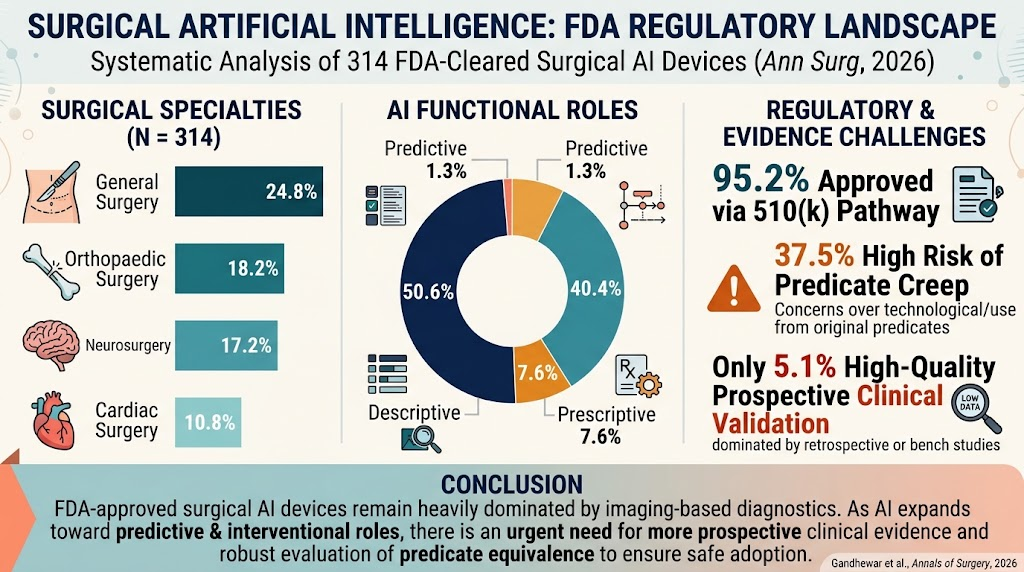
- Approximately one-quarter (25.1%) of FDA-cleared AI/machine learning medical devices are applied in surgery, predominantly in imaging-based diagnostics.
- Most surgical AI devices are categorized as descriptive (50.6%) or diagnostic (40.4%), with limited predictive (1.3%) or prescriptive (7.6%) functionalities.
- The 510(k) premarket notification pathway accounts for over 95% of approvals, with a significant proportion (37.5%) showing high risk of predicate creep.
- Clinical evidence supporting these devices is largely retrospective or bench-based, with only 5.1% supported by prospective, higher-quality validation studies.
Study Background
Artificial intelligence (AI) holds transformative potential for surgical care, encompassing enhancements in preoperative screening, diagnostic accuracy, intraoperative decision support, and postoperative management. Innovations in AI promise to refine surgical pathways, potentially leading to improved patient outcomes, reduced complications, and optimized resource utilization. Despite this promise, the translation of AI technologies into widespread surgical practice remains constrained. A critical bottleneck is regulatory approval, particularly via the U.S. Food and Drug Administration (FDA), which requires robust evidence of safety and efficacy.
Currently, surgical AI device landscapes are incompletely characterized in terms of their functional roles, underlying technologies, evidence quality, and regulatory trajectories. Challenges such as ensuring transparency in AI algorithms, mitigating bias, and managing technological evolution further complicate clinical adoption and regulatory scrutiny. Understanding these dimensions is essential for surgeons, healthcare providers, regulators, and developers to navigate this emerging field effectively.
Study Design
This systematic analysis investigated the landscape of surgical AI devices cleared by the FDA up to July 2025. The study involved a comprehensive screening of all FDA-cleared AI/machine learning-enabled medical devices, with identification of those having surgical applications.
Extracted data included device clinical application areas, AI technology types, evidence quality behind clinical validation, and regulatory approval pathways. Devices were categorized using an adapted framework distinguishing descriptive, diagnostic, predictive, and prescriptive AI roles. Predicate device networks were analyzed to assess the risk of ‘predicate creep’—where subsequent devices deviate significantly from their approved predecessors in intended use or technology, potentially impacting safety.
Statistical and descriptive analyses were conducted using R software to quantify trends and characterize device profiles systematically.
Key Findings
A total of 314 surgical AI devices were identified, representing 25.1% of all FDA-cleared AI/machine learning medical devices. Key findings include:
Clinical Application and Specialty Distribution
– The majority of devices focused on imaging, such as intraoperative imaging interpretation and planning assistance.
– The leading surgical specialties with AI devices were general surgery (24.8%), orthopaedics (18.2%), neurosurgery (17.2%), and cardiac surgery (10.8%).
Functional Classification
– Descriptive AI devices constituted 50.6%, primarily offering information summarization and visualization.
– Diagnostic tools accounted for 40.4%, supporting identification or classification of surgical pathology.
– Predictive AI devices were rare (1.3%), indicating scarce use of algorithms forecasting surgical outcomes.
– Prescriptive AI applications (7.6%) included decision-making support or automated interventions but remain emergent.
Evidence Quality
– Validation predominantly relied on retrospective datasets or bench testing models.
– Only 5.1% of devices had prospective clinical validation, underscoring an evidence gap in high-quality, forward-looking trials.
Regulatory Pathways and Predicate Creep
– The 510(k) premarket notification pathway was overwhelmingly dominant (95.2%), enabling clearance based on substantial equivalence to predicate devices.
– Among 510(k) clearances, 37.5% demonstrated high risk of predicate creep, revealing significant differences in intended use or technical features compared with their predicates, which could pose challenges to safety and effectiveness assessment.
Expert Commentary
The predominance of imaging-based diagnostic tools among surgical AI devices reflects the relative maturity of AI applications in image recognition and interpretation. However, the scant presence of predictive and prescriptive AI signals a nascent stage for more advanced, outcome-driven surgical AI innovations.
The heavy reliance on the 510(k) regulatory pathway raises concerns about thoroughness in evaluation, as predicate creep may undermine safety assurances by allowing devices to be cleared based on increasingly dissimilar predecessors. This underscores the need for regulators to refine criteria or foster alternative pathways ensuring rigorous appraisal of novel AI functionalities.
Furthermore, the limited prospective evidence highlights a critical translational gap. Retrospective studies are susceptible to selection bias and lack real-time clinical context, potentially limiting generalizability. Prospective trials and real-world evidence generation must be emphasized in future device development to build clinician trust and support safer adoption.
Clinicians should critically appraise surgical AI devices’ evidence base before integration, and multidisciplinary collaboration between surgeons, AI developers, and regulators will be vital to advance the field responsibly.
Conclusion
The landscape of FDA-approved surgical AI devices is currently dominated by imaging-centered, descriptive, and diagnostic tools with limited predictive or prescriptive capabilities. The predominance of retrospective validation and heavy reliance on the 510(k) pathway with significant predicate creep highlight pressing regulatory and evidence quality challenges.
As AI innovations in surgery evolve to address more complex decision-making and interventional roles, robust prospective validation, increased transparency, and stringent regulatory scrutiny will be essential. Addressing these gaps will facilitate safer clinical integration, ensuring that AI fulfills its potential to improve surgical care outcomes.
Funding and ClinicalTrials.gov
The original study did not specify funding sources or ClinicalTrials.gov registrations. Future research to prospectively evaluate surgical AI devices would benefit from transparent funding disclosures and trial registrations.
References
1. Chandrasekaran PK, Aggarwal R, Elgendy IY, et al. Artificial intelligence in surgery: Promises and challenges. Nat Med. 2021;27(6):960-972. doi:10.1038/s41591-021-01313-w
2. U.S. Food and Drug Administration. Artificial Intelligence and Machine Learning in Software as a Medical Device. FDA Guidance Documents, 2021.
3. Kelly CJ, Karthikesalingam A, Suleyman M, Corrado G, King D. Key challenges for delivering clinical impact with artificial intelligence. BMC Med. 2019;17(1):195. doi:10.1186/s12916-019-1426-2
4. Topol EJ. Deep Medicine: How Artificial Intelligence Can Make Healthcare Human Again. Basic Books; 2019.
5. Muehlematter UJ, Daniore P, Vokinger KN. Approval of Artificial Intelligence and Machine Learning-Based Medical Devices in the USA and Europe (2015-20): A Comparative Analysis. Lancet Digit Health. 2021;3(4):e195-e203. doi:10.1016/S2589-7500(20)30265-1
6. Gandhewar R, Guni A, Tandon D, et al. Surgical Artificial Intelligence Innovation Trends and Regulatory Insights: A Systematic Analysis of Food and Drug Administration-Approved Devices. Ann Surg. 2026 Oct 8. PMID: 42849513.