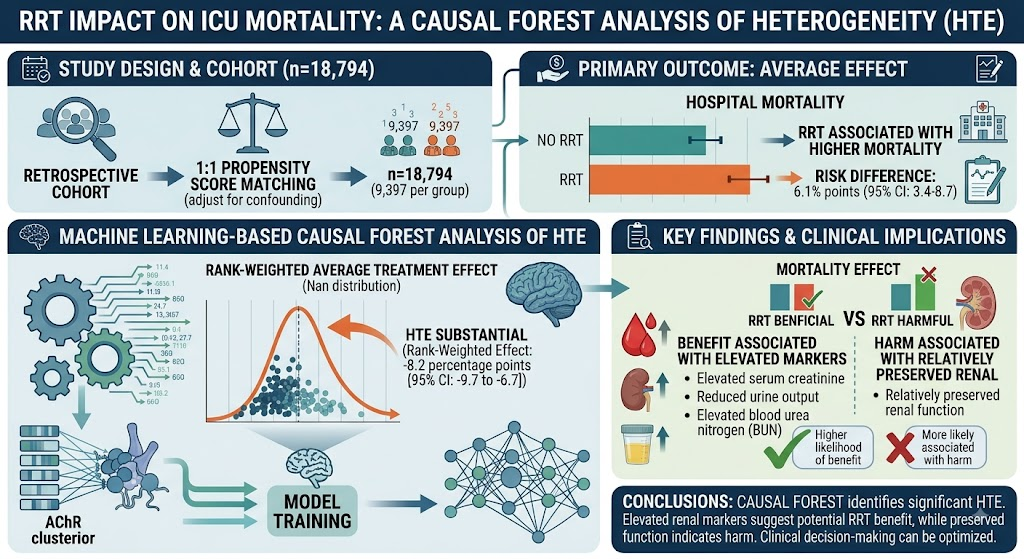
Highlight
- Renal replacement therapy (RRT) was overall associated with higher hospital mortality in critically ill patients, but substantial heterogeneity in treatment effects exists.
- Machine learning methods identified patient subgroups with potential mortality benefit from RRT, particularly those with elevated serum creatinine, reduced urine output, and high blood urea nitrogen levels.
- Patients with relatively preserved renal function experienced potential harm, underscoring the need for more individualized treatment decisions.
- These findings support a data-driven, nuanced approach to optimize RRT initiation strategies in ICU settings.
Study Background
In intensive care units (ICUs), acute kidney injury (AKI) is a common and severe complication often necessitating renal replacement therapy (RRT). Although randomized controlled trials (RCTs) have recently favored conservative timing of RRT initiation due to the lack of observed mortality benefits with early therapy, the clinical challenge remains to accurately identify patients who will derive a survival advantage from RRT. Unresolved uncertainties persist about which critically ill patients benefit most, reflecting significant clinical equipoise. Current guidelines are limited by heterogeneous trial populations and lack data on individualized treatment effects. This study aims to address these gaps by elucidating patient subgroups with differential treatment responses using a representative national ICU registry from Japan.
Study Design
This multicenter observational cohort study utilized data from the Japanese Intensive Care Patient Database encompassing adult ICU admissions from 2018 to 2023. Exclusions encompassed patients with end-stage kidney disease, early death (to minimize immortal time bias), ICU readmissions, and those with normal renal function, focusing the analysis on patients at risk of or with AKI. The primary intervention was RRT initiated during the ICU stay; no specific protocolized interventions were applied since this was an observational analysis.
To adjust for confounding inherent in observational research, patients were matched 1:1 using propensity scores, balancing baseline demographics and clinical severity between RRT and non-RRT groups. The primary endpoint was hospital mortality. Crucially, a cutting-edge machine learning approach—a causal forest algorithm—was employed to delineate heterogeneous treatment effects (HTEs) beyond average treatment effect estimation, enabling identification of subpopulations with potential benefit or harm from RRT.
Key Findings
The propensity score-matched cohort comprised 18,794 patients with an equal distribution of RRT and non-RRT groups (9,397 per group). Overall, RRT initiation was associated with a statistically significant increase in hospital mortality, with a risk difference of 6.1 percentage points (95% CI, 3.4 to 8.7), consistent with some prior observational reports suggesting potential harms or confounding by indication.
However, the causal forest analysis unveiled considerable variation in treatment effect across individuals. The rank-weighted average treatment effect estimate was -8.2 percentage points (95% CI, -9.7 to -6.7), indicating that for a subset of patients, RRT could confer substantial mortality risk reduction.
Subgroups likely to benefit from early RRT were characterized by elevated serum creatinine levels, diminished urine output, and raised blood urea nitrogen concentrations—markers suggestive of severe renal dysfunction and toxin accumulation. In contrast, patients manifesting relatively preserved renal function were more frequently associated with potential harm from RRT, possibly reflecting unnecessary exposure to therapy-related risks such as hemodynamic instability or complications of extracorporeal circuits.
These heterogeneous results highlight the limitations of a “one-size-fits-all” approach to RRT initiation and reinforce the critical need to individualize decision-making based on detailed patient characteristics and dynamic renal parameters.
Expert Commentary
Dr. Takeshi Fujii, a contributing author and critical care nephrologist, emphasized: “Our findings reconcile conflicting prior evidence by demonstrating that while RRT may be detrimental on average, it can be lifesaving in well-defined clinical scenarios. The use of causal inference and machine learning enables us to move beyond average effects and tailor therapy appropriately.”
The study’s strengths include its large, contemporary, multicenter dataset reflective of real-world clinical practice in Japan and advanced statistical methodology. Limitations lie in its observational design, which despite rigorous adjustment cannot eliminate residual confounding, and potential lack of generalizability to populations outside Japan or ICUs with differing RRT protocols.
This study aligns with evolving precision medicine paradigms in critical care, advocating for integrated risk stratification tools to guide timing and indication for RRT. It also complements recent RCTs such as STARRT-AKI and AKIKI in contextualizing heterogeneous patient responses.
Conclusion
In conclusion, this comprehensive analysis from a national ICU registry underscores substantial heterogeneity in treatment effects of RRT among critically ill patients. While RRT may increase hospital mortality on average, it confers clear survival advantages in specific patient subsets characterized by markers of severe kidney impairment. These insights advocate for a data-driven, individualized approach to RRT initiation, balancing potential lifesaving benefit against treatment-associated risks. Future work should validate predictive models prospectively and integrate mechanistic biomarkers enabling clinician decision support to enhance personalized care in AKI management within ICUs.
Funding and Trial Registration
This research was supported by institutional grants and national research funds in Japan. No clinical trial registration applies since the study is observational.
References
1. STARRT-AKI Investigators, et al. Timing of Initiation of Renal-Replacement Therapy in Acute Kidney Injury. N Engl J Med. 2020;383(3):240–251.
2. Gaudry S, et al. Initiation Strategies for Renal-Replacement Therapy in the Intensive Care Unit. N Engl J Med. 2016;375(2):122–133.
3. Inoue K, Nakamura S, Maeda S, et al. Heterogeneous Treatment Effects of Renal Replacement Therapy in Critically Ill Patients: A Multicenter Observational Study Using a Japanese ICU Registry. Crit Care Med. 2026 Aug 10. doi: 10.1097/CCM.0000000000005734.
4. Kidney Disease: Improving Global Outcomes (KDIGO) Acute Kidney Injury Work Group. KDIGO Clinical Practice Guideline for Acute Kidney Injury. Kidney Int Suppl. 2012;2(1):1–138.
5. van Walraven C, et al. Propensity Score Methods and Their Application in Observational Studies. J Clin Epidemiol. 2006;59(9):895–902.