Highlight
1. Synovial fibroblasts (SFs) from RA-risk individuals show early transcriptional and functional changes in lipid metabolism before clinical arthritis manifestation.
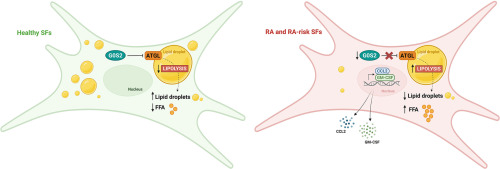
2. Enhanced lipolysis and reduced lipid droplet content in SFs are linked to decreased G0S2 expression, pointing to metabolic dysregulation as a pathogenic element.
3. Pharmacologic inhibition of adipose triglyceride lipase reverses enhanced lipolysis, indicating potential therapeutic targets.
4. Restoration of G0S2 expression correlates with attenuation of the myeloid-supporting phenotype of SFs, implicating metabolic control in immune modulation.
Study Background
Rheumatoid arthritis (RA) is a chronic autoimmune disease characterized by persistent synovial inflammation, leading to painful joint destruction and disability. Synovial fibroblasts (SFs) are integral effector cells driving both inflammation and tissue damage via secretion of inflammatory mediators and matrix-degrading enzymes. In recent years, the role of cellular metabolism in immune and stromal cell function within the RA synovium has gained attention, revealing metabolic rewiring as a key component of disease pathogenesis.
Identifying pathogenic changes before clinical arthritis develops is crucial for early intervention. Individuals who are autoantibody-positive but clinically free of arthritis (RA-risk) provide a unique model to study early mechanisms. Prior work by Jiménez-Martínez et al. demonstrated transcriptional downregulation of genes associated with lipid and fatty acid metabolism in synovial tissue of RA-risk individuals who progressed to RA, despite lack of overt inflammation, suggesting that metabolic alterations might precede classical inflammatory changes.
Study Design
This study investigated transcriptional profiles and lipid metabolism of SFs isolated from four distinct groups: autoantibody-positive RA-risk individuals without clinical arthritis, established RA patients, patients with osteoarthritis (OA), and age-matched controls with noninflammatory orthopedic injuries. Using transcriptome analysis and functional assays, the authors compared gene expression related to lipid metabolism and measured lipid droplet content and lipolysis activity in cultured SFs. Functional modulation experiments involved inhibiting adipose triglyceride lipase and stimulating G0S2 expression to evaluate consequences on lipid metabolism and SF phenotype.
Key Findings
1. Distinct transcriptional signatures in RA and RA-risk SFs related to lipid metabolism:
Transcriptomic profiling revealed that SFs from both RA-risk individuals and RA patients exhibited consistent downregulation of lipid metabolism-related genes, distinguishing them from OA and control SFs. This suggests early metabolic programming alterations in SFs linked to the RA disease process rather than nonspecific joint pathology.
2. Reduced lipid droplet content in RA-risk, RA, and OA SFs despite preserved differentiation capacity:
All three groups showed diminished baseline lipid droplet (LD) amounts compared with controls. However, these SFs retained their capacity for adipogenic differentiation, indicating that decreased lipid storage was not due to an intrinsic loss of adipogenic potential but rather altered lipid handling.
3. Enhanced lipolysis drives lipid droplet reduction in RA and RA-risk SFs:
Functional studies identified increased lipolytic activity in RA and RA-risk SFs, mediated by reduced expression of G0S2, a known inhibitor of adipose triglyceride lipase (ATGL). Pharmacological inhibition of ATGL normalized lipid droplet content, confirming that enhanced lipolysis underlies the observed lipid depletion.
4. G0S2 expression influences SF inflammatory phenotype:
Upregulation of G0S2 in SFs resulted in reduced support for myeloid cells, suggesting that modulation of lipid metabolism affects SF immune interactions and proinflammatory roles. This finding links metabolic regulation directly to cellular mechanisms driving synovial inflammation.
Expert Commentary
This study sheds light on the underexplored area of metabolic changes in synovial fibroblasts preceding clinical RA and emphasizes lipid metabolism as a fundamental determinant of SF pathogenicity. The delineation of G0S2’s role in controlling lipolysis and immunomodulatory functions of SFs provides a compelling target for intervention strategies aimed at halting disease progression at its earliest stages. Limitations include small sample sizes inherent to rare RA-risk cohorts and the need for in vivo validation of metabolic interventions. Moreover, comparisons with OA SFs indicate that some lipid metabolic dysfunction is not exclusive to RA, warranting further investigation into specificity and drivers of these changes.
Conclusion
Enhanced lipolysis mediated by decreased G0S2 expression in synovial fibroblasts represents an early metabolic hallmark of RA pathogenesis in at-risk individuals. These findings support a paradigm in which metabolic reprogramming of stromal cells occurs prior to overt immune activation and clinical arthritis, offering opportunities for novel preventive therapies targeting lipid metabolism. Further mechanistic and translational studies are needed to confirm therapeutic potential and generalize findings across diverse patient populations.
Funding and ClinicalTrials.gov Registration
The study credit includes investigators supported by institutional rheumatology and immunology research grants. Specific funding sources and clinical trial registration numbers were not provided in the abstract and should be sought from the full publication.
References
Jiménez-Martínez M, de Jong TA, Houtman M, Semmelink JF, Zelcer N, van de Sande MGH, Dankers W, van Baarsen LGM. Enhanced lipolysis in synovial fibroblasts mark early pathogenic changes in RA-risk individuals. Ann Rheum Dis. 2026 May 30;85(10):1942-1955. PMID: 42215375. https://pubmed.ncbi.nlm.nih.gov/42215375/