 Highlight
This study demonstrates that a postoperative day 2 (POD2) serum C-reactive protein (CRP) level below 100 mg/L reliably excludes anastomotic leakage (AL) after elective colon cancer resection.
Implementation of this early biomarker strategy could support safe early discharge consistent with enhanced recovery after surgery (ERAS) pathways.
The two-step approach using POD2 CRP and selective POD3 CRP dynamics further refines risk stratification, especially for patients with elevated POD2 CRP levels.
Study Background
Anastomotic leakage (AL) is a severe postoperative complication following colon cancer surgery, associated with substantial morbidity, prolonged hospital stays, and increased healthcare costs. Early identification and exclusion of AL is critical to optimize patient outcomes and resource utilization. Currently, CRP measured on postoperative day 3 (POD3) with values below 100 mg/L is widely used as a reliable biomarker to exclude AL. However, accelerated recovery protocols such as ERAS advocate for earlier discharge, frequently before POD3. This raises an unmet clinical need for earlier biochemical criteria that can safely exclude AL and facilitate timely discharge without compromising patient safety.
Study Design
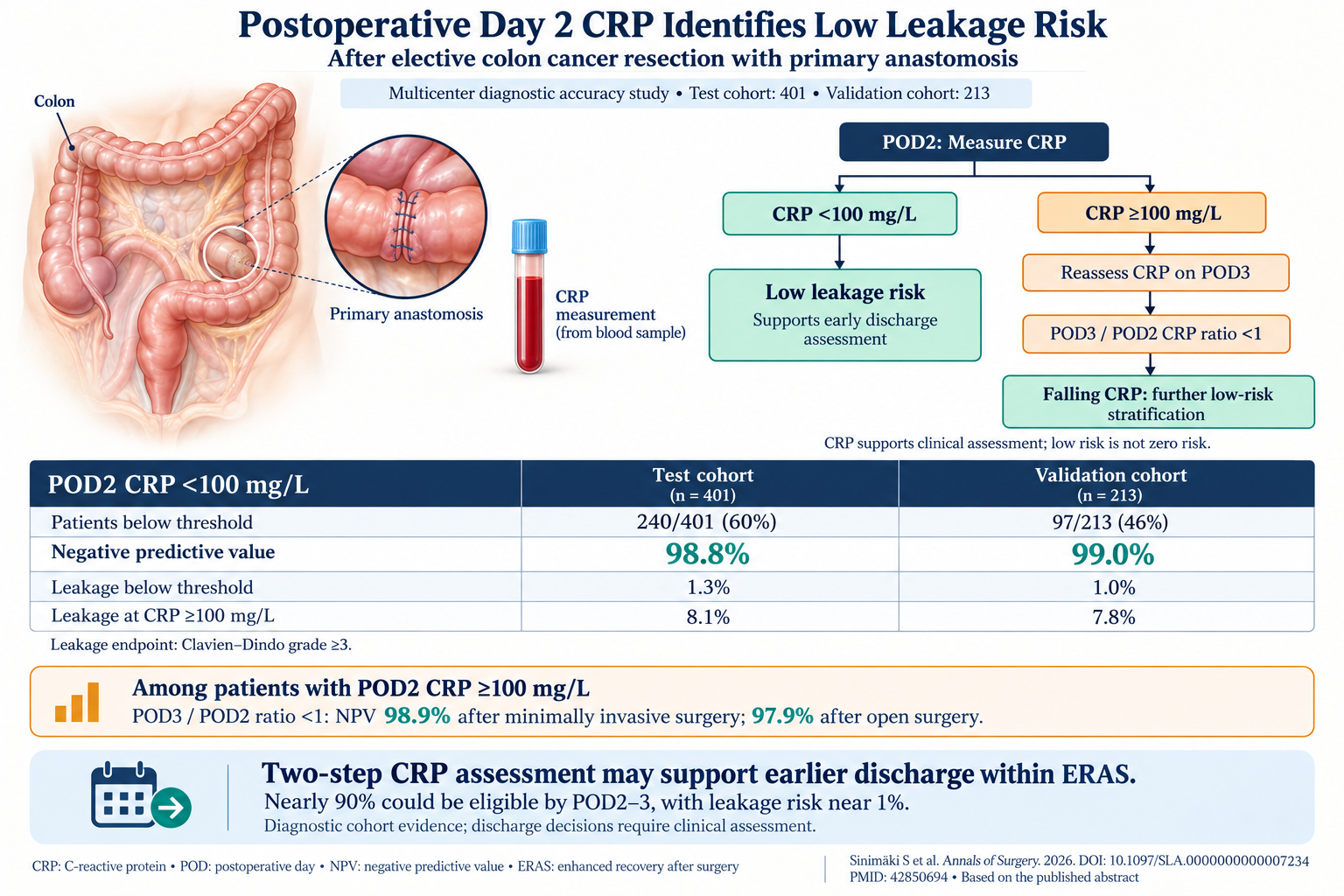
This investigation was a two-cohort multicenter diagnostic accuracy study enrolling patients undergoing elective colon cancer resection with primary anastomosis. The study included a test cohort (n=401) and a validation cohort (n=213). Anastomotic leakage was defined stringently as Clavien-Dindo grade 3 or higher complications, reflecting clinically significant leaks requiring intervention. The primary biomarker evaluated was serum CRP measured on postoperative day 2. The main question was whether a POD2 CRP less than 100 mg/L could reliably exclude AL. For those with POD2 CRP ≥100 mg/L, the trajectory of CRP change from POD2 to POD3 was analyzed using the POD3/POD2 ratio, with a ratio less than 1 indicating a decreasing inflammatory response and potentially lower risk of AL.
Key Findings
Anastomotic leakage rates were 4.0% in the test cohort and 4.7% in the validation cohort, consistent with published benchmark rates. Among patients with POD2 CRP <100 mg/L—representing 60% in the test and 46% in the validation cohort—AL was exceedingly rare, occurring in only 1.3% and 1.0%, respectively. Negative predictive values (NPVs) approached 99%, underscoring the high reliability of POD2 CRP to exclude AL. Conversely, patients with elevated POD2 CRP ≥100 mg/L had significantly higher AL rates (8.1% and 7.8%, respectively). In these higher-risk patients, assessment of POD3 CRP dynamics refined risk stratification: a POD3/POD2 ratio <1, indicating decreasing CRP levels, was associated with NPVs of 98.9% for minimally invasive surgery and 97.9% for open surgery. This two-step algorithm of initial POD2 CRP screening followed by selective POD3 reassessment allowed safe early discharge in nearly 90% of patients by POD2 or POD3 with a residual AL risk approximately 1%.
This stratified approach balances safety and early discharge feasibility, potentially reducing unnecessary hospital days and improving patient throughput in enhanced recovery programs.
Expert Commentary
The utilization of CRP as an early biomarker for postoperative complications has strong biological rationale given its role as an acute phase reactant reflecting systemic inflammation and tissue injury. The innovation in this study is validating POD2 CRP thresholds, which provides a clinically actionable earlier time point compared to the established POD3 criterion. Importantly, the study includes both test and external validation cohorts, adding robustness and generalizability.
From a surgical standpoint, adopting this POD2 CRP-guided approach could support informed discharge decisions, complementing clinical assessment and imaging as needed. It aligns well with ERAS principles, aiming for shorter hospitalization without compromising safety.
However, some limitations merit consideration. The detection of AL was limited to Clavien-Dindo grade ≥3 leaks, which may underestimate minor leaks with possible clinical relevance. Also, local institutional practices and patient characteristics may modulate CRP kinetics and the applicability of these thresholds. Integration with other clinical parameters and diagnostic tools remains essential.
Conclusion
Postoperative day 2 CRP measurement below 100 mg/L is a reliable and early biochemical marker to exclude clinically significant anastomotic leakage following elective colon cancer resection. When combined with selective postoperative day 3 CRP ratio assessment for those at higher initial risk, this two-step algorithm provides an evidence-based framework to guide safe early discharge in ERAS pathways. Adoption of this strategy can improve postoperative care efficiency without sacrificing patient safety. Further prospective studies could validate these findings across diverse surgical populations and incorporate them into multidisciplinary postoperative protocols.
Funding and Clinical Trials
The referenced study did not explicitly disclose funding sources or clinical trial registration within the abstract. Future reports should ideally reflect this transparency.
References
- Sinimäki S, Andersen CL, Nors J, et al. Postoperative Day 2 C-Reactive Protein Identifies Patients at Low Risk of Anastomotic Leakage After Colon Cancer Resection. Ann Surg. 2026 Oct 9. PMID: 42850694.
- Makela JT, et al. C-Reactive Protein as an Early Marker of Anastomotic Leakage Following Colon Surgery: A Diagnostic Meta-Analysis. Dis Colon Rectum. 2017;60(7):692-702.
- ERAS® Society Guidelines for Colon and Rectal Surgery. Protocols endorsed to enhance recovery and reduce postoperative complications.