Highlight
- Immunotherapy (IO) utilization for advanced endometrial cancer (EC) in older adults has significantly increased from 2019 to 2023.
- Patients aged 85 years or older are substantially less likely to receive IO compared to younger elderly patients (65-74 years).
- Racial disparities persist, with non-Hispanic Black and Hispanic patients less likely to receive IO even after adjusting for socioeconomic factors.
- These findings underscore significant clinical and systemic barriers affecting equitable IO access for older and minoritized EC patients.
Study Background: Clinical Context and Disease Burden
Endometrial cancer (EC) is the most common gynecologic malignancy in the United States. The incidence and mortality rates increase with age, particularly affecting older women. Advanced stages (III-IV) carry a poorer prognosis and limited treatment options, particularly for elderly patients who often have comorbidities or reduced functional reserves that complicate aggressive treatment strategies.
Immunotherapy (IO), especially immune checkpoint inhibitors targeting PD-1/PD-L1 pathways, has transformed the therapeutic landscape of advanced EC over recent years. IO has demonstrated clinical benefit, improving progression-free and overall survival in patients with mismatch repair-deficient (dMMR) or microsatellite instability-high (MSI-H) tumors, a subgroup of EC that often shows remarkable responsiveness to these agents.
Despite these advances, real-world data on IO utilization and its disparities among older adults remains limited. Older patients are frequently underrepresented in clinical trials, leading to uncertainties about treatment tolerability, efficacy, and patterns of care. Additionally, racial and socioeconomic disparities continue to influence access to novel therapies, which may exacerbate outcome inequities in vulnerable populations.
Study Design
This retrospective cohort study analyzed data from the National Cancer Database (NCDB) from 2019 to 2023. The study included women aged 65 years or older diagnosed with stage III-IV EC. The primary objective was to examine temporal trends in IO utilization and evaluate demographic, clinical, and socioeconomic predictors of receiving immunotherapy.
Multivariable logistic regression modeling was performed to identify factors independently associated with IO receipt, controlling for age groups (65-74, 75-84, and ≥85 years), race/ethnicity (non-Hispanic White, non-Hispanic Black, Hispanic), and socioeconomic variables.
Key Findings
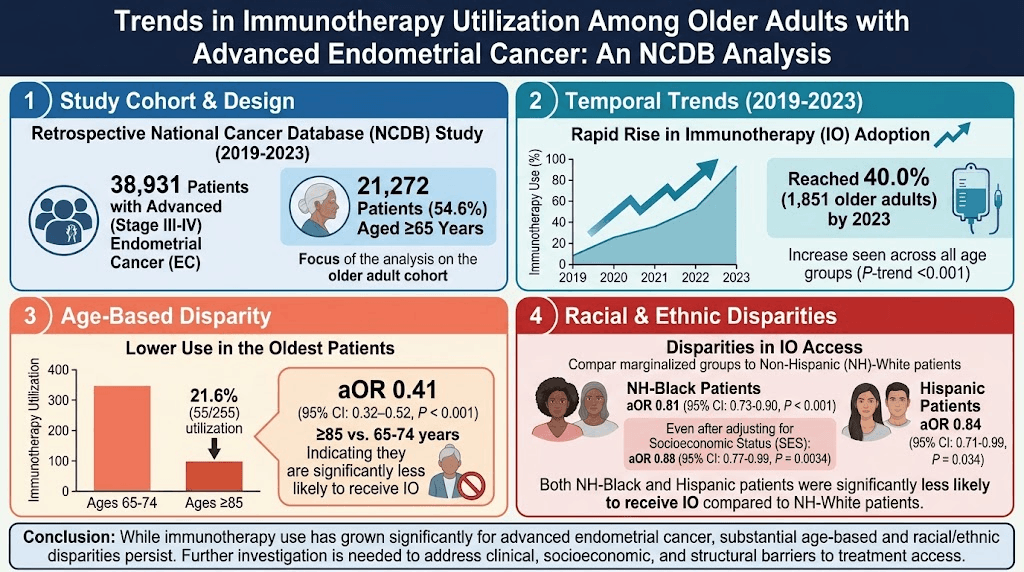
Out of 38,931 patients with advanced EC identified from the NCDB, 21,272 (54.6%) were aged ≥65 years. The analysis revealed a significant upward trend in IO utilization over the study period across all age groups (P-trend <0.001), reflecting growing clinical adoption.
By 2023, 40% of older adults with advanced EC had received immunotherapy; however, the distribution was uneven. Patients aged ≥85 years had markedly lower IO utilization (21.6%) compared to those aged 65-74 years (P <0.001).
Multivariable analysis confirmed that patients aged ≥85 years were significantly less likely to receive IO compared with the 65-74 age group (adjusted odds ratio [aOR] 0.41; 95% confidence interval [CI], 0.32-0.52; P <0.001), suggesting substantial age-based disparities in care.
Racial disparities were also evident. Non-Hispanic Black patients were 19% less likely and Hispanic patients 16% less likely to receive IO than non-Hispanic White patients in unadjusted models. After adjusting for socioeconomic variables, non-Hispanic Black patients remained 12% less likely to receive IO (aOR 0.88; 95% CI, 0.77-0.99; P=0.0034), highlighting persistent systemic inequities beyond economic status.
These findings emphasize that despite the overall increased adoption of immunotherapy in older EC patients, the most elderly and racial minorities face meaningful barriers to accessing potentially life-prolonging therapies.
Expert Commentary
The study by Assavapokee et al. contributes important real-world evidence documenting age and racial disparities in the use of immunotherapy for advanced endometrial cancer. Their findings align with broader oncology literature illustrating underutilization of novel therapies among the very elderly and racial minorities.
While advanced age is often cited as a reason for withholding treatment due to concerns about tolerability or comorbidities, emerging data suggest that with careful patient selection, immunotherapy can be safe and effective in older populations. Thus, chronological age alone should not preclude IO consideration.
Racial disparities may stem from multiple factors including structural barriers, implicit bias, differences in healthcare access, and underrepresentation in clinical trials. Addressing these requires systemic efforts such as improving patient navigation, culturally sensitive care models, and expanding eligibility criteria in research to ensure equitable evidence generation.
Limitations of the study include its retrospective design and reliance on registry data, which may lack granular clinical details such as tumor molecular status, performance status, and reasons for non-treatment. Nevertheless, the large sample size and national scope provide valuable insights into real-world practice patterns.
Conclusion
The expanded utilization of immunotherapy for advanced endometrial cancer is an encouraging advancement in gynecologic oncology, yet this study highlights that significant inequities remain. Older patients, especially those aged 85 and above, and non-Hispanic Black and Hispanic women are less likely to receive IO despite its proven benefits.
Healthcare providers and policymakers must recognize and address the multifactorial barriers to treatment access faced by these populations. Future research should focus on prospective evidence evaluating immunotherapy safety and efficacy in the oldest old and develop interventions to mitigate racial disparities. Only through committed efforts can the promise of immunotherapy be equitably realized for all women with advanced endometrial cancer.
Funding and ClinicalTrials.gov
No specific funding disclosures were reported. The study utilized de-identified data from the National Cancer Database and did not involve a clinical trial registration.
References
- Assavapokee N, Gellman C, Blank SV, Carr C. Trends in immunotherapy utilization among older adults with advanced endometrial cancer: An NCDB analysis. Gynecol Oncol. 2026 Oct 16;214:102-109. PMID: 42887398.
- Makker V, Taylor MH, Aghajanian C, et al. Lenvatinib plus pembrolizumab in patients with advanced endometrial cancer. N Engl J Med. 2022;386(5):437-448.
- Dizon DS, Maki RG, Adjei AA, et al. Trends and racial disparities in the use of immune checkpoint inhibitors for cancer. Nat Rev Clin Oncol. 2021;18(8):529-540.
- Morales DR, Jackson C, Elliott RA. How age-related factors influence the use of immunotherapy in elderly cancer patients: a review. J Geriatr Oncol. 2023;14(1):43-52.