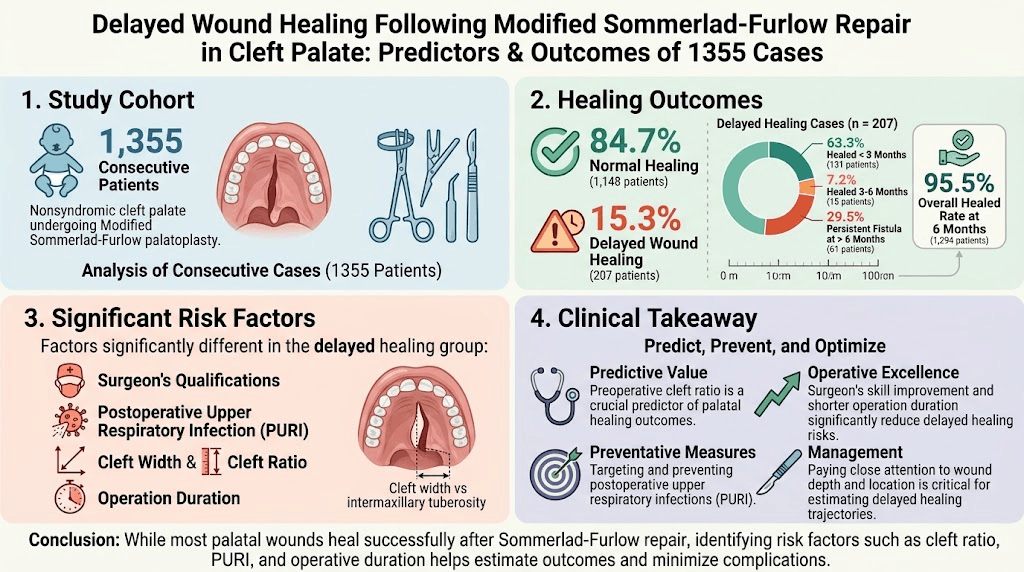
Among 1355 patients undergoing modified Sommerlad-Furlow palatoplasty, 15.3% experienced delayed wound healing, with 4.5% developing persistent fistulas beyond 6 months.
Significant predictors of delayed healing included larger cleft width, higher cleft ratio, prolonged surgery duration, postoperative upper respiratory infections (PURI), and less experienced surgeons.
Preoperative measurement of cleft ratio can assist surgeons in anticipating healing difficulties and tailoring operative techniques accordingly.
Focusing on wound depth and location is critical for evaluating delayed healing progression and guiding postoperative management.
Study Background
Cleft palate represents a common congenital craniofacial anomaly that requires surgical repair to restore palatal function and structure. Optimal wound healing following palatoplasty is crucial to prevent complications such as oronasal fistula and impaired speech or feeding. The modified Sommerlad-Furlow technique has been widely adopted due to its benefits in functional restoration and anatomical reconstruction. However, variations in wound healing outcomes remain an important clinical challenge, leading to morbidity and need for further surgical interventions. Identifying factors that predict delayed healing is essential to improve surgical planning, enhance postoperative care, and reduce complication rates.
Study Design
This retrospective cohort study analyzed 1355 consecutive nonsyndromic cleft palate patients treated using the modified Sommerlad-Furlow repair at a single center. Sixteen variables were collected including demographic factors (sex, age), cleft classification (Veau class), surgeon qualification, use of perioperative antibiotics, application of relaxing incisions, postoperative upper respiratory tract infection status (PURI), preoperative laboratory values (leukocyte count, hemoglobin level), cleft dimensions (width, intermaxillary tuberosity width, cleft ratio), operation duration, and wound healing parameters (initial timing of poor healing detection, depth, and location).
The primary outcome was wound healing status categorized as normal healing or delayed healing. Delayed healing was further stratified by time to resolution: within 3 months, between 3 and 6 months, or persisting beyond 6 months (fistula). Statistical analysis compared variables between normal and delayed healing groups to identify significant predictors.
Key Findings
Among the 1355 patients, 1148 (84.7%) achieved normal wound healing within the expected timeframe. A subset of 207 patients (15.3%) exhibited delayed wound healing. Of these, 131 (63.3% of delayed group) healed within 3 months, 15 (7.2%) between 3 and 6 months, and 61 (29.5%) had persistent fistulas beyond 6 months postoperatively. Overall, 95.5% had fully healed wounds by 6 months.
Significant differences between normal and delayed healing groups included:
– Surgeon’s qualification: Lower qualification levels were associated with higher delayed healing incidence, highlighting the impact of surgical expertise.
– Postoperative upper respiratory tract infection (PURI): Patients experiencing PURI had increased risk of delayed healing, implicating infection in impaired tissue recovery.
– Cleft width and cleft ratio: Larger cleft dimensions correlated with poorer healing outcomes, likely due to greater tissue tension and surgical complexity.
– Operation duration: Lengthier surgeries were linked to increased delayed healing, possibly reflecting surgical difficulty or intraoperative factors.
No significant associations were reported concerning sex, age, antibiotic use, relaxing incision, leukocyte count, hemoglobin level, or cleft type class alone, suggesting these have limited prognostic value in this context.
Detailed analysis of delayed wounds revealed that depth and anatomical location influenced healing course and likelihood of progression to fistula formation. These characteristics warrant careful evaluation during postoperative monitoring and may guide targeted interventions.
Expert Commentary
The large sample size and comprehensive variable analysis strengthen the validity of the findings, offering robust clinical insight into critical factors influencing wound healing after modified Sommerlad-Furlow palatoplasty. The study highlights the pivotal role of surgical skill and intraoperative management, supporting ongoing training and procedural standardization to optimize outcomes.
The observed association between postoperative respiratory infections and delayed healing underlines the importance of perioperative infection control strategies. Prophylactic measures and close surveillance for respiratory complications may reduce wound healing delays.
Preoperative measurement of the cleft ratio as a predictive tool provides a valuable addition to surgical planning. It enables surgeons to anticipate increased risk and adjust techniques, potentially incorporating more conservative tension release or staged repairs where indicated.
Limitations include its retrospective design and single-center nature, which may affect generalizability. Furthermore, patient comorbidities and nutritional status were not detailed, factors known to influence healing.
Future prospective multicenter studies incorporating these variables are warranted to validate and expand these findings. Additionally, evaluating adjunctive therapies such as local tissue engineering, growth factors, or optimized postoperative care protocols might further mitigate delayed healing risks.
Conclusion
This study identifies several key predictors of delayed wound healing following modified Sommerlad-Furlow repair in cleft palate patients, including surgeon qualification, postoperative respiratory infections, cleft width and ratio, and operation duration. Preoperative assessment of cleft dimensions offers a practical tool to stratify risk. Emphasizing surgical expertise, infection prevention, and focused postoperative wound evaluation can enhance healing outcomes and reduce fistula formation. Continued research is vital to refine predictive models and develop targeted interventions to ensure optimal recovery for cleft palate patients.
Funding and Clinical Trials
The original article does not specify funding sources or clinical trial registration details.
References
1. Wu M, Elayah SA, Wang C, Yang J, Liu Y, Shi B, Li Y. Predictors and Outcomes of Delayed Wound Healing Following Modified Sommerlad-Furlow Repair: An Analysis of 1355 Consecutive Cases. The Laryngoscope. 2026 Jun;136(10):4312-4320. PMID: 42242912.
2. Sommerlad BC. A technique for cleft palate repair. Plast Reconstr Surg. 2003 Jan;111(1):19-28.
3. Furlow LT Jr. Cleft palate repair by double opposing Z-plasty. Plast Reconstr Surg. 1986 Jun;78(6):724-38.
4. Berkowitz S. Cleft Lip and Palate: Diagnosis and Management. 2nd ed. Springer; 2006.
5. Lam E, Bardach J. Pharyngeal flap and palatoplasty outcomes: a systematic review. Cleft Palate Craniofac J. 2020 Mar;57(3):365-374.
6. Cleft Palate Foundation. Clinical Practice Guidelines for Cleft Lip/Palate. 2019.
7. Rohrich RJ, Zbar RI. Cleft Palate Surgery: Principles and Problems. Plast Reconstr Surg. 2012;130(4):910-917.