Outpatient ophthalmic procedures have become increasingly common due to advances in surgical techniques and the growing demand for efficient, accessible eye care. Understanding the financial feasibility of offering these procedures in ambulatory surgical centers (ASCs) compared to hospital outpatient departments (HOPDs) is critical as healthcare providers and policymakers navigate cost containment and value-based care models. This study aims to analyze the economic characteristics of various ophthalmic surgeries performed in outpatient settings, focusing on their sustainability amid the 2025 Medicare facility reimbursement landscape.
Study Design and Methods
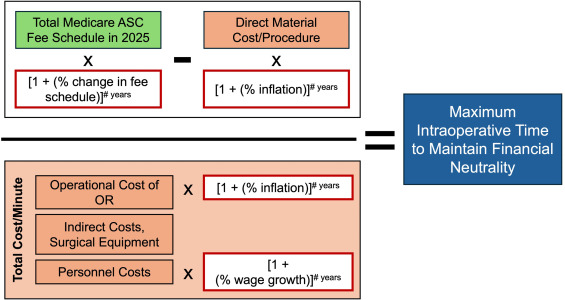
This cost-efficiency analysis examined outpatient facilities in San Diego, California. We developed a novel evaluative framework to assess ASCs and HOPDs by determining the maximum allowable intraoperative time per procedure to maintain financial neutrality—that is, the point where revenues cover costs without loss.
Using insurance claims data, nine common ophthalmic procedures were selected for inclusion: cataract removal with intraocular lens implantation, aqueous shunt to extraocular plate reservoir, upper eyelid blepharoplasty, dacryocystorhinostomy, trabeculectomy, penetrating keratoplasty, repair of blepharoptosis, strabismus repair, and mechanical pars plana vitrectomy.
Total costs incorporated direct material expenses, personnel, overhead, and operational factors, derived from internal financial records, defined operational frameworks, and publicly available Medicare reimbursement data. These comprehensive inputs enabled calculation of maximum intraoperative durations allowable to ensure financial break-even, based on Medicare facility reimbursement rates.
Key Results
The analysis revealed significant variation in maximum intraoperative times between ASCs and HOPDs across procedures:
– For ASCs, maximum intraoperative times ranged from 117.2 minutes for aqueous shunt procedures to only 11.9 minutes for vitrectomy.
– HOPDs generally accommodated twice the maximum intraoperative time per procedure compared to ASCs, ranging from 160.8 minutes for aqueous shunts to 54.5 minutes for upper eyelid blepharoplasty.
The disparity reflects differences in Medicare reimbursement levels and direct material costs associated with each procedure. Lower facility fees for ASCs relative to HOPDs necessitate greater efficiency to remain financially sustainable.
Discussion
Our findings indicate that most common ophthalmic surgeries conducted at ASCs can be completed within time frames that maintain financial neutrality, with over 30 minutes of allowable intraoperative time for the majority of procedures. This underscores the capability of ASCs to offer these surgeries efficiently and cost-effectively.
Medicare reimbursement rates emerged as the primary factor influencing maximum intraoperative duration thresholds, highlighting financial challenges faced by ASCs due to capped reimbursement and lower facility fees compared to hospital outpatient departments. ASCs must therefore optimize operational efficiency and resource utilization to ensure viability.
This framework provides a valuable tool for facilities and policymakers assessing the cost-efficiency and feasibility of shifting ophthalmic procedures from traditional hospital operating rooms to ASCs. By enabling equitable access to surgical eye care through outpatient centers, there is potential to reduce healthcare costs and improve patient convenience.
Clinical and Policy Implications
The shift toward outpatient ophthalmic care aligns with trends emphasizing minimally invasive surgery, rapid recovery, and patient-centered services. As Medicare reimbursement methodologies evolve, maintaining cost-efficiency in ASCs will be pivotal.
Healthcare providers should consider procedure-specific financial viability when deciding on surgical site selection. For higher-cost, longer-duration surgeries, hospital outpatient departments may remain appropriate, while more routine, shorter procedures can benefit from ASC settings.
From a policy perspective, these data support ongoing dialogue about reimbursement adjustments and regulatory flexibility to sustain ASCs’ role in eye care delivery without compromising quality or access.
Limitations and Future Directions
This study was geographically limited to San Diego and focused on Medicare reimbursement rates projected for 2025 and beyond, which may vary nationally or over time. Additionally, indirect costs such as patient travel expenses and non-Medicare payer dynamics were not included.
Future research should explore broader geographic samples, incorporate real-world operational data, and assess patient outcomes alongside economic metrics to provide comprehensive evaluations of outpatient ophthalmic surgery models.
Conclusion
Our cost analysis highlights that ambulatory surgical centers are well-positioned to deliver a broad range of common ophthalmic surgical procedures efficiently under anticipated Medicare reimbursement frameworks. Recognizing the financial interplay between reimbursement, procedure costs, and intraoperative duration helps guide strategic decisions on procedural site selection. This approach fosters equitable healthcare access and optimizes resource utilization in outpatient ophthalmic surgery.

 By
No Comments