Highlight
This large prospective multicenter cohort study demonstrates that distinct early post-transplant donor-derived cell-free DNA (dd-cfDNA) trajectories independently predict the risk of donor-specific antibody development, rejection events, graft dysfunction, and eventual graft loss over three years. Notably, late or persistent elevations in dd-cfDNA identify patients at increased risk, while consistently low or transient elevations indicate favorable outcomes.
Serial dd-cfDNA monitoring within the first 4 months post-kidney transplant aids early risk stratification beyond traditional sensitization markers, suggesting dd-cfDNA trajectories as actionable biomarkers in clinical practice.
Background: Clinical Context and Unmet Need
Kidney transplantation remains the optimal therapy for end-stage renal disease, but long-term graft survival is limited by immune-mediated rejection and other complications. Early detection of graft injury enables timely interventions that may prevent irreversible damage.
Donor-derived cell-free DNA (dd-cfDNA), fragmented DNA shed from the transplanted organ into the recipient’s circulation, has emerged as a noninvasive biomarker reflecting allograft injury. Elevated dd-cfDNA levels early after transplantation have been attributed mainly to ischemia-reperfusion injury, but their implications for long-term outcomes have been unclear.
Understanding the prognostic significance of dd-cfDNA trends shortly after transplantation could refine risk assessment and guide personalized immunosuppression strategies.
Study Design
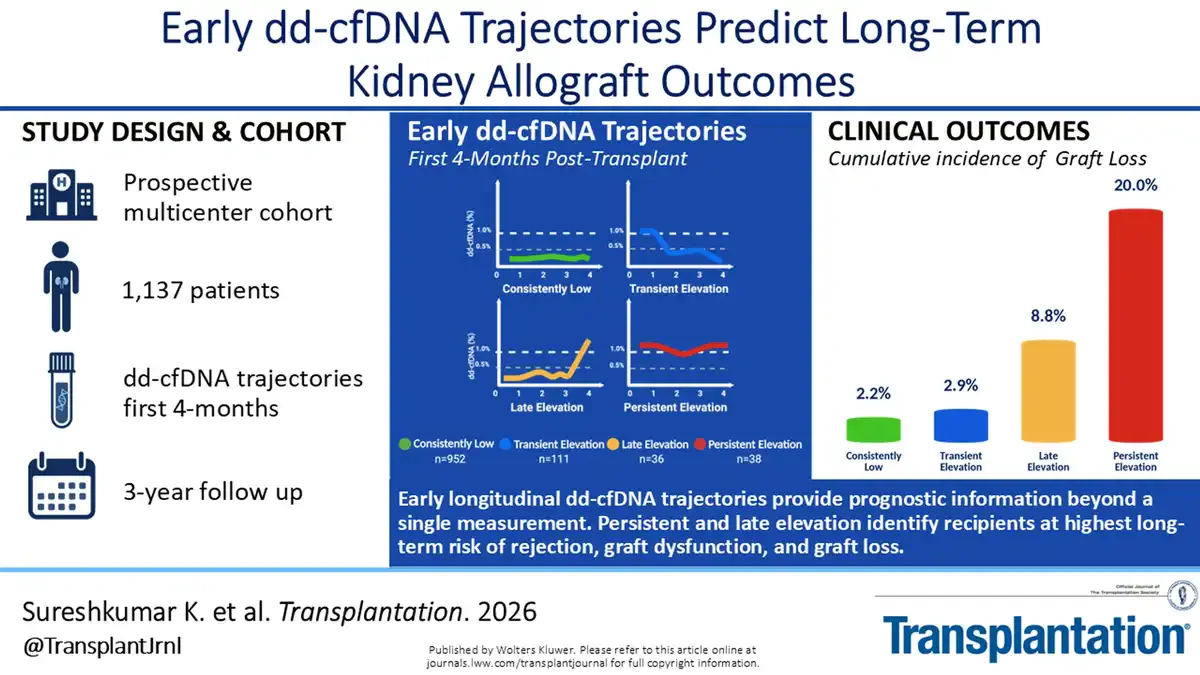
The study retrospectively analyzed a prospective, multicenter registry—the Kidney Outcomes AlloSure Registry—comprising 1,137 kidney transplant recipients with serial dd-cfDNA measurements during the first four months post-transplant. Patients were categorized into four trajectory groups: consistently low dd-cfDNA, transient elevation (early elevation with subsequent normalization), late elevation (rising after initial low levels), and persistent elevation (continuous high dd-cfDNA).
Clinical outcomes tracked over three years included donor-specific antibody (DSA) development, biopsy-proven rejection, graft dysfunction, and graft loss. Multivariable hazard regression models adjusted for calculated panel reactive antibody (cPRA) and retransplant status to control for immunologic risk factors.
Key Findings
Among the cohort, 83.7% had consistently low dd-cfDNA, 9.8% exhibited transient elevation, 3.2% late elevation, and 3.3% persistent elevation profiles. The distribution underscored that most recipients maintain low dd-cfDNA early post-transplant.
Recipients with late elevation exhibited the highest cumulative incidence of DSA formation, an established harbinger of immunologic rejection, indicating evolving alloimmune activation after an initially low-risk period. The persistent elevation group showed the highest incidence of biopsy-proven rejection, graft dysfunction, and graft loss—highlighting sustained graft injury.
Graft loss over three years occurred in 20% of the persistent elevation group and 8.8% of the late elevation group, contrasting sharply with only 2.2% in consistently low and 2.9% in transient elevation groups, suggesting that early dd-cfDNA trajectories stratify patients into distinct risk phenotypes.
Multivariate analysis confirmed that late elevation independently predicted DSA development, rejection, and graft loss, while persistent elevation was independently associated with rejection, graft dysfunction, and graft loss. These associations held regardless of prior transplant status or degree of sensitization (cPRA), underscoring dd-cfDNA as a powerful independent biomarker.
Clinical Implications
This study supports the clinical utility of repeated dd-cfDNA measurements in the early post-transplant period to identify patients at higher risk for unfavorable immunologic events and graft failure. Such stratification facilitates targeted surveillance and potential preemptive treatment adjustments.
Low or transient elevations likely represent benign ischemic/reperfusion injury or transient fluctuations, whereas late or persistent elevations warrant intensified immunologic evaluation, including DSA monitoring and possible biopsy to guide therapeutic decisions.
Expert Commentary
These findings align with emerging evidence positioning dd-cfDNA as a dynamic marker reflecting allograft injury and immunologic status. Unlike static measures, trajectory analysis provides temporal context, capturing evolving risk.
The study’s large multicenter design and robust follow-up enhance generalizability. However, limitations include potential variability in dd-cfDNA assay timing and confounding by clinical interventions not fully accounted for. Further interventional trials are needed to determine whether dd-cfDNA-guided therapeutic strategies improve graft survival.
Biologically, dd-cfDNA elevations reflect apoptotic and necrotic release from injured graft tissue, with persistent elevations likely representing ongoing immune-mediated damage.
Conclusion
Early post-transplant dd-cfDNA measurements yield valuable prognostic information beyond traditional immunologic risk factors. Serial dd-cfDNA trajectory profiling stratifies kidney transplant recipients into distinct risk groups with divergent outcomes regarding rejection, DSA development, and graft loss.
Persistent or late elevations identify high-risk patients who may benefit from closer monitoring and tailored immunosuppression to preserve graft function. These results advocate for integrating dd-cfDNA trajectory assessment into routine post-transplant care pathways to enhance personalized risk management.
Funding and Clinical Trials
The study was conducted by the KOAR Investigators and supported through institutional and collaborative funding sources as detailed in the original publication. Clinical trial registration details were not specified in the abstract.
References
1. Sureshkumar K, Klein JA, Kumar D, et al. Prognostic Significance of Early Donor-derived Cell-free DNA Trajectories After Kidney Transplantation. Transplantation. 2026 Nov 2; PMID: 42970489.
2. Bloom RD, Bromberg JS, Poggio ED, et al. Cell-Free DNA and Active Rejection in Kidney Allografts. J Am Soc Nephrol. 2017;28(7):2221-2232.
3. Halloran PF, Reeve J, Akalin E, et al. Genome-wide expression profiling in kidney transplantation: mechanisms and markers of rejection. Am J Transplant. 2010;10(11):2422-2430.
4. Sigdel TK, Nicora CD, Hsieh SC, et al. Organ-Specific Transplant Biomarkers Using Shotgun Proteomics. J Proteome Res. 2017;16(1):152-167.
Specialty calculators
For clinical reference; use professional judgment.