Highlight
This phase 2b randomized placebo-controlled trial evaluated deupirfenidone, a novel deuterated pirfenidone analog, in patients with idiopathic pulmonary fibrosis (IPF). The study demonstrated that deupirfenidone significantly slowed the decline in forced vital capacity (FVC) compared to placebo over 26 weeks. Safety profiles were consistent with known antifibrotic therapy tolerability, predominantly gastro-intestinal adverse events. These findings suggest deupirfenidone may offer improved efficacy and tolerability over current standard treatment.
Study Background
Idiopathic pulmonary fibrosis (IPF) is a progressive and fatal interstitial lung disease characterized by scar tissue accumulation in lung parenchyma leading to reduced lung compliance and impaired gas exchange. The disease primarily affects older adults and carries a median survival of 3-5 years after diagnosis. Current antifibrotic treatments such as pirfenidone and nintedanib slow disease progression but are limited by side effects and suboptimal efficacy. Deupirfenidone is a strategically deuterated form of pirfenidone designed to retain pharmacodynamic activity while improving pharmacokinetic parameters, potentially enhancing effectiveness and tolerability. There remains a significant unmet need for safer, more efficacious IPF therapies to delay lung function decline and improve patient outcomes.
Study Design
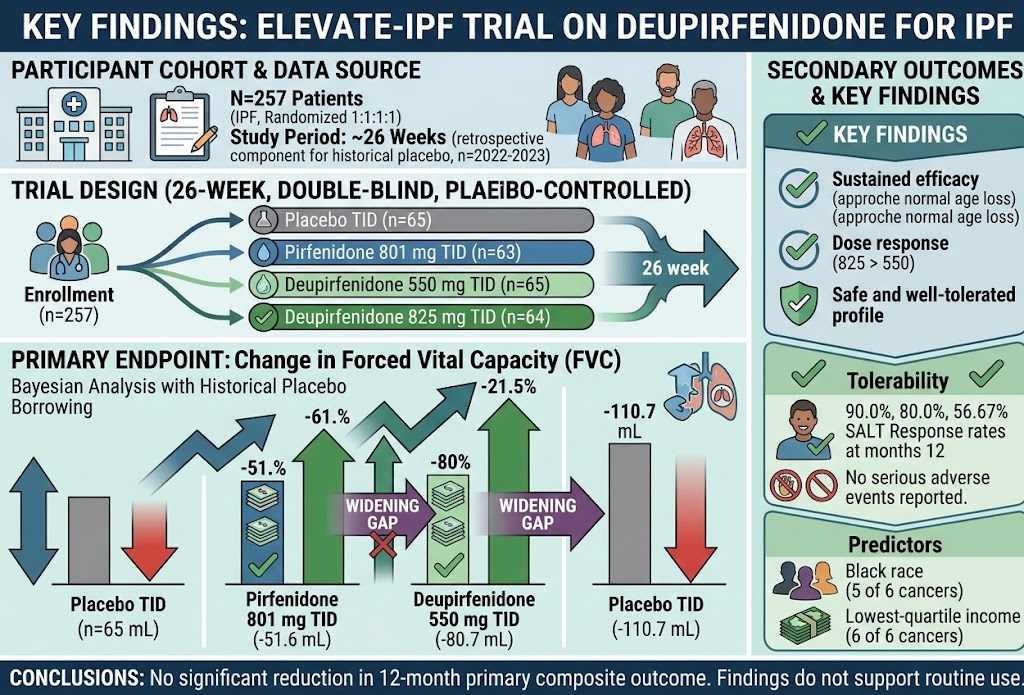
The ELEVATE-IPF trial was a multicenter, phase 2b double-blind, randomized, placebo-controlled study enrolling 257 patients diagnosed with IPF. Participants were randomized 1:1:1:1 into four arms receiving either deupirfenidone 550 mg three times daily (TID), deupirfenidone 825 mg TID, pirfenidone 801 mg TID (standard pirfenidone dose), or placebo. The primary endpoint was the rate of change in forced vital capacity (FVC) over 26 weeks comparing combined deupirfenidone arms versus placebo. The analysis applied robust Bayesian methods primarily, complemented by frequentist secondary analyses. Safety assessments and adverse event monitoring were conducted throughout the study period.
Key Findings
The study reported that at 26 weeks, the posterior mean change in FVC for placebo-treated patients was -110.71 mL (95% credible interval [CI], -148.75 to -70.98), indicating expected disease progression. The combined deupirfenidone arms showed a more favorable FVC decline with a mean change of -48.42 mL (95% CI, -87.66 to -9.04), yielding a posterior mean difference of 62.29 mL (95% CI, -6.13 to 115.73; posterior probability 0.985), favoring deupirfenidone. Secondary frequentist analysis revealed the adjusted mean FVC change for placebo was -112.5 mL (95% CI, -167.2 to -57.8), while the deupirfenidone 825 mg arm showed -21.5 mL (95% CI, -78.2 to 35.1). The adjusted mean difference was 91.0 mL (95% CI, 12.2 to 169.7; P = .02), confirming statistical significance.
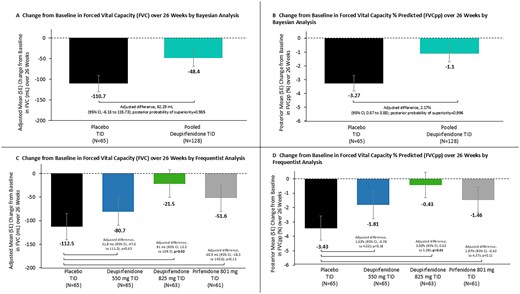
Changes from baseline over 26 weeks for A. FVC by bayesian analysis; B. FVCpp by bayesian analysis; C. FVC by frequentist analysis; and D. FVCpp by frequentist analysis. FVC = forced vital capacity; FVCpp = percent of predicted value; SE = standard error; TID = 3 times daily. Posterior mean (SE) by Bayesian approach is estimated based on a random coefficient regression model with absolute FVC (A) or FVCpp (B) over time, including baseline, as a response, and fixed effects for treatment (placebo or pooled deupirfendione 550 mg and deupirfenidone 825 mg), week, and treatment by week interaction, as well as participant-level random effects for the intercept and slope. Adjusted mean (SE) by frequentist approach is estimated based on a random coefficient regression model with absolute FVC (C) or FVCpp (D) over time, including baseline, as a response, and fixed effects for treatment (placebo, pirfenidone, deupirfenidone mg or deupirfenidone 825 mg), week, and treatment by week interaction, as well as participant-level random effects for the intercept and slope.
(The fig from https://academic.oup.com/ajrccm/article/212/8/1761/8571410)
Compliance was generally good, with treatment continuation rates of 80.0% for placebo, 68.3% for pirfenidone, 64.6% for deupirfenidone 550 mg, and 78.1% for deupirfenidone 825 mg at study end. The safety profile of deupirfenidone was consistent with known effects of antifibrotic agents; gastrointestinal adverse events were most common, including nausea, diarrhea, and dyspepsia, but were manageable and not predominant causes of discontinuation. No new safety signals emerged, and overall tolerability was considered favorable.
Expert Commentary
The ELEVATE-IPF trial delivers important clinical insights into the potential utility of deupirfenidone in IPF management. The concept of deuteration to modulate drug pharmacokinetics while preserving efficacy represents an innovative avenue in antifibrotic therapy development. The observed attenuation of lung function decline compared with placebo supports deupirfenidone as a promising candidate for IPF treatment.
While pirfenidone remains a cornerstone antifibrotic agent, its limitations, such as gastrointestinal side effects and interpatient variability in metabolism, underline the importance of next-generation therapies. Deupirfenidone’s improved pharmacokinetic profile may translate into clinical benefits, although longer-term data and larger phase 3 studies are necessary to confirm durability of effect and safety.
Limitations of the study include relatively short treatment duration and modest sample size, which may affect generalizability. Additionally, direct comparative efficacy between deupirfenidone and pirfenidone requires further clarification, as this study’s primary comparison was deupirfenidone versus placebo. Integration of patient-reported outcomes and real-world effectiveness data would enrich understanding of clinical impact.
Conclusion
Deupirfenidone has demonstrated significant potential in slowing lung function decline in IPF patients over 26 weeks with an acceptable safety profile. This novel deuterated analog offers hope for improved antifibrotic therapy in a disease with high morbidity and mortality. Future larger-scale trials and longer follow-up will be critical to establish its role in the IPF treatment paradigm and possibly improve quality of life and survival.
Funding and Trial Registration
This study was registered at ClinicalTrials.gov under number NCT05321420. Details regarding funding sources were not specified in the available abstract.
References
Maher TM, Hamblin MJ, Choi WI, Case AH, Tomos IP, Tzouvelekis AE, Shore JE, Bergna MA, Golod D, Elenko E, Zhang Y, Graham CS, Song JW, Kulkarni T, and the ELEVATE IPF Investigators. Deupirfenidone compared with pirfenidone and placebo in idiopathic pulmonary fibrosis (ELEVATE-IPF): a phase 2b randomized placebo-controlled trial. Am J Respir Crit Care Med. 2026;212(8):1761-1769. PMID: 42085224.