Highlights
- Medicaid expansion under the ACA is associated with a significant reduction in 1-year mortality among young adults initiating dialysis for kidney failure.
- Expansion increases Medicaid coverage and reduces uninsurance rates, improving access to predialysis nephrology care and longer prescribed hemodialysis sessions.
- Patients in expansion states showed increased use of peritoneal dialysis modalities, potentially contributing to better outcomes.
- Policy-level interventions in health insurance programs have demonstrable impact on survival outcomes in this vulnerable young adult population.
Background
Chronic kidney disease (CKD) culminating in kidney failure imposes significant morbidity and mortality, particularly in young adult populations transitioning from pediatric care. Dialysis initiation marks a critical juncture with a high risk of early mortality. The Affordable Care Act (ACA), by expanding Medicaid coverage, aimed to mitigate gaps in healthcare access, especially for young adults aged 19 to 23 who previously faced insurance discontinuity when aging out of pediatric coverage. Whether this policy intervention translates into reduced mortality for young adults initiating dialysis had been unclear, necessitating robust evaluation.
Key Content
Study Design and Population
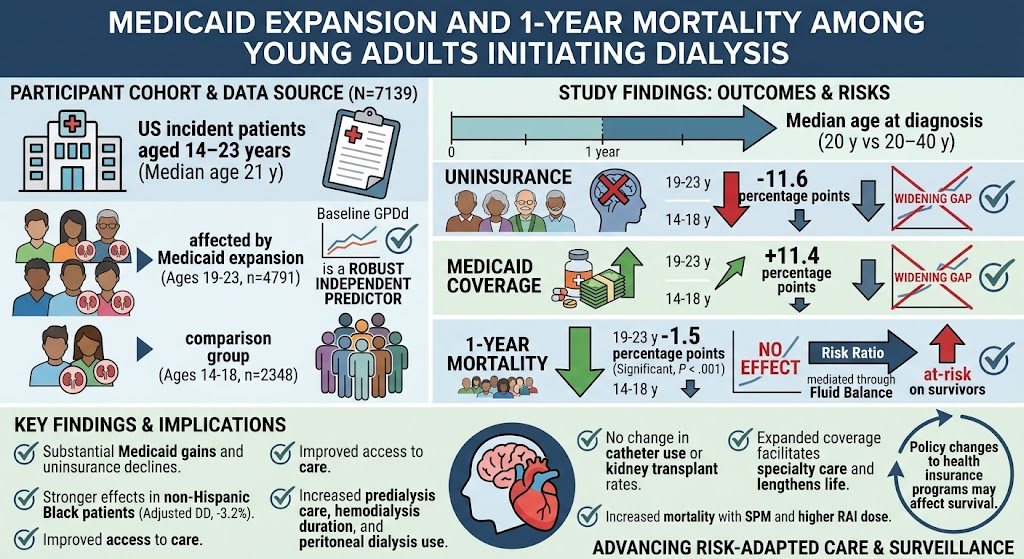
The pivotal study by Swaminathan et al. (2026) employed a quasi-experimental difference-in-differences design analyzing 7,139 patients aged 14 to 23 years initiating dialysis from 2010 to 2019 across Medicaid expansion states. Patients aged 19–23, whose Medicaid eligibility was expanded under the ACA, were compared with a control group aged 14–18, whose eligibility was unchanged, enabling a natural experiment framework to assess policy impact.
Impact on 1-Year Mortality
Prior to Medicaid expansion, the 1-year mortality for the 19–23 cohort was 3.6%, which decreased markedly to 2.1% post-expansion (absolute reduction of 1.5 percentage points; 95% CI, –2.5 to –0.6). In contrast, the control group’s mortality rates showed no statistically significant improvement. The difference-in-difference estimate adjusting for concurrent trends yielded a 1.8 percentage point decline in mortality (95% CI, –2.9 to –0.7), signifying a substantial survival benefit attributable to Medicaid expansion.
Changes in Insurance Coverage and Healthcare Access
Medicaid coverage among 19- to 23-year-olds increased from 37.1% to 48.5%, while uninsurance dropped dramatically from 19.4% to 7.8%. These changes corresponded with improved access to predialysis nephrology care, a known predictor of better dialysis outcomes. Additionally, patients received longer prescribed hemodialysis sessions (≥4 hours), which are linked to improved survival. The increased utilization of peritoneal dialysis in the expansion group suggests modality choice may have been influenced by better insurance coverage, expanding patient-centered treatment options.
Unchanged Measures
Notably, Medicaid expansion was not associated with changes in catheter use at hemodialysis initiation or kidney transplant rates, indicating that while insurance coverage facilitated certain aspects of care and outcomes, other factors such as transplant access and vascular access practices require additional interventions.
Expert Commentary
The findings elucidate a critical link between health policy and clinical outcomes in kidney failure. By providing continuous insurance coverage, Medicaid expansion reduces barriers to timely nephrology referral and optimal dialysis prescription, which are essential in reducing early mortality. The observed reduction in mortality aligns mechanistically with improved pre-dialysis care enabling better patient optimization before dialysis initiation.
However, the lack of impact on catheter use or transplant rates underscores persistent challenges in vascular access management and organ allocation that insurance expansion alone cannot resolve. Furthermore, the quasi-experimental design, although robust for policy evaluation, is subject to residual confounding from unmeasured factors such as socioeconomic variables and regional practice patterns.
Clinical guidelines emphasize early nephrology involvement and individualized dialysis prescription; thus, expanding insurance coverage should be considered a vital structural intervention to enable guideline adherence. Future studies assessing long-term outcomes beyond one year and investigation into transplant access disparities post-expansion are warranted.
Conclusion
Medicaid expansion under the ACA is strongly associated with improved 1-year survival among young adults initiating dialysis, primarily through enhanced insurance coverage, increased nephrology care, and optimized dialysis treatment. These findings underscore the profound influence of health insurance policy on survival outcomes in young adults with end-stage kidney disease. Addressing remaining gaps in catheter use and transplant access will require multifaceted approaches beyond insurance expansion.
References
- Swaminathan S, Kim D, Sommers BD, Mehrotra R, Trivedi AN. Medicaid Expansion and 1-Year Mortality Among Young Adults Initiating Dialysis. JAMA Pediatr. 2026;180(8):851-857. PMID: 42113528.
- United States Renal Data System. 2022 Annual Data Report: Epidemiology of Kidney Disease in the United States. National Institutes of Health; 2022.
- Levin A, Stevens PE. Summary of KDIGO 2012 CKD Guideline: Behind the scenes, need for guidance, and a framework for moving forward. Kidney Int. 2014 May;85(1):49-61.
- Saran R, Robinson B, Abbott KC, et al. US Renal Data System 2019 Annual Data Report: Epidemiology of kidney disease in the United States. Am J Kidney Dis. 2020;75(1 Suppl 1):A6-A7.
- Plantinga LC, Tuot DS, Powe NR. Awareness of chronic kidney disease among patients and providers. Adv Chronic Kidney Dis. 2010 May;17(3):225-36.