Highlight
– Hyperexcitability of the medial prefrontal cortex (mPFC) is identified as a central driver of chronic visceral pain in patients with irritable bowel syndrome with diarrhea (IBS-D).
– Low-frequency repetitive transcranial magnetic stimulation (lf-rTMS) targeting the mPFC effectively reduces visceral pain and improves bowel function.
– Mechanistic studies in a mouse model reveal that lf-rTMS inhibits glutamatergic neurons in the mPFC, modulating nociceptive inputs from the anterior cingulate cortex through an NR2A-dependent pathway.
– Clinical trial validation shows sustained analgesic effects lasting at least eight weeks post-treatment, supporting lf-rTMS as a promising neuromodulatory therapy for IBS-D.
Study Background
Irritable bowel syndrome with diarrhea (IBS-D) is a prevalent functional gastrointestinal disorder characterized by recurrent abdominal pain associated with altered bowel habits, predominantly diarrhea. Chronic visceral pain remains a challenging symptom to manage, significantly impairing quality of life and posing therapeutic dilemmas. Evidence increasingly implicates aberrant central nervous system processing—particularly altered brain activity and connectivity—in the pathogenesis of IBS-related visceral hypersensitivity. However, the precise neural substrates driving this pain experience and the potential for targeted neuromodulation to relieve symptoms have remained incompletely understood.
Study Design
This comprehensive investigation employed a multi-modal approach integrating functional magnetic resonance imaging (fMRI), experimental visceral sensitivity assessments, mechanistic animal studies, and a clinical neuromodulation trial. Initially, patients with IBS-D underwent fMRI during visceral sensitivity testing to identify hyperactive brain regions correlating with pain intensity. Subsequent mechanistic studies utilized a well-established IBS mouse model to explore neuronal pathways and synaptic mechanisms underpinning visceral pain and neuromodulatory interventions. Finally, a controlled clinical trial evaluated the efficacy and durability of low-frequency repetitive transcranial magnetic stimulation (lf-rTMS) targeting the medial prefrontal cortex (mPFC) for visceral pain relief and symptom improvement in IBS-D patients.
Key Findings
Functional brain imaging revealed pronounced hyperexcitability in the mPFC of IBS-D patients, strongly correlating with reported visceral pain severity. This localized hyperactivity pinpointed the mPFC as a central hub mediating chronic visceral discomfort.
Mechanistic analyses in mice demonstrated that visceral pain was driven by hyperactive glutamatergic neurons within the mPFC, receiving nociceptive inputs from the anterior cingulate cortex through an NR2A subunit–dependent glutamate receptor pathway. This excitatory circuit contributed to heightened pain perception and altered synaptic plasticity, underpinning chronic visceral hypersensitivity.
Application of low-frequency rTMS to the mPFC in IBS mice inhibited these glutamatergic neurons, normalized synaptic function, and sustainably reduced visceral pain behaviors, elucidating a plausible cellular mechanism for the analgesic effects.
Translating these findings, a clinical trial administering a two-week course of mPFC-targeted lf-rTMS to IBS-D patients resulted in significant reduction of visceral pain scores and improvement in bowel habits. These therapeutic effects correlated with decreased mPFC activity on follow-up fMRI and persisted for at least eight weeks post-treatment, indicating durable symptom relief without adverse safety signals.
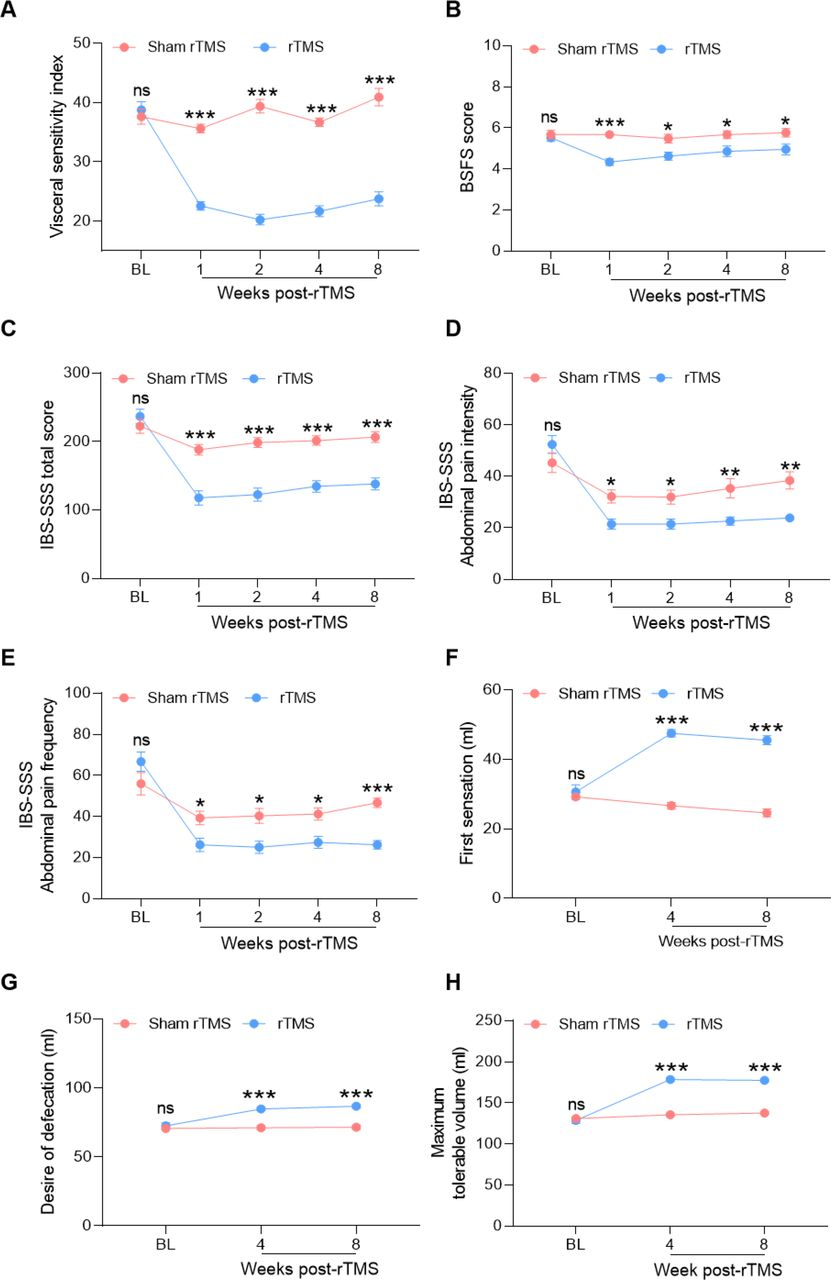
Fig Lf-rTMS produces long-lasting alleviation of symptoms of patients with IBS-D. A follow-up assessment of (A) Visceral Sensitivity Index, (B) BSFS score, (C) IBS-SSS, (D) abdominal pain intensity, (E) abdominal pain frequency, (F) first sensation, (G) desire of defecation and (H) maximum tolerable volume in the sham rTMS and rTMS groups. Data are represented as mean±SEM, n=21 individuals per group. Significance was assessed by two-way ANOVA followed by Bonferroni’s post hoc test. *p<0.05, **p<0.01, ***p<0.001. ANOVA, analysis of variance; BL, baseline; BSFS, Bristol Stool Form Scale; IBS-D, IBS with diarrhoea; IBS-SSS, IBS Symptom Severity Scale; Lf-rTMS, low frequency repetitive transcranial magnetic stimulation; ns, no significance.
Collectively, this work provides robust evidence that mPFC hyperexcitability is a mechanistic driver of IBS-D visceral pain and that targeted neuromodulation via lf-rTMS can achieve clinically meaningful analgesia and symptom control.
Expert Commentary
The study represents a significant advance in understanding the neural substrates of IBS-D visceral pain and harnessing noninvasive brain stimulation as a novel therapeutic modality. Identifying the mPFC glutamatergic hyperactivity aligns with growing literature emphasizing central sensitization and brain-gut axis dysfunction in IBS. The use of fMRI as both a biomarker and therapeutic target is particularly noteworthy, enhancing translational relevance.
While promising, further research is warranted to optimize stimulation parameters, assess long-term efficacy and safety, explore patient selection criteria, and integrate lf-rTMS into comprehensive IBS management frameworks. Additionally, understanding how modulation of NR2A-dependent pathways translates to human physiology could open avenues for adjunctive pharmacologic approaches.
Conclusion
This integrated study highlights the medial prefrontal cortex as a critical node driving chronic visceral pain in IBS-D via glutamatergic hyperactivity and aberrant nociceptive processing. Low-frequency repetitive transcranial magnetic stimulation targeting the mPFC offers a novel, mechanism-based neuromodulatory strategy that effectively alleviates visceral pain and improves bowel symptoms with sustained benefits. These findings pave the way for innovative brain-directed therapies in functional gastrointestinal disorders, addressing a longstanding clinical need with precision medicine tools.
Funding and Clinicaltrials.gov
The original study was conducted by Weng RX et al., with details published in Gut (2026). Specific funding sources were not detailed in the reviewed abstract. The clinical trial registration information is not provided in the abstract; readers are advised to consult the full publication for trial identification numbers and funding disclosures.
References
1. Weng RX, Lin W, Sun Q, et al. Low-frequency repetitive transcranial magnetic stimulation attenuates visceral pain in IBS with diarrhoea via inhibition of the medial prefrontal cortex. Gut. 2026;75(9):1682-1694. PMID: 41629148.
2. Labus JS, Mayer EA. Brain-gut dysfunction: a basis for visceral hypersensitivity in IBS. Nat Rev Gastroenterol Hepatol. 2009;6(10):547-556.
3. Tillisch K, Labus J, Kilpatrick L, et al. Neuroimaging and IBS: insights into central mechanisms underlying symptoms. Neurogastroenterol Motil. 2011;23(5):434-438.
4. Lefaucheur JP, et al. Evidence-based guidelines on the therapeutic use of repetitive transcranial magnetic stimulation (rTMS). Clin Neurophysiol. 2014;125(11):2150-2206.
5. Tracey I, Bushnell MC. How neuroimaging studies have challenged us to rethink: is chronic pain a disease? J Pain. 2009;10(11):1113-1120.