Highlight
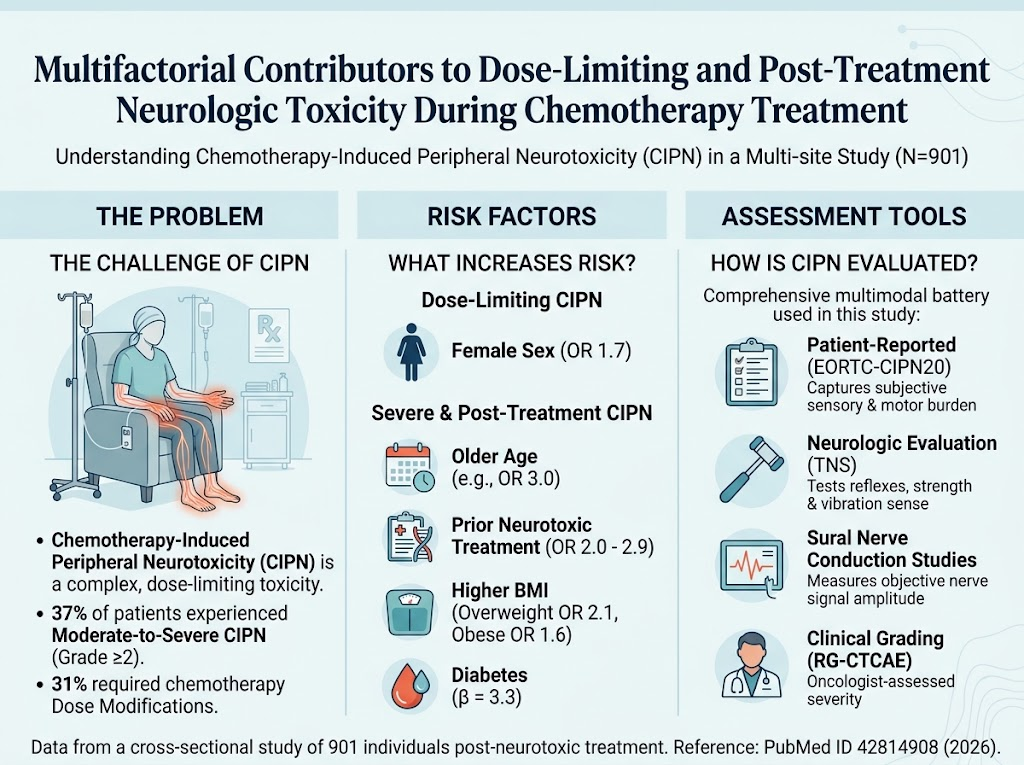
– Chemotherapy-induced peripheral neurotoxicity (CIPN) affects over one-third of patients undergoing neurotoxic cancer therapies, significantly limiting treatment dosing and reducing quality of life.
– Female sex is independently associated with dose-limiting CIPN, requiring chemotherapy dose modifications.
– Older age, diabetes, increased body mass index (BMI), and prior exposure to neurotoxic treatments are strong predictors of both post-treatment CIPN severity and patient-reported neurological symptom burden.
– Comprehensive multimodal assessment including clinical grading, neurologic evaluation, and patient-reported outcomes improves characterization of CIPN and identification of high-risk patients.
Study Background
Chemotherapy-induced peripheral neurotoxicity (CIPN) is a prevalent, dose-limiting adverse effect of various neurotoxic chemotherapeutic agents, such as taxanes, platinum compounds, vinca alkaloids, bortezomib, and thalidomide. CIPN manifests as progressive sensory and motor deficits, often accompanied by neuropathic pain, severely impairing function and quality of life. Persistent CIPN post-treatment can contribute to long-term disability and complicate survivorship. Despite its clinical importance, heterogeneity in outcome measures and study designs has impeded consensus on key clinical risk factors for CIPN, thereby limiting individualized toxicity prediction and proactive management strategies. This study addresses these gaps by systematically evaluating clinical contributors to both dose-limiting and post-treatment CIPN outcomes using a robust, multidimensional neuropathy assessment in a large, multisite cohort.
Study Design
A cross-sectional, multisite observational study enrolled 901 individuals with a median age of 61 years (interquartile range [IQR] 19), predominantly female (66%), who had received established neurotoxic chemotherapy regimens from Australian oncology centers. The median time since treatment completion was 12 months (IQR 18), allowing evaluation of subacute and chronic CIPN manifestations. Chemotherapy agents included taxanes, platinum compounds, vinca alkaloids, bortezomib, and thalidomide.
CIPN was quantified through a triad of assessment modalities:
- Clinical grading (using established neuropathy grading scales with moderate-to-severe CIPN defined as grade ≥2),
- Neurologic evaluation encompassing the Total Neuropathy Score (TNS) and sural nerve conduction studies measuring amplitude,
- Patient-reported outcomes using the European Organization for Research and Treatment of Cancer Quality of Life Chemotherapy-Induced Peripheral Neuropathy Questionnaire (EORTC-CIPN20).
Clinical variables examined as potential predictors included demographic factors (age, sex), metabolic measures (body mass index, diabetic status), and medical history (presence of preexisting peripheral neuropathy, prior exposure to neurotoxic chemotherapy). Dose modification events due to CIPN toxicity were recorded from clinical documentation.
Statistical methodology involved initial variable selection with Least Absolute Shrinkage and Selection Operator (LASSO) regression followed by multivariable logistic and linear regression modeling to examine associations, reporting results as odds ratios (OR) or beta coefficients (β) with 95% confidence intervals (CI).
Key Findings
Approximately 37% of participants exhibited moderate-to-severe CIPN by clinical grading, and 31% had undergone chemotherapy dose modifications attributable to CIPN toxicity.
Factors Associated with Dose-Limiting CIPN:
Female sex emerged as a significant independent predictor of dose-limiting CIPN necessitating dose modification (OR 1.7; 95% CI 1.2-2.5), highlighting a sex-based susceptibility to neurotoxicity impacting treatment tolerability.
Post-Treatment CIPN Associations Across Assessment Modalities:
- Patient-Reported Neuropathy Severity (EORTC-CIPN20): Older age (β=3.9; 95% CI 2.0-5.7), diabetic status (β=3.3; 95% CI 0.1-6.5), overweight (β=3.1; 95% CI 0.9-5.2), obesity (β=3.8; 95% CI 1.4-6.2), and prior neurotoxic chemotherapy exposure (β=5.1; 95% CI 1.3-8.9) were associated with increased neuropathic symptom burden.
- Neurologic Evaluation (TNS, Sural Nerve Amplitude): Similar variables correlated with objective measures of nerve dysfunction.
- Clinical Grading: Age (OR 3.0; 95% CI 2.2-4.2), overweight status (OR 2.1; 95% CI 1.5-3.0), obesity (OR 1.6; 95% CI 1.1-2.4), and prior neurotoxic treatment (OR 2.9; 95% CI 1.2-6.8) were linked to more severe clinical neuropathy grades.
Predictors of Severe CIPN (Highest Quartile or Moderate/Severe Grading):
Older age and prior neurotoxic treatment consistently increased risk across all assessment modalities:
- EORTC-CIPN20 OR 1.9 (95% CI 1.3-2.6)
- TNS OR 3.2 (95% CI 2.2-4.8)
- Clinical grading OR 1.8 (95% CI 1.3-2.4) for age
- EORTC-CIPN20 OR 1.9 (95% CI 1.0-3.4)
- TNS OR 2.0 (95% CI 1.1-3.7)
- Clinical grading OR 2.1 (95% CI 1.2-3.7) for prior neurotoxic chemotherapy
Expert Commentary
This carefully designed multisite study illuminates multifactorial contributors to CIPN and underscores the complexity of predicting neurotoxicity from clinical factors readily available before or during chemotherapy. The consistent influence of age and prior neurotoxic exposure aligns with biological knowledge about cumulative neuronal injury and reduced regenerative capacity in older patients. The finding of female sex as a risk factor for dose-limiting toxicity requires further mechanistic investigation but is supported by some previous literature suggesting sex-specific neurophysiological or pharmacokinetic differences.
The study’s strength lies in its comprehensive, multimodal assessment of CIPN, combining objective neurophysiological data with patient-reported and clinical grading metrics. This approach acknowledges the complexity of neuropathy presentation and the limitations of any single measurement tool. However, as a cross-sectional study, causal inferences are limited, and longitudinal follow-up will be necessary to confirm predictive validity. Additionally, the study population drawn from Australian oncology centers may affect generalizability to other ethnicities and healthcare settings.
Overall, the findings provide a pragmatic framework for clinicians to identify patients at higher risk for developing severe and dose-limiting CIPN based on routinely collected clinical data. This may facilitate early intervention strategies such as dose adjustments, neuroprotective measures, or enhanced monitoring to mitigate toxicity and preserve treatment efficacy.
Conclusion
Chemotherapy-induced peripheral neurotoxicity remains a significant barrier to optimal cancer treatment and contributes substantially to long-term morbidity. This study delineates key clinical risk factors including older age, female sex, metabolic comorbidities, higher BMI, and prior neurotoxic chemotherapy that interplay to increase susceptibility to dose-limiting and persistent CIPN. Implementing comprehensive neuropathy assessments alongside these clinical predictors may enable more personalized management to reduce neurotoxicity burden and improve survivorship outcomes. Ongoing research is warranted to explore underlying mechanisms and develop targeted preventive or therapeutic interventions.
Funding and ClinicalTrials.gov
No specific funding disclosures were reported. The study was conducted across multiple Australian oncology centers. Clinical trial registration details were not provided in the source abstract.
References
Li T, Timmins HC, Horvath LG, et al. Multifactorial Contributors to Dose Limiting and Post-Treatment Neurologic Toxicity During Chemotherapy Treatment. Neurology. 2026 Sep 30;107(8):e218599. PMID: 42814908.
Seretny M, Currie GL, Sena ES, et al. Incidence, prevalence, and predictors of chemotherapy-induced peripheral neuropathy: A systematic review and meta-analysis. Pain. 2014 Dec;155(12):2461-2470. doi:10.1016/j.pain.2014.09.020.
Hershman DL, Lacchetti C, Dworkin RH, et al. Prevention and Management of Chemotherapy-Induced Peripheral Neuropathy in Survivors of Adult Cancers: American Society of Clinical Oncology Clinical Practice Guideline. J Clin Oncol. 2014 Jun 10;32(18):1941-1967. doi:10.1200/JCO.2013.54.0914.