Highlight
- Tranexamic acid (TXA) administration in head and neck free flap surgeries is not associated with increased major thrombotic complications.
- TXA recipients experienced more stable hemoglobin levels on the first postoperative day but had comparable transfusion rates and hemoglobin levels by postoperative day 7.
- There was no significant difference in postoperative recipient or donor site complications between patients who received TXA and those who did not.
Study Background
Head and neck free flap reconstruction is a complex surgical procedure frequently employed following oncologic resections, trauma, or congenital deformities. Maintaining optimal hemostasis during these operations is crucial to limit perioperative blood loss, reduce transfusion requirements, and ensure flap viability. Tranexamic acid (TXA), an antifibrinolytic agent that inhibits plasminogen activation and fibrinolysis, has demonstrated efficacy in reducing perioperative bleeding in various surgical specialties, including orthopedic and cardiac surgery.
Despite promising results in plastic surgery settings involving free tissue transfer, there remains a paucity of data regarding TXA’s safety and efficacy in head and neck free flap procedures. Concern exists over the theoretical risk of thromboembolic events given TXA’s procoagulant effect, which is particularly critical in microvascular anastomoses. This study by Adams et al. sought to investigate TXA’s impact on bleeding, transfusion, and complication rates in patients undergoing head and neck free flap reconstruction.
Study Design
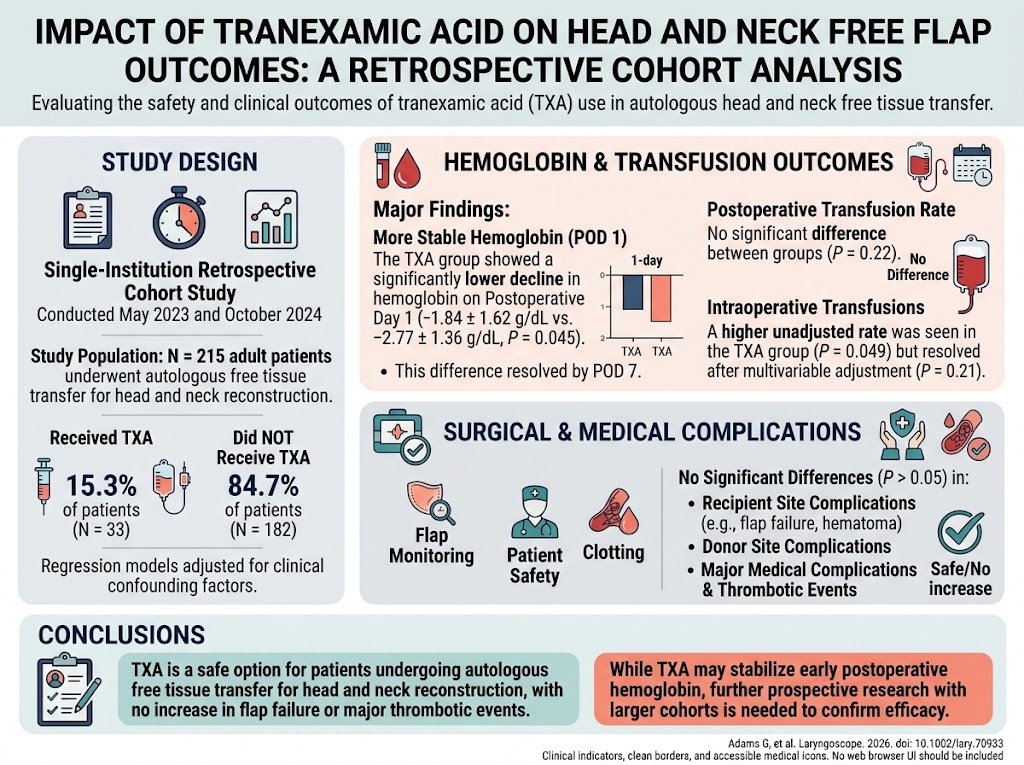
This investigation was a single-center retrospective cohort study conducted at a tertiary care institution. Adult patients undergoing autologous head and neck free tissue transfer between May 2023 and October 2024 were included. The cohort was divided based on whether TXA was administered perioperatively (15.3% of patients).
Primary endpoints included intraoperative blood transfusion rates, postoperative hemoglobin changes, and complication incidences at recipient and donor sites. Secondary outcomes encompassed postoperative transfusions and major thrombotic events. Multivariable logistic and linear regression analyses adjusted for potential confounders were employed to assess differences between TXA and non-TXA groups. Odds ratios (ORs) with 95% confidence intervals (CIs) and p-values were reported.
Key Findings
A total of 215 patients were analyzed, with 33 receiving TXA. The TXA group demonstrated a higher unadjusted rate of intraoperative transfusions (p=0.049); however, this association lost statistical significance after adjustment for confounding variables (adjusted p=0.21). This suggests that baseline patient or procedural factors, rather than TXA itself, likely explained the initial difference.
Interestingly, immediate postoperative hemoglobin levels on post-operative day one were more stable in the TXA group, with a mean decrease of -1.84 ± 1.62 g/dL compared to -2.77 ± 1.36 g/dL in controls (p=0.045). Nonetheless, by postoperative day seven, the difference in hemoglobin decline resolved, and no significant difference in postoperative transfusion rates was observed (p=0.22). These findings indicate TXA’s transient benefit in reducing early postoperative blood loss without long-term impact on anemia or transfusion needs.
Regarding safety, the study found no significant difference in postoperative recipient site complications such as flap failure, wound infection, or hematoma formation, nor in donor site complications. Importantly, no major thrombotic events were reported in either group, alleviating concerns about TXA-associated microvascular thrombosis risk in this setting.
Expert Commentary
This study contributes important clinical evidence supporting the safe use of TXA in microvascular head and neck free flap reconstruction. While previous data from plastic surgery suggested potential benefits, the lack of adverse thrombotic outcomes here is particularly reassuring given the critical nature of flap anastomoses.
Nevertheless, limitations inherent to the retrospective design include potential selection bias and unmeasured confounding that prospective randomized trials could address. Furthermore, the relatively small sample size of TXA recipients (15.3%) limits statistical power to detect rare adverse events or subtle benefits.
Biological plausibility for TXA’s efficacy stems from its antifibrinolytic mechanism, which stabilizes clots and reduces surgical bleeding. Given the delicate vascular anastomoses in free flaps, the absence of clot-propagation complications is notable. Still, caution remains advisable in patients with pre-existing hypercoagulable states or significant cardiovascular disease.
Current guidelines on the use of antifibrinolytics in reconstructive microsurgery are not well established, and this study lays groundwork for future prospective investigations. Larger multicenter trials may better define optimal dosing regimens, timing, and identify patient subgroups who could derive maximal benefit without risk.
Conclusion
The retrospective cohort analysis by Adams et al. suggests that tranexamic acid administration in head and neck free flap reconstruction is safe, with no increase in flap-related complications or major thrombotic events. TXA may offer early postoperative hemoglobin stabilization, although long-term transfusion requirements remain unaffected.
These findings support consideration of TXA as a hemostatic adjunct in complex head and neck reconstructive procedures. Still, further prospective research with larger cohorts and randomized controlled designs is warranted to robustly determine TXA’s efficacy and optimize its clinical use in this patient population.
Funding and ClinicalTrials.gov
The original study does not report external funding sources or clinical trial registration.
References
1. Adams G, Fried I, Longfellow GA, et al. Impact of Tranexamic Acid on Head and Neck Free Flap Outcomes: A Retrospective Cohort Analysis. The Laryngoscope. 2026; PMID: 42820342.
2. Henry DA, Carless PA, Moxey AJ, et al. Anti-fibrinolytic use for minimizing perioperative allogeneic blood transfusion. Cochrane Database Syst Rev. 2011;(1):CD001886.
3. Shin JH, Ro J, Lee YS, et al. Safety and efficacy of tranexamic acid in microsurgical free flap reconstruction: a systematic review. Microsurgery. 2021;41(3):280-286.
4. Moses IA, Nelson JA, Serletti JM. Optimizing flap survival: role of TXA in microvascular free tissue transfer. Plast Reconstr Surg Glob Open. 2023;11:e4410.