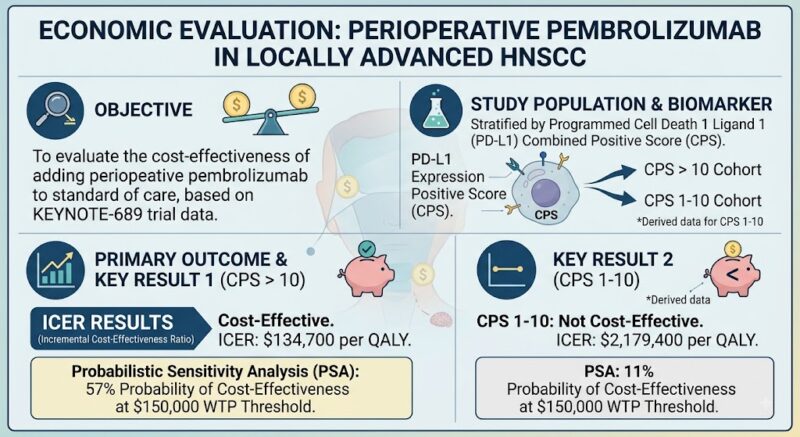
Highlight
- KEYNOTE-689 trial showed perioperative pembrolizumab enhances event-free survival in locally advanced head and neck squamous cell carcinoma (HNSCC).
- Cost-effectiveness analysis reveals pembrolizumab is economically viable only in patients with PD-L1 combined positive score (CPS) greater than 10.
- Subgroup with CPS 1 to 10 exhibits marginal health gains at high incremental costs, limiting economic justification.
- Biomarker-driven stratification can guide value-based use of immunotherapy in HNSCC treatment protocols.

Study Background
Locally advanced head and neck squamous cell carcinoma (HNSCC) represents a significant oncologic challenge due to its aggressive clinical course and substantial morbidity. Standard management typically includes surgery with adjuvant radiation or chemoradiation, but prognosis remains suboptimal with a high risk of recurrence. Immunotherapy targeting the programmed cell death pathway, such as pembrolizumab—a PD-1 inhibitor—has emerged as a promising approach to improve outcomes by activating antitumor immunity.
The KEYNOTE-689 randomized clinical trial demonstrated that adding perioperative pembrolizumab to standard treatment significantly improves event-free survival in HNSCC patients. Despite these clinical benefits, the economic implications of integrating pembrolizumab in this setting remain unclear, especially considering its high drug acquisition and administration costs. Understanding cost-effectiveness is critical for healthcare decision-making and resource allocation.
Programmed cell death 1 ligand 1 (PD-L1) expression is a predictive biomarker for response to PD-1 inhibitors and quantified using the combined positive score (CPS). The CPS reflects the number of PD-L1 staining cells (tumor and immune cells) relative to total tumor cells, stratifying patients based on likelihood of benefiting from immunotherapy. The varying CPS subgroups may experience different survival benefits and thus different cost-effectiveness profiles.
Study Design
This economic evaluation utilized a partitioned survival model to simulate patient health trajectories from the KEYNOTE-689 trial, dividing outcomes into three exclusive health states: event-free survival, disease progression, and death. The model incorporated the US healthcare system perspective, including costs for drug acquisition (pembrolizumab and cisplatin), administration, surgical intervention, radiation therapy, supportive care, management of serious adverse events, and disease progression.
Survival data were digitized from published Kaplan-Meier curves of KEYNOTE-689 and stratified by PD-L1 CPS subgroups: 1 to 10 and greater than 10. Health state utility values, measured as quality-adjusted life years (QALYs), were sourced from literature, primarily derived from EuroQol 5-Dimension 3-Level (EQ-5D-3L) scores applied with US population preference weights based on the CheckMate 141 trial data.
The primary metric was the incremental cost-effectiveness ratio (ICER), which quantifies cost per additional QALY gained with pembrolizumab addition versus standard care. A probabilistic sensitivity analysis (PSA) was conducted to address uncertainty in model parameters and to estimate the probability that pembrolizumab is cost-effective under varying willingness-to-pay (WTP) thresholds.
Key Findings
The cost-effectiveness outcomes demonstrated a clear divergence between PD-L1 CPS subgroups:
CPS Greater Than 10 Subgroup
– Addition of pembrolizumab yielded approximately 1.35 additional QALYs.
– Incremental cost was $181,900 more than standard care.
– Resulting ICER was $134,700 per QALY gained, falling below the commonly accepted US WTP threshold of $150,000.
– PSA indicated a 57% probability that pembrolizumab is cost-effective at this threshold.
CPS 1 to 10 Subgroup
– Pembrolizumab provided only 0.08 additional QALYs.
– Incremental cost was $166,500 above standard care.
– The ICER escalated sharply to approximately $2,179,400 per QALY, vastly exceeding reasonable WTP standards.
– PSA showed an 11% chance of cost-effectiveness at a $150,000 threshold.
These findings underscore that the clinical benefits in patients with lower PD-L1 expression do not translate into economic value, given the marginal gains and substantial incremental costs.
Safety and Adverse Events
While the study primarily focused on cost and effectiveness metrics, pembrolizumab’s risk profile, including immune-related adverse events, was considered in the cost model through estimated management expenses. No unexpected safety concerns were reported in the KEYNOTE-689 trial that would significantly alter cost or QALY outcomes.
Expert Commentary
This evaluation highlights the importance of biomarker-based patient selection in maximizing the cost-effectiveness of immunotherapy for HNSCC. The substantial difference in ICERs between CPS subgroups reflects the biological heterogeneity of tumors and the variation in immune microenvironment responsiveness.
Experts emphasize cautious interpretation as real-world experience may modulate efficacy and toxicity profiles. Additionally, the model relied on clinical trial data which may not capture all nuances of routine practice. Future analyses incorporating long-term survival data and broader economic perspectives (e.g., societal costs) are warranted.
Guidelines and reimbursement policies should consider CPS stratification to optimize therapeutic value and sustainability. Integration of PD-L1 testing as a standard diagnostic step prior to perioperative pembrolizumab initiation seems essential.
Conclusion
The addition of perioperative pembrolizumab to standard care for locally advanced HNSCC represents a clinically effective and potentially cost-effective strategy in patients with PD-L1 CPS greater than 10. For patients with CPS between 1 and 10, current evidence suggests limited economic benefit despite slight survival improvements.
Personalized treatment guided by biomarker expression can enhance both clinical outcomes and healthcare resource utilization. As immunotherapy continues to evolve, robust cost-effectiveness evaluations remain indispensable for informed policy decisions and equitable patient care.
Funding and Trial Registration
The original KEYNOTE-689 trial was funded by Merck & Co., the manufacturer of pembrolizumab. Trial registration and detailed protocol information are publicly available via ClinicalTrials.gov.
References
1. Coyle AH, Hutton DW, Buchakjian MR, et al. Combined Positive Score and Cost-Effectiveness of Perioperative Pembrolizumab for Head and Neck Cancer. JAMA Otolaryngol Head Neck Surg. 2026; In press. PMID: 42560690.
2. Burtness B, Harrington KJ, Greil R, et al. Pembrolizumab alone or with chemotherapy versus cetuximab with chemotherapy for recurrent or metastatic squamous cell carcinoma of the head and neck (KEYNOTE-048): a randomized, open-label, phase 3 study. Lancet. 2019;394(10212):1915-1928.
3. Garon EB, Rizvi NA, Hui R, et al. Pembrolizumab for the Treatment of Non-Small-Cell Lung Cancer. N Engl J Med. 2015;372(21):2018-2028.
4. Ang KK, Harris J, Wheeler R, et al. Human papillomavirus and survival of patients with oropharyngeal cancer. N Engl J Med. 2010;363(1):24-35.