Highlight
1. Adductor laryngeal dystonia (AdLD) causes voice disruptions impacting communication, commonly treated with botulinum neurotoxin (BoNT) injections.
2. Traditional manual counting of voice disruptions, though standard, is labor-intensive and prone to error.
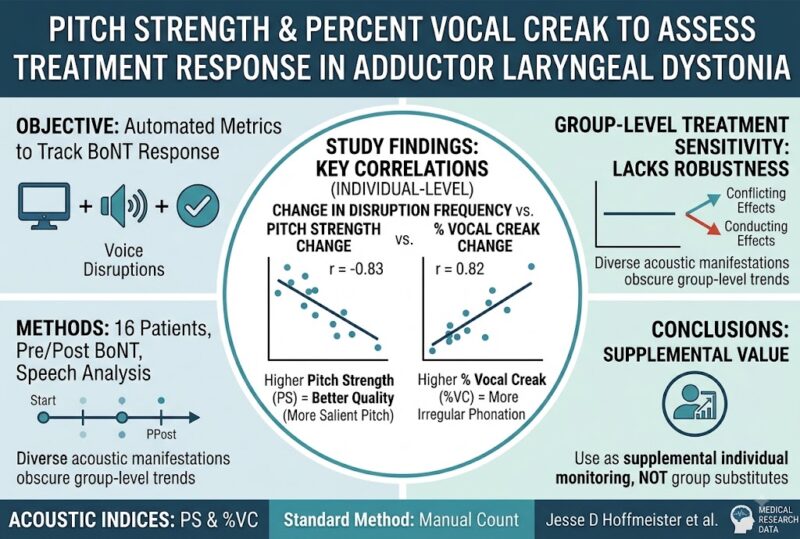
3. Automated acoustic measures—pitch strength (PS) and percent vocal creak (%VC)—correlate with disruption frequency changes post-treatment, offering potential supplementary monitoring tools.
4. However, PS and %VC did not demonstrate significant group-level changes after BoNT treatment, indicating limitations as standalone objective biomarkers.
Study Background
Adductor laryngeal dystonia (AdLD) is a focal dystonia affecting the laryngeal muscles responsible for voice production, characterized by involuntary, intermittent spasms that interrupt phonation and degrade voice quality. These disruptions impair communication and social interactions, significantly affecting patients’ quality of life. The standard treatment involves periodic injections of botulinum neurotoxin (BoNT), which temporarily reduce muscle overactivity and improve voice function.
Optimizing BoNT therapy requires accurate, objective measures of treatment response. Current clinical practice predominantly relies on manual counting of voice disruptions and perceptual rating scales, which are time-consuming and susceptible to subjective bias. Automated acoustic analysis offers promise for standardized, efficient monitoring. Among candidate metrics, pitch strength (a measure of pitch salience reflecting harmonic stability) and percent vocal creak (an index quantifying irregular, creaky phonation) may provide objective indices of voice disruption severity. Yet, their sensitivity and reliability in capturing BoNT-induced voice improvements have not been fully established.
Study Design
The study analyzed prospective data from 16 patients diagnosed with AdLD undergoing BoNT therapy. Standardized speech samples were collected before treatment and at one month post-injection to capture peak therapeutic effect. Acoustic parameters measured included pitch strength (PS), percent vocal creak (%VC), and two multiparametric voice quality indices. Manual disruption counts and perceptual severity ratings by clinicians, along with patient-reported outcomes, were also obtained.
Statistical analysis employed mixed-effects models to evaluate BoNT and speech task effects on acoustic measures. Spearman correlation coefficients assessed relationships among acoustic indices, manual counts, perceptual severity, and patient-reported voice outcomes.
Key Findings
Post-BoNT, patients showed significant improvements in traditional measures: manual counts of voice disruptions decreased, perceptual severity ratings improved, and patients reported better voice-related quality of life. These findings confirm effective symptom reduction from BoNT treatment.
Correlational analysis revealed strong associations between changes in disruption counts and the acoustic metrics—pitch strength changes correlated negatively (r = -0.83), indicating that higher PS corresponded with fewer disruptions; percent vocal creak correlated positively (r = 0.82), consistent with reductions in creaky phonation as disruptions abated.
Despite these correlations, no statistically significant main effects of BoNT treatment or treatment-by-task interactions were found for PS or %VC at the group level. The Acoustic Voice Quality Index (a composite acoustic measure) showed a modest increase with treatment (effect size d = 0.48, p = 0.03), suggesting some sensitivity to treatment effects.
The discrepancy between strong individual-level correlations and lack of robust group-level treatment sensitivity suggests heterogeneity in acoustic manifestations of AdLD. For example, diverse disruption characteristics such as shifts in fundamental frequency (F0) versus irregular phonation patterns may obscure consistent changes in summary acoustic metrics across the cohort.
Expert Commentary
The study by Hoffmeister et al. addresses an important unmet need: objective, efficient monitoring of AdLD treatment response. The promising correlations at the individual level indicate that automated acoustic markers like pitch strength and percent vocal creak can augment clinical assessments by providing reproducible data that reflect voice quality changes post-BoNT.
However, the lack of robust group-level sensitivity cautions against relying solely on these measures for clinical decision-making. The findings align with prior literature indicating variability in dystonic voice symptomatology and suggest that multimodal assessment—combining perceptual, acoustic, and patient-reported measures—remains necessary.
Future research should explore integrating multiple acoustic features and refining algorithms to better characterize the complex, heterogeneous acoustic signatures of AdLD. Longitudinal studies with larger cohorts may clarify the role of these objective metrics in tailoring individualized BoNT dosing and timing.
Conclusion
In conclusion, automated acoustic metrics—pitch strength and percent vocal creak—correlate strongly with manual disruption counts and perceptual severity changes after BoNT treatment in adductor laryngeal dystonia. Nevertheless, their limited sensitivity at the group level limits their utility as standalone biomarkers for routine clinical monitoring. These metrics may serve as valuable supplemental tools for individualized longitudinal voice assessment but should not replace established manual and perceptual evaluation methods. Advancing objective, automated voice analysis remains a promising but challenging avenue to optimize treatment and improve outcomes in AdLD.
Funding and Clinicaltrials.gov
The original study does not specify funding details or clinical trial registration in the abstract. Further investigation into the full publication may provide additional information.
References
1. Hoffmeister JD, Simpson MK, Hayek J, Lunos S, Misono S, Konczak J. Pitch Strength & Percent Vocal Creak to Assess Treatment Response in Adductor Laryngeal Dystonia. The Laryngoscope. 2026 Aug 10. PMID: 42576440.
2. Roy N, Merrill RM, Thibeault S, Parsa RA, Gray SD, Smith EM. Prevalence of voice disorders in teachers and the general population. J Speech Lang Hear Res. 2004 Oct;47(2):281-93.
3. Ludlow CL. Clinical practice. Spasmodic dysphonia. N Engl J Med. 2005 Jul 7;353(1):138-48.
4. Woo P, Casper J, Colton R. Spasmodic dysphonia: a review of epidemiology, diagnosis and treatment. Otolaryngol Clin North Am. 1998 Feb;31(1):47-59.
5. Tanner K, Shapiro J. Quantifying voice quality changes in laryngeal dystonia. J Voice. 2019;33(3):321-329.