Highlight
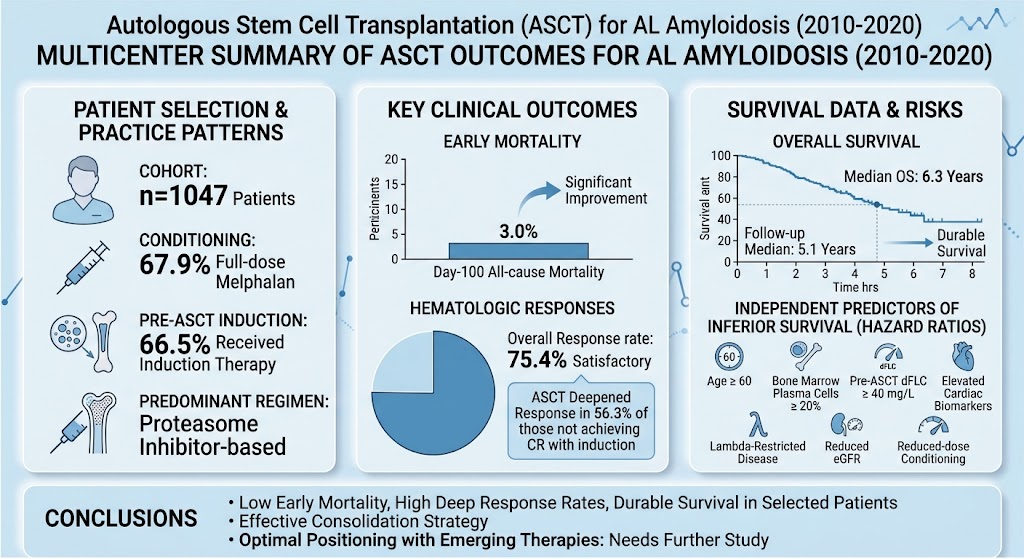
This large retrospective multicenter study of 1047 AL amyloidosis patients undergoing autologous stem cell transplantation (ASCT) from 2010 to 2020 reveals significantly reduced early mortality (3.0% at day 100), high rates of hematologic response post-transplantation (75.4%), and a median overall survival of 6.3 years. Key prognostic factors impacting survival include age, bone marrow plasma cell burden, disease biomarkers, and conditioning regimen intensity. ASCT continues to serve as an effective consolidative strategy in carefully selected patients despite evolving therapeutic landscapes.
Study Background
AL amyloidosis is a rare but often devastating plasma cell dyscrasia characterized by the deposition of misfolded light chain proteins, causing organ dysfunction mainly affecting the heart and kidneys. Historically, treatment has focused on suppressing the clonal plasma cell population to reduce amyloidogenic light chains. Autologous stem cell transplantation (ASCT) has been established as an intensive therapy delivering deep hematologic responses and often translating to improved organ function and survival. However, ASCT is associated with significant treatment-related risks, historically limiting eligibility to younger and fitter patients. The development of novel agents such as proteasome inhibitors and monoclonal antibodies has expanded therapeutic options, but the role and optimal timing of ASCT in the era of these therapies remain debated. This study evaluates contemporary patient selection criteria, therapeutic approaches surrounding ASCT, efficacy, and survival outcomes in a large, real-world cohort.
Study Design
This retrospective study aggregated data from nine tertiary referral centers across the United States and Europe. It included 1047 patients with biopsy-proven AL amyloidosis who underwent ASCT from 2010 to 2020. Most patients received full-dose melphalan conditioning (200 mg/m2), while a subset received reduced doses based on clinical factors. Induction therapy was administered in two-thirds of patients prior to ASCT, predominantly using proteasome inhibitor-based regimens (e.g., bortezomib). Primary endpoints included day-100 all-cause mortality, hematologic response rates post-ASCT, depth of hematologic response compared to pre-ASCT status, and overall survival. Prognostic factors impacting outcomes were also analyzed.
Key Findings
Early Mortality and Safety: The day-100 all-cause mortality rate was 3.0%, demonstrating a notable improvement relative to historic cohorts reporting rates >10%. This indicates enhanced patient selection, supportive care, and management of transplant-related complications.
Hematologic Response: Post-ASCT assessments showed 75.4% of patients achieved a satisfactory hematologic response, including complete and very good partial responses. Among patients with paired response evaluation before and after ASCT, 56.3% experienced deepening of hematologic remission, underscoring ASCT’s role in consolidating and improving disease control beyond induction therapy.
Overall Survival: Median follow-up was 5.1 years with a median overall survival (OS) of 6.3 years. This reflects durable survival outcomes compared to historical controls and aligns with the improving prognosis in AL amyloidosis patients treated aggressively.
Prognostic Factors: Multivariate analysis identified the following independent predictors of inferior survival: age ≥60 years, bone marrow plasma cell infiltration ≥20%, difference between involved and uninvolved free light chains (dFLC) ≥40 mg/L before ASCT, elevated cardiac biomarkers (e.g., NT-proBNP), lambda light chain restriction, reduced renal function (estimated glomerular filtration rate [eGFR]), and use of reduced-dose melphalan conditioning. These factors enable risk stratification and can guide patient candidacy and conditioning intensity.
Expert Commentary
This comprehensive multicenter experience highlights the enduring relevance of ASCT in managing AL amyloidosis, particularly in the context of improved supportive care and integration of modern induction regimens. Achieving deep hematologic remission post-ASCT correlates with improved survival and potential organ response, reinforcing transplantation’s consolidative role. However, the study underscores that optimal patient selection remains critical given that older age, higher disease burden, and organ impairment adversely affect outcomes.
These findings align with current expert consensus and guidelines that recommend ASCT as an integral option for well-selected patients with limited cardiac involvement and preserved performance status. The growing availability of effective novel agents invites future prospective trials to define the best sequencing or combination strategies. For example, the role of induction therapy, conditioning intensity modulation, and tandem transplant approaches requires further investigation.
Limitations of this retrospective design include heterogeneity of treatment protocols and potential selection biases towards fitter patients. Nonetheless, the large sample size across diverse centers strengthens the generalizability of observed trends.
Conclusion
In this large, contemporary cohort, autologous stem cell transplantation for AL amyloidosis demonstrated low early mortality, high rates of deep hematologic response, and durable survival in appropriately selected patients. ASCT remains a cornerstone consolidative therapy complementary to novel induction regimens. Future research should aim to optimize integration with emerging therapies, refine patient selection criteria, and explore strategies to mitigate risk in vulnerable populations to further improve outcomes in AL amyloidosis.
Funding and ClinicalTrials.gov
Funding sources and clinical trial identifiers were not explicitly reported in the source study.
References
1. Lerman B, Schönland S, Hegenbart U, et al. Autologous stem cell transplantation for AL amyloidosis: a multicenter summary of outcomes 2010-2020. Bone Marrow Transplant. 2026 Jun 22;61(9):1162-1168. PMID: 42332218.
2. Merlini G, Wechalekar AD, Palladini G. AL amyloidosis: advances in diagnosis and management. Blood. 2013;121(24):5124-30.
3. Gertz MA, Kyle RA. Plasma cell disorders: amyloidosis and related disorders. Hematology Am Soc Hematol Educ Program. 2002:172-91.
4. Palladini G, Dispenzieri A, Gertz MA, et al. New criteria for response to treatment in immunoglobulin light chain amyloidosis based on free light chain measurement and cardiac biomarkers. J Clin Oncol. 2012;30(36):4541-9.
5. Sanchorawala V. Light-chain (AL) amyloidosis: diagnosis and treatment. Clin J Am Soc Nephrol. 2006;1(6):1331-41.