Introduction and Context
Cardiovascular disease (CVD) remains the leading cause of morbidity and mortality in the United States. Lipid management — primarily lowering low-density lipoprotein cholesterol (LDL-C) — is a cornerstone of CVD prevention. In December 2025 the U.S. Department of Veterans Affairs (VA) and the Department of Defense (DoD) released an update to their Clinical Practice Guideline (CPG) for lipid management in adults (Arnold et al., 2026). The 2025 update responds to new evidence, evolving risk tools, and emerging lipid-lowering therapies since the prior VA/DoD guidance (2020) and other major society statements (e.g., AHA/ACC 2018/2019 guidance).
Why this update matters now
– New randomized trials and long-term outcome data for nonstatin agents (notably PCSK9 inhibitors and bempedoic acid), expanded experience with ezetimibe, and evolving data on lipoprotein(a) (Lp[a]) and coronary artery calcium (CAC) testing have changed the prevention landscape.
– Risk-estimation approaches and shared decision-making tools have proliferated; the panel adopted a new calculator (PREVENT) to improve risk estimation in contemporary U.S. populations.
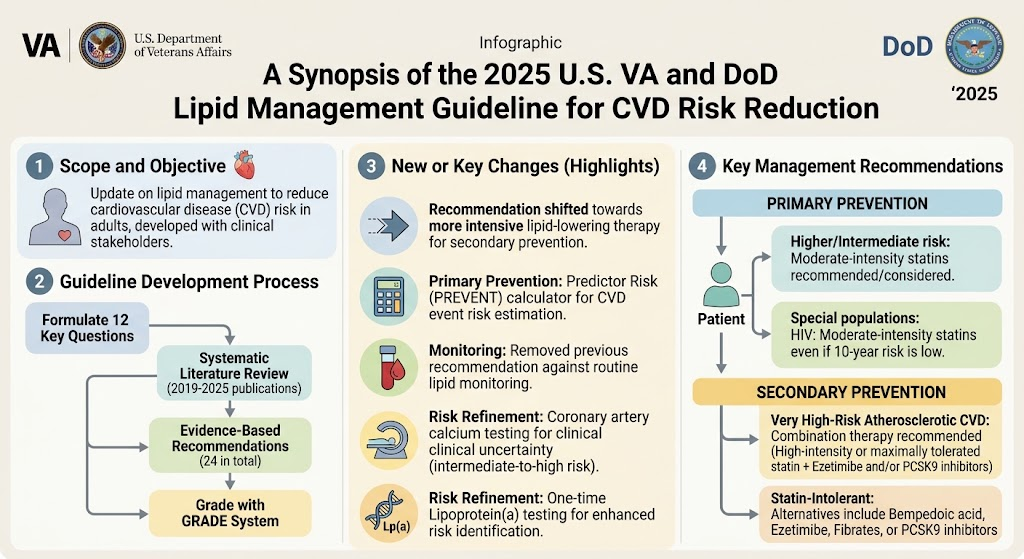
– The VA/DoD committee used GRADE to issue 24 evidence-based recommendations addressing screening, risk estimation, primary and secondary prevention, and management of statin intolerance.
New Guideline Highlights
Key themes and headline recommendations in the 2025 VA/DoD update (Arnold et al., 2026):
– New preferred risk calculator: The guideline now recommends the Predicting Risk of Cardiovascular Disease EVENTs (PREVENT) calculator for 10-year risk estimation in primary prevention.
– Risk refinement: Coronary artery calcium (CAC) testing is suggested for patients with intermediate-to-high calculated risk when uncertainty about risk-based treatment decisions persists. One-time Lp(a) measurement is recommended to identify individuals with inherited, enhanced lifetime risk.
– Lipid monitoring: The prior VA/DoD caution against routine lipid monitoring was removed; the panel provides pragmatic monitoring guidance aligned with therapy intensity and adherence.
– Primary prevention: Moderate-intensity statin therapy remains the recommended treatment for adults at higher calculated risk and should be considered for those at intermediate risk. For adults living with HIV, moderate-intensity statins are suggested even when 10-year risk is low.
– Secondary prevention and high-risk disease: The guideline shifts toward more intensive LDL-C lowering in secondary prevention. For patients with atherosclerotic CVD who are at very high risk, the panel suggests combination therapy (high-intensity or maximally tolerated statin plus ezetimibe and/or PCSK9 inhibitors) to achieve lower LDL-C targets.
– Statin intolerance: For patients unable to tolerate statins, the guideline recommends alternative therapies including bempedoic acid, ezetimibe, fibrates (when appropriate), or PCSK9 monoclonal antibodies.
Key takeaways for clinicians
– Use PREVENT for initial risk estimation in primary prevention.
– Apply CAC and Lp(a) selectively to refine risk and guide shared decision-making.
– Consider expanded use of combination lipid-lowering therapy in very-high-risk secondary prevention.
– Integrate the guideline’s practical monitoring and statin-intolerance pathways into routine practice.
Updated Recommendations and Key Changes (2020 → 2025)
Major changes in the 2025 update compared with the prior VA/DoD guidance and in relation to other major guidelines are summarized below.
– Risk estimation
– 2020: Recommended pooled cohort equations (PCE) and individualized clinician judgment.
– 2025: Recommends PREVENT calculator for 10-year risk estimation (GRADE used for recommendation). PREVENT is intended to reflect contemporary U.S. population demographics and event rates.
– Lipid monitoring
– 2020: Advised against routine frequent lipid testing in stable low-risk patients.
– 2025: Removes blanket recommendation against routine monitoring; provides frequency guidance tied to therapy initiation, titration, and adherence (e.g., labs at 4–12 weeks after statin start/change, then periodic checks).
– Risk refinement strategies
– 2025 adds two explicit options: (1) CAC testing for intermediate-to-high risk with clinical uncertainty; (2) one-time Lp(a) measurement for lifetime risk identification.
– Primary prevention
– 2025 clarifies statin intensity thresholds: moderate-intensity statin recommended for higher risk and considered for intermediate risk. New: specific recommendation to consider moderate-intensity statin for adults living with HIV irrespective of low 10-year risk due to chronic immune activation and increased lifetime risk.
– Secondary prevention
– 2025 leans toward lower LDL-C through combination therapy for very-high-risk atherosclerotic CVD patients: add ezetimibe and consider PCSK9 inhibitors if LDL-C remains above thresholds despite maximally tolerated statin.
– Statin intolerance
– 2025 specifies alternatives and sequences including bempedoic acid, ezetimibe, fibrates when appropriate, and PCSK9 monoclonal antibodies for LDL-C lowering where indicated.
Evidence driving the updates
– Large outcome trials of PCSK9 inhibitors (FOURIER, ODYSSEY) demonstrated incremental cardiovascular event reduction when LDL-C is lowered beyond what statins achieve (Sabatine et al., 2017; Schwartz et al., 2018).
– The CLEAR Outcomes trial showed cardiovascular benefit with bempedoic acid in statin-intolerant populations (Ray et al., 2023), supporting its inclusion as an alternative.
– Expanding data support the prognostic utility of CAC for personalizing primary prevention, and mounting evidence links elevated Lp(a) to lifetime CVD risk, motivating one-time testing.
Topic-by-Topic Recommendations
Below are practical, topic-specific recommendations adapted from the 2025 VA/DoD guideline. Recommendation strength and certainty: the guideline used the GRADE framework for each recommendation; where the panel used conditional language, clinicians should emphasize shared decision-making.
1) Risk estimation (primary prevention)
– Use the PREVENT calculator to estimate 10-year atherosclerotic CVD risk in adults without established CVD.
– Consider additional lifetime risk estimation for younger adults where 10-year risk may underestimate cumulative exposure.
2) Risk refinement
– Coronary artery calcium (CAC) testing
– Suggest CAC testing for individuals with intermediate-to-high calculated risk when clinical uncertainty exists regarding initiation of statin therapy (e.g., patient hesitant, borderline LDL-C or competing risks).
– A CAC score of 0 may justify deferring statin therapy in some patients, whereas higher scores support escalation.
– Lipoprotein(a)
– Recommend one-time measurement of Lp(a) in adults to identify genetically high-risk individuals; elevated Lp(a) (often defined as ≥50 mg/dL or ≥125 nmol/L depending on assay) should prompt consideration of more aggressive LDL-C lowering and family screening.
3) Primary prevention — pharmacotherapy
– For adults at higher calculated 10-year risk: recommend moderate-intensity statin therapy.
– For adults at intermediate risk: consider moderate-intensity statins after shared decision-making.
– Specific population: adults living with HIV — suggest moderate-intensity statin therapy even when 10-year risk is low (recognizing chronic inflammation and higher lifetime CVD risk).
4) Secondary prevention — established atherosclerotic CVD
– For most patients with established atherosclerotic CVD, initiate or continue high-intensity statin therapy unless contraindicated.
– For very-high-risk patients (recurrent events, multiple vascular beds, progressive disease): suggest adding ezetimibe and, if LDL-C remains above thresholds despite maximally tolerated statin plus ezetimibe, consider PCSK9 inhibitors (monoclonal antibodies) to achieve lower LDL-C.
5) Statin intolerance and alternatives
– Confirm true statin intolerance using structured assessment (rechallenge, symptom attribution).
– If statin intolerance precludes adequate statin use, consider alternative LDL-C–lowering agents:
– Ezetimibe
– Bempedoic acid (outcome data supportive in statin-intolerant populations)
– PCSK9 monoclonal antibodies when high-risk and substantial LDL-C lowering required
– Fibrates primarily for triglyceride-driven risk or combined dyslipidemia where indicated
6) Monitoring and follow-up
– Check lipid panel 4–12 weeks after initiating or changing statin therapy, then at 3–12 month intervals to assess adherence and response.
– For stable patients adherent to therapy and with LDL-C at goal, periodic monitoring (e.g., annually) is reasonable.
7) Special populations
– HIV: moderate-intensity statin recommended for adults living with HIV even if 10-year risk estimates are low; pay attention to drug–drug interactions between antiretroviral therapy and statins.
– Older adults: personalize therapy using overall health status, frailty, and life expectancy; shared decision-making is essential.
– Chronic kidney disease: consider individual risk; many CKD patients derive benefit from statins except those on dialysis where evidence differs.
Expert Commentary and Insights
Panel reasoning and controversies
– Adoption of PREVENT: The panel favored PREVENT over older calculators because it better matches recent U.S. event rates and captures certain demographic adjustments. Some experts caution that any risk calculator has limits and that clinician judgment remains critical.
– CAC and Lp(a): Experts emphasized that these tools are for refinement, not mass screening. CAC is helpful when a patient’s willingness to take a statin hinges on imaging evidence of subclinical atherosclerosis. One-time Lp(a) testing is compelling because it identifies a lifelong, genetically determined risk factor; however, definitive targeted therapies for Lp(a) (e.g., RNA therapies) were not widely available as standard care in 2025, so measurement primarily informs LDL-C intensity and family screening.
– Intensification for secondary prevention: The panel’s shift toward combination therapy reflects recognition that lower LDL-C yields incremental benefit in very-high-risk patients. Cost, access, and patient preferences remain important constraints, particularly for PCSK9 monoclonal antibodies.
– Statin intolerance: The guideline emphasizes objective approaches to evaluate and manage suspected intolerance, including rechallenge and use of nonstatin agents. There remains controversy about the true prevalence of clinically meaningful statin intolerance and the best steps for rechallenge.
Future research needs highlighted by the panel
– Head-to-head strategies of combination LDL-C–lowering vs stepwise escalation on clinical outcomes in real-world populations.
– Broader implementation studies of PREVENT and CAC-guided decision pathways across diverse healthcare settings.
– Long-term outcome data for emerging Lp(a)-lowering therapies and their role in treatment algorithms.
Practical Implications for Clinical Practice
– Workflow: Integrate PREVENT into electronic health records and decision support to standardize risk communication.
– Shared decision-making: Use PREVENT outputs, CAC results (if available), and Lp(a) status to frame conversations about benefits, harms, and costs of lipid-lowering therapy.
– Access and cost: Recognize that PCSK9 inhibitors and some newer agents remain costly; document adherence and LDL-C trajectories to support prior authorization when appropriate.
Patient vignette (application example)
– Marcus, a 58-year-old man with treated hypertension and LDL-C 145 mg/dL, has a PREVENT 10-year risk of 8% (intermediate). He is reluctant to take a daily medication. After discussing options, he undergoes CAC testing, which shows a score of 86. The clinician explains that this level of CAC increases his likelihood of benefit from statin therapy; Marcus agrees to start a moderate-intensity statin and returns at 8 weeks for LDL-C monitoring and adherence counseling. This vignette mirrors the guideline’s recommendation to use CAC selectively to refine risk and guide shared decisions.
References
– Arnold MJ, Spacek L, Bush KNV, Waring AA, Ballard-Hernandez J, Beckman D, Kelley C, Natarajan S, Neubauer BE, Phillips EM, Roberts S, Sall J, Walsh-Irwin C, Heidenreich P. A Synopsis of the 2025 U.S. Department of Veterans Affairs and U.S. Department of Defense Clinical Practice Guideline for Lipid Management for Cardiovascular Disease Risk Reduction. Ann Intern Med. 2026 Sep 15. PMID: 42735406. URL: https://pubmed.ncbi.nlm.nih.gov/42735406/
– Grundy SM, Stone NJ, Bailey AL, et al. 2018 AHA/ACC Guideline on the Management of Blood Cholesterol. Circulation. 2019;139:e1082–e1143.
– Goff DC Jr., Lloyd-Jones DM, Bennett G, et al. 2013 ACC/AHA Guideline on the Assessment of Cardiovascular Risk. Circulation. 2014;129(Suppl 2):S49–S73.
– Sabatine MS, Giugliano RP, Keech AC, et al. Evolocumab and Clinical Outcomes in Patients with Cardiovascular Disease. N Engl J Med. 2017;376:1713–1722. (FOURIER)
– Schwartz GG, Steg PG, Szarek M, et al. Alirocumab and Cardiovascular Outcomes after Acute Coronary Syndrome. N Engl J Med. 2018;379:2097–2107. (ODYSSEY OUTCOMES)
– Ray KK, Landmesser U, Leiter LA, et al. Bempedoic Acid and Cardiovascular Outcomes. N Engl J Med. 2023. (CLEAR Outcomes)
Note: This synopsis focuses on the core recommendations of the 2025 VA/DoD guideline and reflects the committee’s GRADE-based conclusions. Clinicians should consult the full guideline for detailed recommendation statements, implementation tools, and the evidence tables that underlie each recommendation.