Highlight
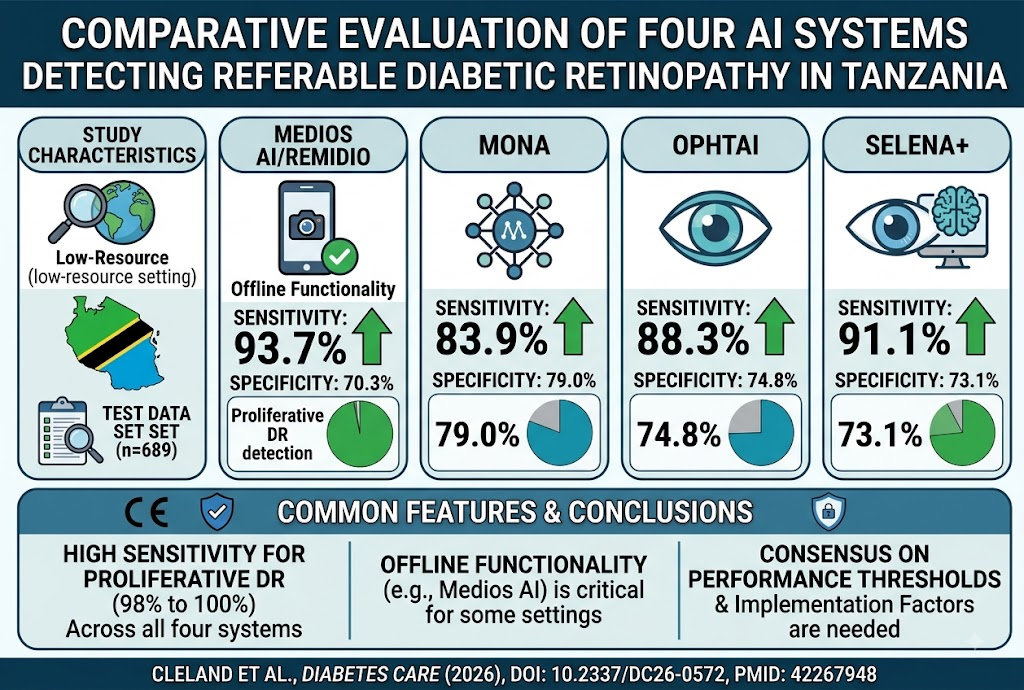
This head-to-head comparative study evaluated four commercial artificial intelligence (AI) systems—Medios AI/Remidio, MONA, Ophtai, and SELENA+—for diabetic retinopathy (DR) detection in a Tanzanian population, revealing sensitivities of 83.9% to 93.7% for referable DR and over 98% for proliferative DR. All systems had regulatory approval, with one capable of offline use. These findings support AI’s role in expanding DR screening access in low-resource settings.
Study Background
Diabetic retinopathy (DR) is a leading cause of visual impairment worldwide, disproportionately affecting populations in low- and middle-income countries where screening infrastructure is limited. Early identification of referable DR, including proliferative forms requiring timely intervention, is critical in preventing vision loss. Artificial intelligence (AI) tools have emerged as promising adjuncts to increase the reach and efficiency of DR screening programs. However, comparative evaluations of commercially available AI systems in underserved populations, particularly studies disclosing system identities, are scarce. This hinders informed procurement and deployment decisions essential for effective public health interventions in low-resource contexts such as Tanzania.
Study Design
This study employed a scoping review combined with expert consultations to select four commercially available AI systems that were potentially suitable for DR screening implementation in Tanzania. The developers of Medios AI/Remidio, MONA, Ophtai, and SELENA+ agreed to participate. Retinal images were prospectively collected from a Tanzanian diabetic population enrolled in a DR screening program. The reference standard was expert human grading of retinal images for DR severity, focusing on the detection of referable DR (defined by presence of moderate nonproliferative DR or worse, including proliferative DR). Primary outcomes included sensitivity and specificity for detecting referable DR. Secondary assessments included sensitivity for proliferative DR detection, regulatory status, referral thresholds, and operational features important for implementation such as online versus offline functionality.
Key Findings
A total of 689 individuals were included in the evaluation cohort; among them, 379 (55.0%) had referable DR and 93 (13.5%) had proliferative DR, reflecting a substantial disease burden. The four AI systems demonstrated high sensitivity for referable DR detection, ranging from 83.9% (lowest) to 93.7% (highest). Specificity ranged between 70.3% and 79.0%, indicating a trade-off between identifying true disease cases and false positives. Notably, all four AI systems exhibited excellent sensitivity exceeding 98% for proliferative DR, underscoring their potential in detecting the most vision-threatening cases requiring urgent referral.
All evaluated systems were marked as Conformité Européenne (CE) medical devices, ensuring compliance with European regulatory standards, a key consideration for procurement confidence. Among these, Medios AI/Remidio uniquely supported offline operation, an important feature for settings with limited internet connectivity. Referral thresholds and integration capabilities varied, highlighting implementation nuances beyond diagnostic accuracy.
Expert Commentary
This study addresses a critical gap by providing a transparent and direct comparison of multiple commercially available AI systems for DR screening in a real-world, resource-limited African setting. The robust sensitivity for referable and proliferative DR suggests that these tools can significantly extend screening capacity beyond clinical eye specialists, potentially reducing the diabetes-related visual impairment burden. However, specificity below 80% may lead to substantial false-positive rates, which could strain referral pathways if not managed appropriately.
Implementation considerations, including regulatory approval and offline functionality, are crucial – especially in low-income regions with infrastructure challenges. The offline capability of Medios AI/Remidio exemplifies adaptability to such environments. Nevertheless, further impact studies assessing patient outcomes, cost-effectiveness, and integration into health systems are warranted. Consensus on minimal acceptable performance criteria for AI tools in varied contexts remains a priority to ensure safe and equitable deployment. Attention must also be paid to training and support for local healthcare workers using these systems.
Conclusion
This head-to-head evaluation highlights that multiple CE-marked commercial AI systems demonstrate strong diagnostic performance for detecting referable and proliferative diabetic retinopathy in a Tanzanian screening cohort. Their deployment could aid in scaling DR screening programs in low-resource settings, contributing to early detection and timely treatment to prevent blindness. Future work should focus on establishing implementation guidelines, performance standards, and comprehensive real-world assessments to optimize clinical impact and cost-efficiency.
Funding and ClinicalTrials.gov
The original study does not specify funding sources or clinical trial registration details. Future publications or supplementary materials might provide this information.
Reference:
Cleland CR, Bascaran C, Makupa WU, Shilio B, Tufail A, Egan C, Fajtl J, Olvera-Barrios A, Rudnicka AR, Owen CG, Wallis C, Cartwright E, Bastawrous A, Macleod D, Burton MJ. Head-to-Head Comparative Evaluation of Four Commercially Available Artificial Intelligence Systems for Detecting Referable Diabetic Retinopathy in a Tanzanian Population. Diabetes Care. 2026 Aug 1;49(8):1451-1457. doi: 10.2337/dc26-0572. PMID: 42267948.