Highlights
- Plasma phosphorylated tau 217 (p-tau217) is a validated blood-based biomarker for early Alzheimer disease (AD) pathology, strongly predictive of progression from cognitively unimpaired (CU) status to mild cognitive impairment (MCI) and dementia.
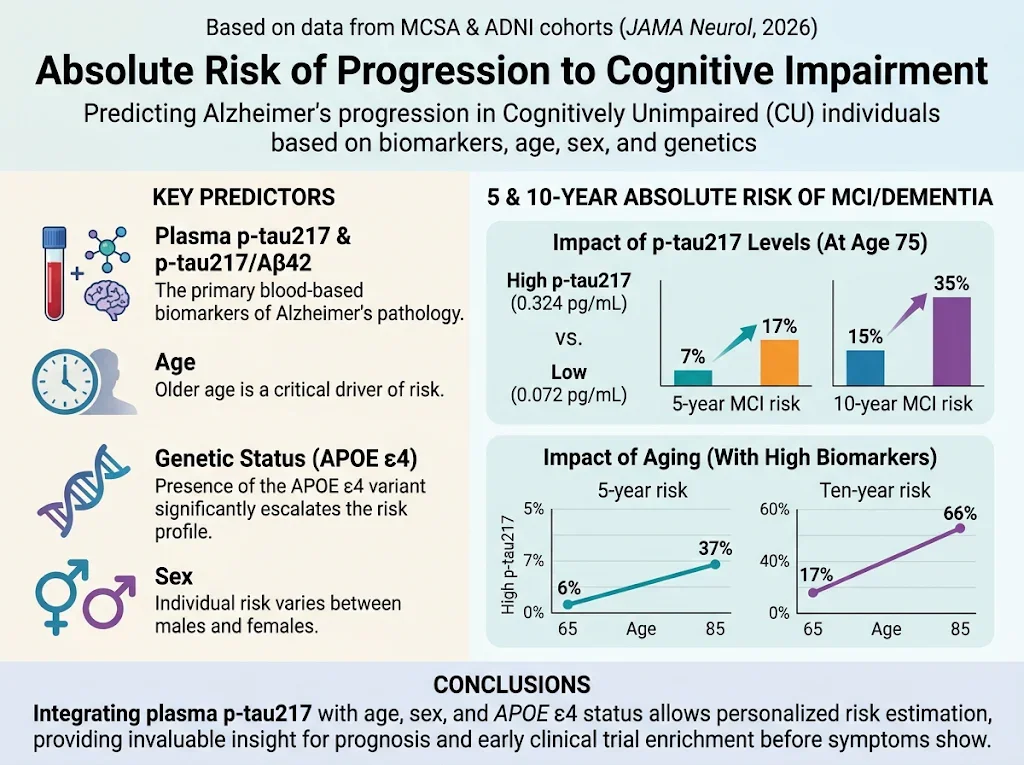
- Integration of plasma p-tau217 concentrations with age, sex, and APOE ε4 genotype allows individualized absolute risk estimates of cognitive decline over 5- and 10-year horizons, facilitating prognosis and clinical trial enrichment.
- Longitudinal analyses reveal APOE ε4 carriers have steeper p-tau217 trajectories, and higher baseline p-tau217 is associated with faster cognitive decline and brain atrophy across diverse ethnic populations.
- Multimodal biomarker strategies, combining plasma p-tau217 with amyloid beta (Aβ) ratios and neuroimaging features, enhance detection and staging accuracy of AD pathology, providing robust risk stratification tools.
Background
Alzheimer disease (AD) remains a leading cause of dementia worldwide, with pathogenesis beginning decades prior to symptom onset. Detection of pathological hallmarks—amyloid plaques and tau neurofibrillary tangles—through biomarkers is pivotal for early diagnosis, prognostication, and therapeutic intervention planning. Plasma phosphorylated tau at threonine 217 (p-tau217) has emerged as a sensitive and specific blood biomarker reflecting AD-related tau pathology and amyloid burden. Despite advances in detecting biomarker positivity in asymptomatic individuals, prognostic heterogeneity persists—some biomarker-positive, cognitively unimpaired individuals remain stable for years, while others progress rapidly. The apolipoprotein E epsilon 4 (APOE ε4) allele is the most significant genetic risk factor for late-onset AD, modulating biomarker kinetics and clinical progression. Epidemiologically, age and sex also influence disease risk, yet precise integration of these variables for individualized absolute risk estimation remains an unmet need.Key Content
Absolute Risk Estimation Using Plasma p-tau217, Age, Sex, and APOE ε4
The recent large-scale cohort study by Algeciras-Schimnich et al. (JAMA Neurol, 2026) analyzed 1644 participants from the Mayo Clinic Study of Aging (MCSA) and 534 from the Alzheimer’s Disease Neuroimaging Initiative (ADNI), all cognitively unimpaired aged 60–90 years. Using continuous-time multistate models, they demonstrated that higher plasma p-tau217 levels (e.g., 0.324 pg/mL at the 90th percentile) conferred approximately 2.6 to 4.0-fold increased hazard of progression to MCI or dementia across sex and APOE ε4 strata compared to the 10th percentile (0.072 pg/mL). Effect sizes were consistent across both cohorts, reinforcing robustness. Adjusted for mean sex and APOE ε4 prevalence, 5-year absolute risk of MCI at age 75 years doubled from 7% to 17% comparing low versus high p-tau217. Extending to 10 years, risk increased from 15% to 35%. Risk markedly escalated with advancing age from 65 to 85 years; at high p-tau217 concentrations, 10-year risk reached 66%. Similar risk patterns were observed for the p-tau217/Aβ42 ratio, underscoring the complementary value of amyloid status.Complementary Evidence Supporting Plasma p-tau217 Prognostic Utility
A pooled analysis of 7 multi-ethnic cohorts (Lancet Neurol, 2026) comprising over 8500 participants validated that baseline plasma p-tau217 predicted incident cognitive impairment, with hazard ratios amplified in APOE ε4 carriers. Each standard deviation increase in p-tau217 associated with approximately 41% higher risk, and APOE ε4 carriers experienced faster transition to symptoms. Temporal separation of biomarker elevation and symptom onset (~3–4 years) highlights the preclinical window. Longitudinal ADNI analyses revealed that APOE ε4 allele accelerates plasma p-tau217 trajectory independently of amyloid burden, with plasma p-tau217 slope correlating strongly with cognitive decline and hippocampal atrophy. This indicates APOE’s direct influence on tau pathology kinetics. Additional longitudinal cohort data show elevated p-tau217 predicts not only risk but also rates of cognitive decline across domains, modulated by sex and APOE status. For instance, APOE ε4 carriers demonstrate more rapid decline associated with higher p-tau217, informing risk stratification nuances.Integration of Plasma Biomarkers and Neuroimaging for Risk Stratification
Multiprotein plasma panels incorporating p-tau217 alongside other proteins (e.g., neurofilament light chain, glial fibrillary acidic protein) enhance accuracy in identifying advanced tau pathology, potentially surpassing p-tau217 alone. Combining plasma biomarkers with MRI volumetrics (hippocampal and amygdalar volumes) and APOE status yields machine learning models with area under the curve (AUC) >0.87 for amyloid-β positivity prediction and strong prognostic discrimination in mild cognitive impairment (MCI) cohorts. These multimodal approaches promise practical, non-invasive screening and monitoring tools to tailor individualized prognosis and optimize clinical trial cohort selection.Influence of Other Factors on Plasma p-tau217 and Risk of Cognitive Impairment
Age is a significant driver of rising p-tau217 levels and associated risk. Sex differences are apparent but complex; some studies suggest females have distinct biomarker trajectories or risk profiles. Menopause timing may modulate APOE ε4-related AD susceptibility mediated through hormonal changes impacting tau accumulation. Physical activity and systemic inflammation may influence plasma biomarker levels but require further investigation. Anxiety phenotypes have been linked to p-tau181 but not consistently to p-tau217, highlighting specificity of tau species in neuropathological correlates.Expert Commentary
The convergence of evidence establishes plasma p-tau217 as a sensitive and specific biomarker with potent prognostic capabilities in preclinical and early AD stages. Its incorporation with critical variables like age, sex, and APOE ε4 genotype refines absolute risk estimations, enabling personalized medicine paradigms. The major strengths include large, diverse cohorts with longitudinal follow-up and harmonized biomarker assays enhancing generalizability. However, limitations remain—most cohorts are predominantly of European ancestry; hence, validation in more diverse populations is imperative. Also, while plasma biomarkers enable scalable screening, their clinical implementation requires standardization, harmonization of assays, and clear interpretation frameworks. The reported statistical models based on continuous biomarker values and genetic factors provide granular risk stratification superior to categorical cutoffs, supporting nuanced clinical decisions. Additionally, the robust correlation of p-tau217 trajectories with cognitive decline endorses its potential as a surrogate endpoint in therapeutic trials. Emerging multiprotein plasma panels and machine learning integration with MRI further elevate prognostic precision, suggesting a move toward comprehensive biomarker-based staging beyond single analytes. Future investigations should explore mechanisms underlying APOE ε4’s direct impact on tau kinetics and the interaction of modifiable factors (e.g., sleep, physical activity) with biomarker trajectories and clinical progression. Moreover, longitudinal intervention studies are needed to evaluate if modifying plasma p-tau217 levels translates to clinical benefit.Conclusion
Recent advances firmly establish plasma phosphorylated tau 217 as a transformative biomarker for estimating absolute risk of progression from cognitive unimpaired states to MCI and dementia. The synergistic use of p-tau217 concentrations with age, sex, and APOE ε4 genotype enables individualized, time-defined risk estimates crucial for prognosis, clinical monitoring, and enrichment of clinical trials in preclinical AD. Continued research should focus on expanding validation across diverse populations, refining multiprotein biomarker panels, and integrating multimodal data for improved risk prediction. Standardization and accessibility of plasma p-tau217 assays promise to democratize AD biomarkers, enabling early and accurate identification of at-risk individuals and personalized therapeutic strategies.References
- Algeciras-Schimnich A, Hu M, Weigand SD, et al; Alzheimer’s Disease Neuroimaging Initiative. Absolute Risk of Progression to Cognitive Impairment Based on Plasma Phosphorylated Tau 217, Age, Sex, and APOE ε4. JAMA Neurol. 2026 Nov 16; PMID: 43037989.
- Morris JC, Rajan KB, Rodriquez Laing AM, et al. Plasma phosphorylated tau 217 concentrations, APOE genotype, and timing of cognitive impairment. Lancet Neurol. 2026 Nov;25(11):1010-1024. PMID: 42716078. <liMayeli M, Ossenkoppele R, Buckley RFL, et al. APOE ε4 accelerates plasma p-tau217 trajectory and correlates with cognition and imaging in ADNI. Neurol Sci. 2026 Oct 23;47(11):883. PMID: 42909513.
- Janelidze S, Stomrud E, Smith R, et al. Plasma Biomarkers for Neocortical Tau Burden. JAMA Neurol. 2026 Oct;83(10):990-1001. PMID: 42573994.
- Jack CR Jr, Bennett DA, Blennow K, et al. NIA-AA Research Framework: Toward a biological definition of Alzheimer’s disease. Alzheimers Dement. 2018;14(4):535-562. (for biomarker context)
Specialty calculators
For clinical reference; use professional judgment.