Highlight
• Most first-time mothers undergoing assisted reproductive technology (ART) experience uncomplicated singleton pregnancies after fresh or frozen embryo transfers.
• Compared with natural conception, pregnancies after ART show a small but notable increase in single and multiple maternal and perinatal complications.
• The vast majority of neonates survive beyond 28 days regardless of conception method, underscoring reassuring neonatal outcomes post-ART.
• These findings provide evidence to guide counselling and set realistic expectations for couples undergoing ART.
Study Background
Assisted reproductive technology (ART) has transformed the management of infertility over recent decades. Among ART modalities, fresh embryo transfer (fresh-ET) and frozen-thawed embryo transfer (frozen-ET) are commonly used to establish pregnancies. Despite its benefits, ART has been associated with altered maternal and perinatal risks compared with natural conception (NC). These complications include hypertensive disorders, preterm birth, abnormal fetal growth patterns, and placental abnormalities.
While prior studies have examined individual adverse outcomes after ART, the clustering of multiple complications within pregnancies remains underexplored. Understanding the frequency and spectrum of single versus multiple maternal and perinatal complications following ART is crucial for informing pre-treatment counselling, optimizing prenatal management, and setting realistic expectations for prospective parents. This study conducted a comprehensive population-based cohort analysis in three Nordic countries to address these knowledge gaps.
Study Design
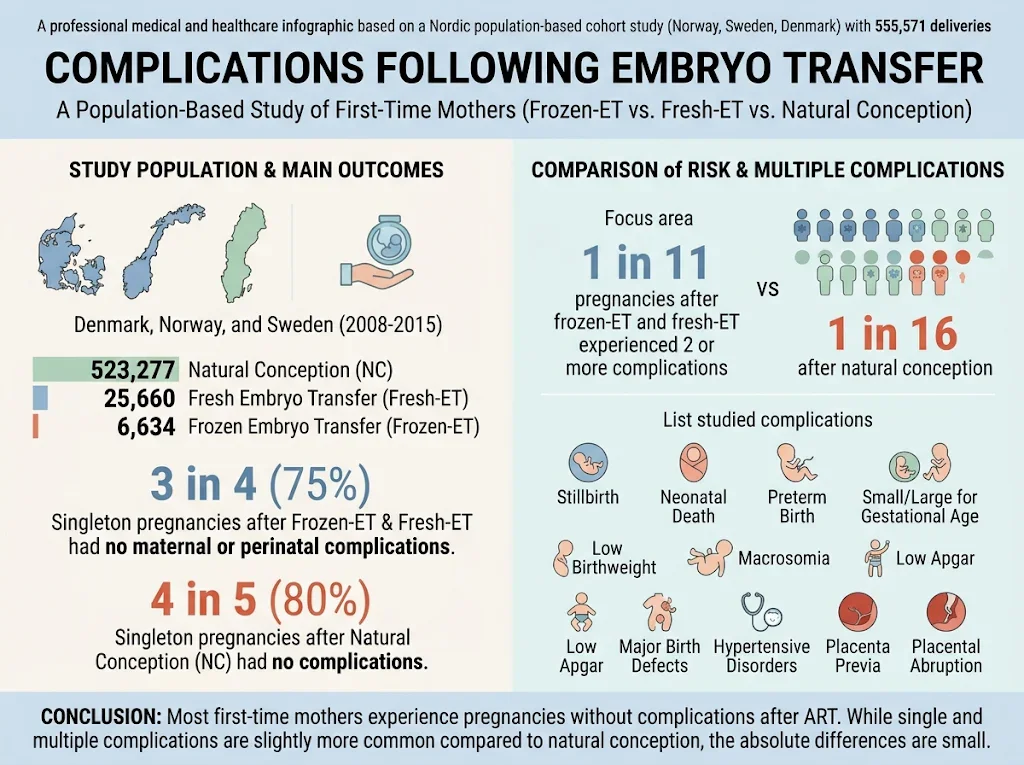
This was a population-based cohort study utilizing nationwide registry data from Denmark (2008-2014), Norway (2008-2015), and Sweden (2008-2015). The analysis was restricted to singleton pregnancies among first-time mothers to reduce confounding by parity and multiple births.
The cohorts included 6,634 deliveries after frozen-ET, 25,660 after fresh-ET, and 523,277 after NC. Outcomes assessed reflected both maternal and perinatal complications:
- Stillbirth
- Neonatal death (within 0–27 days after delivery)
- Preterm birth (gestational age <37 weeks)
- Small for gestational age (SGA) and large for gestational age (LGA)—defined as birthweight deviations >22% below or above expected according to sex and gestational age
- Low birthweight (<2500 g) and macrosomia (≥4500 g)
- Apgar score <5 at 5 minutes
- Major birth defects
- Hypertensive disorders in pregnancy
- Placenta previa
- Placental abruption
The primary comparisons were the frequency of pregnancies with no complications, single complications, and multiple complications across the three groups.
Key Findings
The study revealed that approximately 75% of singleton pregnancies after frozen-ET and fresh-ET occurred without any maternal or perinatal complications. This compares with about 80% of such pregnancies following natural conception, indicating a modestly lower rate of complication-free pregnancies in ART cohorts.
Among pregnancies with neonatal survival beyond 28 days—a high percentage across all groups (99.3% after frozen-ET, 99.3% after fresh-ET, 99.5% after NC)—the occurrence of two or more complications was more frequent after ART. Specifically, multiple complications affected 1 in 11 pregnancies following assisted conception (both frozen and fresh-ET) versus 1 in 16 pregnancies after natural conception.
Notably, when complications occurred following ART, they were usually isolated rather than clustered with others. The absolute differences in rates of single and multiple complications between ART and NC groups were small, underscoring the relatively favorable risk profile of ART pregnancies despite some increased risks.
The detailed distribution of specific complications was not fully delineated in the abstract; however, the inclusion of placental disorders, birthweight abnormalities, and hypertensive disorders highlights the multifactorial nature of risks associated with ART pregnancies.
Expert Commentary
This large, population-based cohort study provides robust epidemiological evidence clarifying the burden of maternal and perinatal complications in first-time mothers following different modes of conception. The inclusion of data from national registries in Denmark, Norway, and Sweden ensures high data quality and broad generalizability to similar populations in high-resource settings.
The findings align with existing literature showing elevated risks of certain adverse outcomes after ART but importantly contextualize these within an overall pattern where most pregnancies remain uncomplicated. This nuanced understanding is critical for balanced patient counselling.
Potential limitations include some residual confounding by unmeasured factors such as underlying infertility diagnosis, maternal lifestyle, and socioeconomic status. Also, the study did not explore outcomes beyond the neonatal period or long-term child health impacts.
Biological plausibility for increased complication clustering following ART may relate to altered placentation, epigenetic modifications, or selection biases inherent in ART-treated populations. Further mechanistic research may clarify causal pathways.
Conclusion
This well-conducted Nordic population-based cohort study shows that the majority of first-time mothers undergoing ART experience singleton pregnancies free of maternal and perinatal complications, with only a modest increase in single or multiple complications compared to natural conception. These reassuring data support informed shared decision-making and emphasize that while vigilance in monitoring ART pregnancies is warranted, the absolute risk differences are small.
Future research should examine underlying mechanisms for increased complications post-ART and extend follow-up to capture long-term offspring health outcomes. Clinicians can utilize these findings to counsel patients realistically, optimizing prenatal care and alleviating undue anxiety about ART-associated risks.
Funding and Trial Registration
The original study does not specify funding sources or clinical trial registration details in the abstract.
References
Landsverk E, Opdahl S, Bergh C, Wennerholm UB, Rasmussen S, Vassard D, Pinborg A, Rönö K, Gissler M, Westvik-Johari K. Clustering of Maternal and Perinatal Complications Following Fresh and Frozen Embryo Transfer in First-Time Mothers: A Population-Based Cohort Study. BJOG. 2026 Nov 16. PMID: 43040833.
Specialty calculators
For clinical reference; use professional judgment.