Highlight
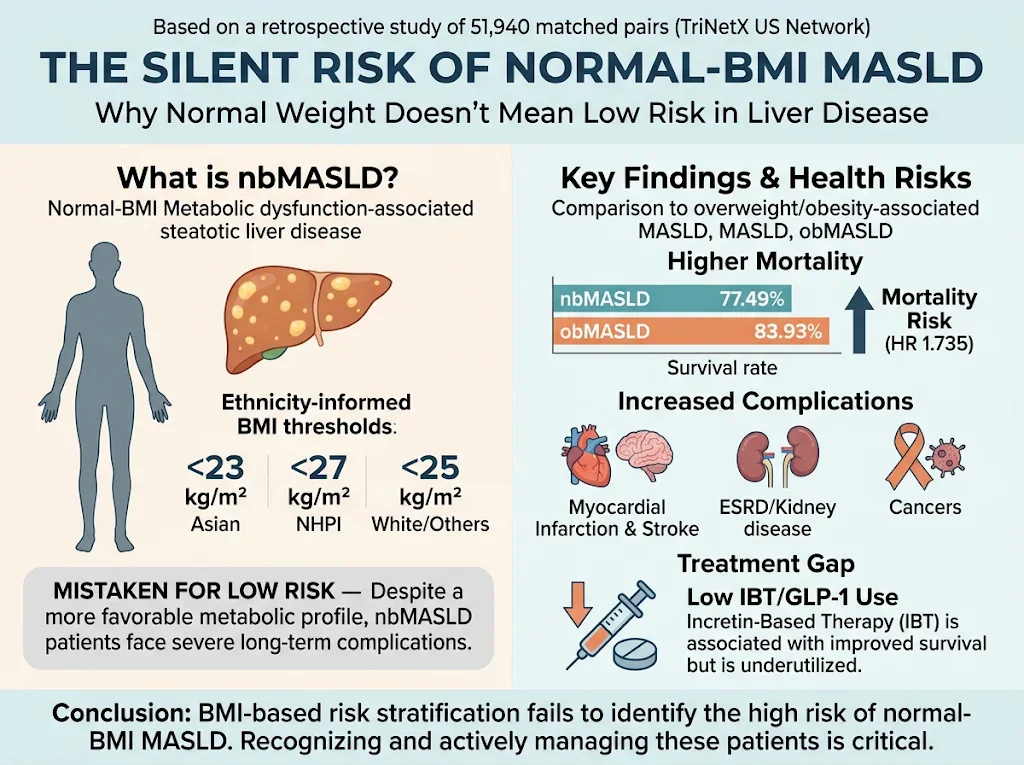
- Normal-BMI metabolic dysfunction-associated steatotic liver disease (nbMASLD) carries significantly higher all-cause mortality than MASLD with overweight or obesity (obMASLD).
- NbMASLD patients experience increased cardiovascular events, including myocardial infarction and stroke, with ethnicity-specific risks notably higher in White and Black populations.
- Increased incidence of certain cancers such as colorectal, pancreatic, and multiple myeloma occurs particularly in Whites with nbMASLD.
- Incretin-based therapy (IBT) use is markedly lower in nbMASLD despite its association with improved survival, indicating an important treatment gap.
Study Background
Metabolic dysfunction-associated steatotic liver disease (MASLD) has emerged as a major public health problem linked to metabolic syndrome and insulin resistance, traditionally associated with overweight or obesity. However, growing evidence shows MASLD can develop in individuals within a normal body mass index (BMI) range, often termed normal-BMI MASLD (nbMASLD). The disease burden and clinical outcomes in these patients remain poorly understood, especially across diverse ethnic populations with different BMI thresholds for metabolic risk. Moreover, therapeutic approaches such as incretin-based therapies (IBTs), including glucagon-like peptide-1 receptor agonists (GLP-1 RAs), are widely studied in obese MASLD but their utilization and benefits in nbMASLD are not well characterized. This study addresses a critical unmet need by examining long-term mortality, cardiovascular events, cancer risks, and treatment patterns in nbMASLD versus obesity-associated MASLD (obMASLD) across ethnic groups.
Study Design
This retrospective, observational study utilized the TriNetX United States Network electronic health record database, encompassing data from 2005 to 2025. Adult patients diagnosed with MASLD or metabolic dysfunction-associated steatohepatitis (MASH) were included. The study applied ethnicity-informed BMI cutoffs to define normal BMI: <23 kg/m2 for Asians, <27 kg/m2 for Native Hawaiian and Pacific Islanders, and <25 kg/m2 for Whites/others. Patients with obesity or overweight BMI above these thresholds were classified as obMASLD. Propensity-score matching balanced demographic and clinical covariates between the groups to reduce confounding. Endpoints included all-cause mortality, major cardiovascular outcomes (myocardial infarction, stroke), end-stage renal disease (ESRD), cancer incidence (colorectal, pancreatic, multiple myeloma), and use of incretin-based therapies. Time-to-event analyses employed Kaplan-Meier curves and Cox proportional hazards models using obMASLD as the reference group.
Key Findings
The analysis included 619,171 eligible patients, yielding 51,940 matched pairs of nbMASLD and obMASLD subjects. Overall, nbMASLD was associated with significantly higher all-cause mortality across combined ethnic groups—77.49% survival versus 83.93% in obMASLD (hazard ratio [HR] 1.735; 95% confidence interval [CI], 1.653-1.822).
Cardiovascular risks varied by ethnicity. White and Black nbMASLD patients exhibited a higher hazard of myocardial infarction, with White patients also displaying increased stroke risk. Black patients had a notably elevated risk of ESRD under nbMASLD status. Cancer risks focusing on colorectal, pancreatic, and multiple myeloma were significantly increased predominantly among White nbMASLD patients.
Despite worse outcomes, use of incretin-based therapy (IBT), including GLP-1 receptor agonists, was conspicuously lower in the nbMASLD group compared to obMASLD. Importantly, IBT use correlated with improved survival outcomes, indicating its potential benefit in this population.
Data Table: Summary of Major Outcomes and IBT Use in nbMASLD Versus obMASLD
| Outcome | Ethnic Group | nbMASLD HR (95% CI) | Direction of Risk | IBT Use |
|---|---|---|---|---|
| All-cause mortality | Combined | 1.735 (1.653-1.822) | Higher in nbMASLD | Lower in nbMASLD |
| Myocardial infarction | White, Black | Increased (Exact HR not specified) | Higher in nbMASLD | Lower |
| Stroke | White | Increased | Higher in nbMASLD | Lower |
| ESRD | Black | Increased | Higher in nbMASLD | Lower |
| Cancers (colorectal, pancreatic, multiple myeloma) | White | Increased | Higher in nbMASLD | Lower |
Expert Commentary
This large-scale analysis challenges the conventional notion that MASLD is predominantly a problem of obesity. The substantially increased mortality and cardiovascular and oncologic complications in nbMASLD despite a more metabolically favorable profile suggest hidden pathophysiological mechanisms beyond BMI. Ethnic-specific risk stratification underscores the need for personalized medical approaches.
Critically, the low utilization of GLP-1 receptor agonists and other IBTs in the normal-BMI group represents a significant therapeutic gap. These agents, established for improving insulin sensitivity and reducing liver fat, may offer survival benefits beyond their glycemic effects and should be considered in nbMASLD management paradigms.
Limitations include retrospective design and potential residual confounding despite propensity matching. BMI thresholds, although ethnicity-informed, remain imperfect surrogates for metabolic health. Future prospective studies should explore mechanistic underpinnings, optimal risk stratification tools, and tailored pharmacotherapy for nbMASLD.
Conclusion
Normal-BMI MASLD is a clinically significant phenotype associated with higher mortality, greater cardiovascular and cancer burden, and underutilization of effective incretin-based therapies compared to obesity-associated MASLD. Current BMI-based screening and risk assessment approaches inadequately capture this high-risk population. Enhanced awareness, ethnicity-sensitive diagnostic criteria, and expanded therapeutic considerations including GLP-1 receptor agonists are urgently needed to address this unmet clinical challenge.
Funding and Clinical Trials
The study by Casimiro et al. was retrospective and did not report dedicated funding sources or clinical trial registrations.
References
- Casimiro I, Agawa A, Tacata RHN, Lim E, Kuwada SK. Normal-BMI MASLD is Associated with Increased Mortality, Cardiovascular Events, Cancer and Lower GLP-1 Use. J Clin Endocrinol Metab. 2026 Oct 28. PMID: 42947552.
- Chalasani N, Younossi Z, Lavine JE, et al. The diagnosis and management of nonalcoholic fatty liver disease: Practice guidance from the American Association for the Study of Liver Diseases. Hepatology. 2018;67(1):328-357.
- Sanyal AJ, Friedman SL, McCullough AJ, Dimick-Santos L. Challenges and opportunities in NAFLD: A clinical and translational overview. Hepatology. 2021;73(Suppl 1):15-29.
- Kakara M, Fung T, Hirsch M. Efficacy of GLP-1 receptor agonists in the management of nonalcoholic fatty liver disease. Endocrinology and Metabolism Clinics of North America. 2022;51(4):689-703.
- WHO Expert Consultation. Appropriate body-mass index for Asian populations and its implications for policy and intervention strategies. Lancet. 2004;363(9403):157-163.
Specialty calculators
For clinical reference; use professional judgment.