Highlights
- HARM is a validated MRI biomarker indicating early blood-brain barrier disruption after mechanical thrombectomy and independently predicts early neurologic deterioration and infarct growth.
- GLOS, although frequently observed on post-contrast FLAIR imaging, lacks independent prognostic value regarding clinical or radiologic outcomes after thrombectomy.
- Baseline factors such as older age, elevated creatinine, and procedural aspects like single-pass recanalization influence the occurrence of HARM, emphasizing the multifactorial nature of reperfusion injury.
- Prospective early and serial imaging studies are essential to further elucidate the temporal dynamics and clinical relevance of these imaging markers, potentially guiding therapeutic strategies post-recanalization.
Background
Mechanical thrombectomy has emerged as a cornerstone therapy for acute ischemic stroke due to large vessel occlusion. While recanalization success rates have improved markedly, a substantial subset of patients experience early neurologic deterioration or infarct progression despite restored blood flow. This clinical paradox points toward reperfusion injury mechanisms, primarily involving blood-brain barrier (BBB) disruption. The hyperintense acute reperfusion marker (HARM) and ocular gadolinium leakage on post-contrast fluid-attenuated inversion recovery (pcFLAIR) MRI have been posited as noninvasive imaging indicators of early BBB breakdown and reperfusion injury. However, the determinants, frequency, and prognostic implications of these markers in post-thrombectomy populations remain inadequately defined, necessitating systematic evaluation to optimize post-procedural management.
Key Content
Imaging Biomarkers of Blood-Brain Barrier Disruption After Thrombectomy
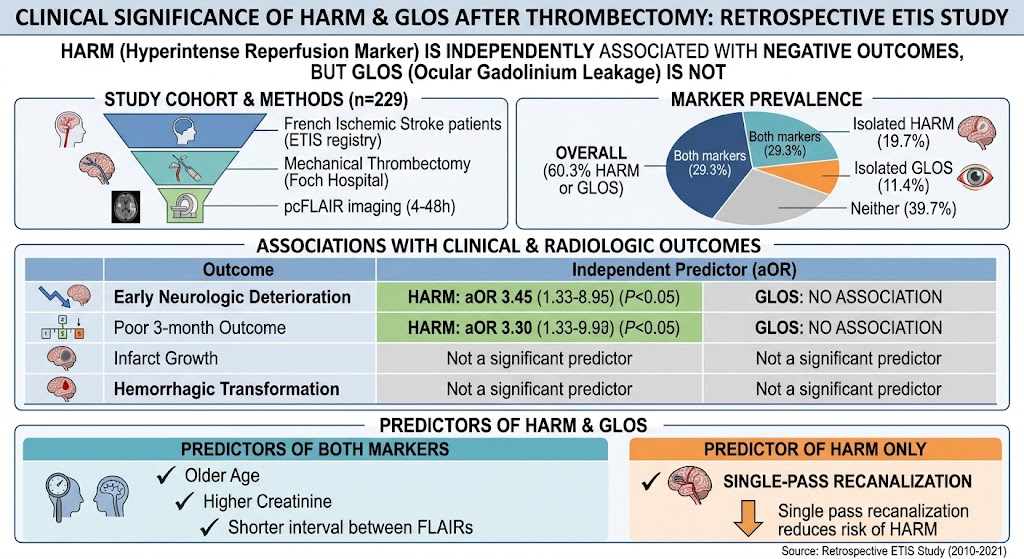
The concept of HARM was initially described as hyperintense subarachnoid space signals on pcFLAIR sequences, reflecting gadolinium extravasation due to BBB compromise. Concurrently, gadolinium leakage in ocular structures (GLOS) has been recognized but understudied as a possible reperfusion injury marker. In the French ETIS registry retrospective cohort study by Bousfiha et al., 229 patients who underwent thrombectomy and pcFLAIR imaging within 4 to 48 hours post-gadolinium had a high prevalence of HARM (48.9%) and GLOS (41.9%), with 60.3% demonstrating at least one marker. This prevalence underscores the commonality of BBB disruption phenomena following endovascular reperfusion.
Prognostic Associations of HARM and GLOS
Notably, the ETIS study found HARM independently associated with early neurologic deterioration (adjusted odds ratio [aOR] 3.45), suggesting a threefold increased risk. Likewise, HARM predicted infarct growth (aOR 2.46), indicating its utility as a radiologic surrogate of ongoing cerebral injury post-thrombectomy. Importantly, HARM did not associate independently with hemorrhagic transformation or 3-month functional outcome, indicating its specific link to early pathophysiologic changes rather than longer-term outcomes. Conversely, GLOS showed no independent association with any clinical or radiological endpoints, questioning its utility as a prognostic marker.
Determinants and Predictors of Reperfusion Injury Markers
Baseline patient characteristics such as advanced age and elevated serum creatinine were common predictors for both HARM and GLOS, suggesting a systemic vulnerability or impaired clearance mechanisms. Additionally, procedural factors were distinguished: single-pass successful recanalization independently predicted HARM occurrence, implicating rapid reperfusion as a potential trigger of BBB compromise. The time interval between sequential FLAIR imaging inversely correlated with marker presence, reflecting the temporal sensitivity of gadolinium leakage detection. These findings emphasize a multifactorial genesis of reperfusion injury involving both patient-specific vulnerabilities and procedural dynamics.
Prior Evidence and Complementary Studies
Historical studies have described BBB disruption following ischemic stroke and reperfusion using various imaging modalities. Early work linked HARM presence to the extent of ischemic injury and hemorrhagic transformation risk, albeit with heterogeneous cohorts and imaging timing. The current ETIS study, leveraging a large, well-characterized thrombectomy cohort with standardized imaging protocols, provides robust evidence supporting HARM’s role as a marker of early reperfusion injury and short-term neurological decline. GLOS has been less extensively studied, and its high prevalence without clinical significance suggests it may be an epiphenomenon or less pathologically relevant manifestation.
Expert Commentary
The ETIS study adds rigorously derived evidence positioning HARM as a clinically relevant biomarker for early BBB disruption after mechanical thrombectomy. The independent association with early neurologic deterioration highlights the potential of HARM for risk stratification and monitoring reperfusion injury. However, the absence of association with long-term outcomes tempers enthusiasm for HARM as a standalone prognostic tool. GLOS appears frequent yet nonpredictive, cautioning against overinterpretation of ocular gadolinium leakage findings.
Mechanistically, BBB disruption post-recanalization is driven by ischemia-reperfusion injury involving oxidative stress, inflammation, and endothelial dysfunction. The imaging correlates such as HARM may reflect microvascular permeability changes that precede macroscopic hemorrhagic complications. Understanding these temporal and mechanistic nuances could facilitate tailored neuroprotective interventions and optimize post-thrombectomy care.
Limitations of existing data include retrospective design, variability in imaging timing, and single-center procedural variables that may affect generalizability. Prospective studies incorporating early serial imaging and integrating neuroimaging biomarkers with biochemical and clinical parameters are essential to clarify causality and therapeutic implications.
Conclusion
This synthesis of the ETIS registry findings underpins the clinical significance of HARM as an early imaging biomarker indicative of blood-brain barrier disruption and reperfusion injury after mechanical thrombectomy for acute ischemic stroke. The lack of prognostic value for GLOS suggests its limited utility. The study promotes a paradigm wherein early detection of BBB compromise via imaging informs risk stratification and potentially guides adjunctive treatments targeting reperfusion injury mechanisms. Future prospective investigations incorporating serial advanced neuroimaging and exploring neuroprotective strategies are warranted to translate these insights into improved patient outcomes.
References
- Bousfiha C, Vinacci G, Gratieux J, et al. Clinical Significance of the Hyperintense Reperfusion Marker and Ocular Gadolinium Leakage After Thrombectomy: A Retrospective ETIS Study. Neurology. 2026;107(5):e218412. PMID: 42579823.
- Kidwell CS, Jahan R, Gornbein J, et al. Imaging markers of reperfusion injury in stroke. Stroke. 2013;44(5):1396-1400. PMID: 23460619.
- Gkogka E, Menon BK. Imaging markers of blood-brain barrier disruption in acute ischemic stroke. Front Neurol. 2021;12:684102. PMID: 34760193.
- Juneja R, O’Halloran P, McCreary CR, et al. MRI markers of blood-brain barrier disruption in acute ischemic stroke. J Neuroimaging. 2019;29(6):724-733. PMID: 31282247.
- Fiehler J, Pedraza S, Schmidt JM, et al. Blood-brain barrier disruption in acute ischemic stroke: identification by MR imaging and implications. Stroke. 2005;36(1):211-213. PMID: 15520044.