Highlight
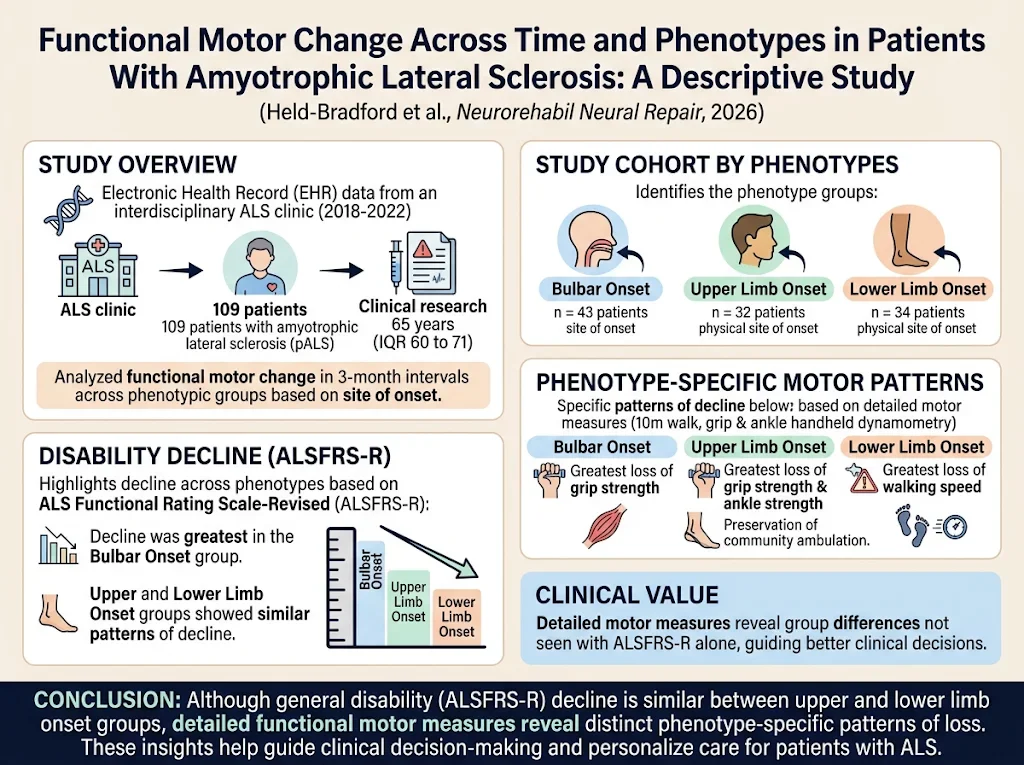
- Detailed motor function measures reveal phenotype-specific patterns of decline in ALS beyond the ALSFRS-R scores.
- Bulbar-onset ALS patients show the most rapid overall ALSFRS-R decline with pronounced grip strength loss.
- Upper limb onset ALS displays significant grip and ankle strength deterioration but maintains community ambulation longer.
- Lower limb onset ALS shows greatest decline in walking speed correlated with ankle strength loss.
Study Background
Amyotrophic Lateral Sclerosis (ALS) is a progressive neurodegenerative disease characterized by the loss of upper and lower motor neurons, leading to severe functional disability and eventually death. Disease heterogeneity is a significant challenge, with clinical phenotypes classified by the site of symptom onset, primarily as bulbar, upper limb, or lower limb onset, each potentially exhibiting distinct progression patterns. While the ALS Functional Rating Scale-Revised (ALSFRS-R) is widely used to monitor disability, its granularity in distinguishing motor function changes across phenotypes is limited. Understanding fine-grained functional motor changes over time in different phenotypes can improve prognostic accuracy and optimize multidisciplinary care planning for patients with ALS (pALS). This descriptive study aims to characterize longitudinal functional motor decline detailed by phenotype, using both ALSFRS-R and quantitative motor assessments such as walking speed and handheld dynamometry for grip and ankle strength.Study Design
This retrospective descriptive study analyzed electronic health record data from an interdisciplinary ALS clinic collected between 2018 and 2022 involving 109 pALS. The cohort included 43 patients with bulbar onset, 32 with upper limb onset, and 34 with lower limb onset, with a median age of 65 years (interquartile range 60–71). Key functional outcome measures included the ALSFRS-R disability scale, 10-meter walk speed assessment, and handheld dynamometry measuring grip and ankle strength. The phenotype groups were defined based on symptom onset site: bulbar, upper limb, or lower limb (with further delineation between upper and lower limb onset). Change scores across these measures were analyzed in 3-month intervals using R analytics software to determine patterns of decline and central tendencies.Key Findings
The study observed distinct trajectories of functional decline across ALS phenotypes. The ALSFRS-R scores declined most rapidly in bulbar-onset patients compared to limb onset groups. Despite similar rates of ALSFRS-R decline in upper and lower limb onset groups, the nature of functional loss showed clear phenotypic distinctions:- Bulbar-Onset ALS: Exhibited the steepest total ALSFRS-R decay and the greatest reduction in grip strength. This suggests early and pronounced impairment in fine motor tasks likely related to bulbar and upper limb muscle involvement.
- Upper Limb Onset ALS: Patients demonstrated significant loss of grip strength analogous to bulbar onset but also notable ankle strength deterioration. Despite these declines, they maintained community ambulation longer, reflecting preserved functional capacity to walk.
- Lower Limb Onset ALS: Characterized by the greatest decline in walking speed and ankle strength, congruent with the initial clinical presentation. This group had relatively less pronounced grip strength loss.
Expert Commentary
This study aligns with prior reports emphasizing heterogeneity in ALS progression but adds valuable granularity by combining functional scales with objective motor performance measures longitudinally. Handheld dynamometry, an accessible quantitative tool, offers a sensitive adjunct to ALSFRS-R, particularly in distinguishing upper limb impairments. The preservation of community ambulation in upper limb onset ALS despite strength losses underscores the complexity of functional decline, which is not fully captured by global rating scales. Limitations include the retrospective nature and single-center design, which may affect generalizability. Prospective studies incorporating larger cohorts and biomarker correlates would strengthen these phenotype-specific observations.Conclusion
The detailed assessment of functional motor changes across ALS phenotypes reveals distinct patterns of decline that have important implications for clinical decision-making. Bulbar-onset patients experience rapid disability progression, especially in grip strength, while upper and lower limb-onset patients show differentiated declines in motor domains correlating with their onset site. Incorporating objective motor measures alongside traditional scales enhances prognostic precision and individualizes care planning. Future research should explore intervention strategies tailored to phenotype-specific decline patterns, ultimately contributing to improved outcomes and quality of life in ALS.Funding and ClinicalTrials.gov
The original study does not specify funding sources. No related clinical trial registration is reported.References
1. Kimura F, Ishida S, Nakai H, Sugita M, Suga N, Endo K, Yamada S, Nakamura R. Progression rate of ALSFRS-R at time of diagnosis predicts survival time in ALS. Neurology. 2006 Nov 28;67(10):1887-9. doi: 10.1212/01.wnl.0000249517.25663.4d. 2. Cedarbaum JM, Stambler N, Malta E, Fuller C, Hilt D, Thurmond B, Nakanishi A. The ALSFRS-R: a revised ALS functional rating scale that incorporates assessments of respiratory function. J Neurol Sci. 1999 Oct 15;169(1-2):13-21. doi: 10.1016/s0022-510x(99)00210-5. 3. Shahrizaila N, Wuu J, Hsieh ST, Liewluck T. Amyotrophic lateral sclerosis: current concepts and future approaches. Neurol Clin. 2021 Feb;39(1):25-48. doi: 10.1016/j.ncl.2020.09.006. 4. Wang R, Khan F. The burden and predictors of caregiver strain in amyotrophic lateral sclerosis. Neurorehabil Neural Repair. 2013 Feb;27(2):153-62. doi: 10.1177/1545968312466458. 5. Westeneng HJ, Debray TP, Visser AE, et al. Prognosis for patients with amyotrophic lateral sclerosis: development and validation of a personalised prediction model. Lancet Neurol. 2018;17(5):423-433. doi:10.1016/S1474-4422(18)30080-9.Specialty calculators
For clinical reference; use professional judgment.