Highlight
– Emerging evidence challenges prior beliefs about cardioprotection from light-to-moderate alcohol consumption.
– Alcohol acts as a cardiovascular stressor with dose-, pattern-, and host-dependent effects, including hypertension, arrhythmias, cardiomyopathy, and stroke.
– Pathogenic mechanisms involve myocardial injury, autonomic disturbances, oxidative stress, and inter-organ crosstalk affecting endothelial and microvascular function.
– Cardiovascular ageing induced by alcohol encompasses mitochondrial dysfunction, inflammageing, epigenetic dysregulation, and ventriculo-arterial uncoupling.
Study Background
Cardiovascular disease (CVD) remains a leading cause of morbidity and mortality worldwide, with lifestyle factors like alcohol consumption critically shaping disease risk profiles. Until recently, observational data suggested that light-to-moderate alcohol intake might confer protective effects against coronary heart disease and all-cause mortality, contributing to public health messaging that endorsed low-level drinking for cardiovascular benefit. However, contemporary analyses employing Mendelian randomization, biomarker-sophisticated cohorts, and updated meta-analyses have cast substantive doubt on this paradigm. Despite continuing debate, especially at very low consumption levels and in select populations, the emerging consensus conceptualizes alcohol as a complex, dose-responsive cardiovascular toxin whose effects vary by exposure pattern and individual susceptibility.
Study Design
This comprehensive review synthesizes data from epidemiological cohort studies, genetic epidemiology (Mendelian randomization), mechanistic cellular and animal models, and system-level cardiovascular investigations published to date. It integrates findings on varied drinking patterns—including acute binge drinking, sustained heavy intake, episodic binge drinking superimposed on chronic use, and withdrawal phases—examining their unique and overlapping cardiovascular phenotypes. The framework incorporates inter-organ communication, autonomic and hemodynamic stressors, and vascular biology alterations, with emphasis on microvascular dysfunction and progressive cardiovascular ageing.
Key Findings
Reappraisal of Alcohol’s Cardiovascular Effects
Traditional observational studies indicated a J-shaped or U-shaped dose-response curve, where light-to-moderate alcohol use was associated with reduced coronary and overall mortality risk. However, these findings have been questioned due to residual confounding, selection bias, and reverse causality. Mendelian randomization studies leveraging genetic variants related to alcohol metabolism consistently show that even modest alcohol consumption may increase blood pressure and cardiovascular risk metrics. Updated biomarker-informed research further challenges the notion of cardioprotection at any exposure level, although some uncertainties persist for very low consumption and certain outcomes.
Diversified Cardiovascular Phenotypes Related to Alcohol Exposure Patterns
Distinct clinical and subclinical cardiovascular manifestations arise according to alcohol use patterns:
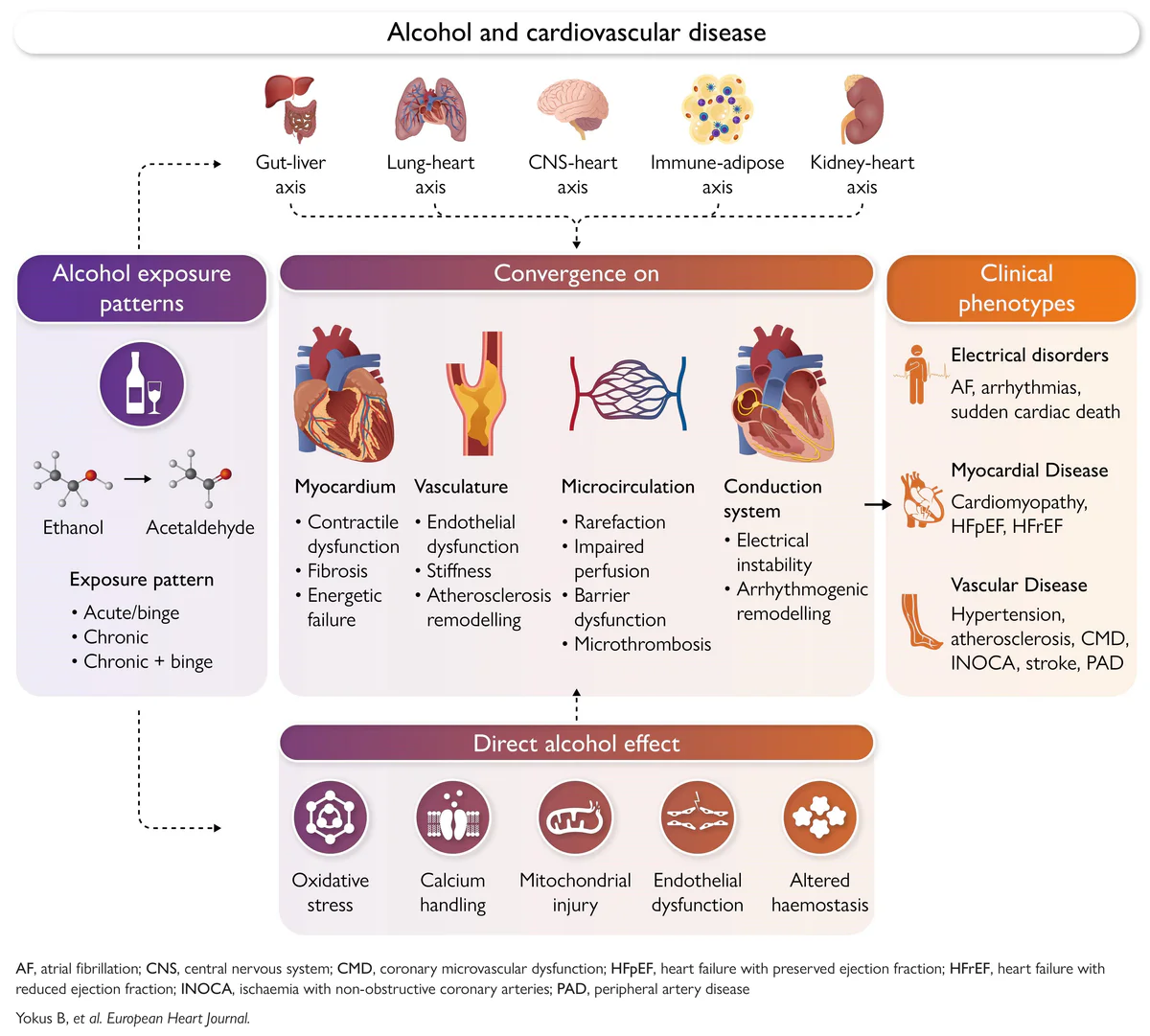
– Acute or binge drinking episodes provoke transient hypertension, atrial fibrillation, ventricular arrhythmias, hemodynamic instability, and sudden cardiac death.
– Sustained heavy intake promotes chronic hypertension, alcoholic cardiomyopathy characterized by dilated ventricles and systolic dysfunction, heart failure, ischemic stroke, and vascular disease.
– Chronic intake with episodic binges induces a complex phenotype including electrical instability, microvascular dysfunction, and progressive myocardial injury.
– Withdrawal states elicit autonomic imbalances and exacerbate arrhythmogenic risk.
Systemic and Cellular Mechanisms Underpinning Alcohol-Related Cardiovascular Injury
Alcohol toxicity involves direct myocardial injury through ethanol and acetaldehyde metabolites generating oxidative and nitrosative stress, impairing mitochondrial energetics essential for cardiomyocyte contraction and repair. Dysregulated endothelial signaling in coronary microvasculature impedes vasodilation and nutrient delivery. There is also substantial involvement of microbial-derived inflammatory mediators affecting systemic inflammation and endothelial activation. Neurohumoral activation of sympathetic pathways heightens hemodynamic load and electrical instability. Disrupted ion homeostasis undermines excitation-contraction coupling, facilitating arrhythmias and contractile dysfunction. The dominance of these pathways varies by drinking pattern and host factors, emphasizing the heterogeneity in risk presentation.
Coronary microvascular dysfunction emerges as a convergence node linking many adverse effects but may not be obligatory for all alcohol-induced cardiovascular injury phenotypes.
Alcohol-Related Cardiovascular Ageing: A Unifying Phenotype
Cumulative alcohol exposure accelerates cardiovascular ageing phenotypes characterized by progressive decline in myocardial performance and vascular compliance. Central to this process are mitochondrial dysfunction, chronic oxidative and nitrative stress, inflammageing driven by immune senescence, cellular senescence impairing repair and regeneration, and maladaptive fibrosis. Epigenetic and circadian dysregulation further exacerbate tissue dysfunction, while ventriculo-arterial uncoupling compromises cardiovascular reserve capacity. Although most evidence is derived from animal models and indirect human data, this conceptual model integrates disparate findings into a clinically relevant framework linking alcohol exposure to premature cardiovascular ageing and reduced resilience.
Modifiers of Risk and Reversibility
Multiple host factors—including biological sex, genetic background affecting alcohol metabolism and cardiovascular susceptibility, comorbidities (e.g., hypertension, diabetes), sleep-circadian disruption, nutrition, concurrent medication use, and polysubstance abuse—modulate the pattern and extent of injury and potential for recovery upon alcohol reduction or abstinence. Comprehensive assessment of alcohol exposure in clinical settings is critical for personalized cardiovascular prevention strategies.
Expert Commentary
The evolving understanding of alcohol’s effects on cardiovascular health calls for a paradigm shift in both clinical practice and public health policy. The prior endorsement of moderate drinking as cardioprotective is increasingly untenable given robust genetic and biomarker data. Clinicians should consider alcohol as a modifiable cardiovascular risk factor with heterogeneous phenotypes based on dose, pattern, and patient context. The presented systems-cardiology framework advances mechanistic insight beyond simplified dose-response models, emphasizing multi-organ interactions and microvascular contributions essential for developing targeted interventions.
Limitations in current evidence include incomplete direct human data elucidating molecular pathways of cardiovascular ageing induced by alcohol and challenges disentangling confounders in epidemiological studies. Future research should prioritize longitudinal mechanistic studies and interventions assessing reversibility of subclinical microvascular and myocardial injury.
Conclusion
Alcohol consumption exerts complex, dose- and pattern-dependent effects on cardiovascular health, ranging from transient functional disturbances to chronic cardiomyopathy and vascular disease. Contemporary evidence refutes the notion of universal cardioprotection with low-level drinking and underscores alcohol as a cardiovascular stressor impacting myocardial energetics, electrophysiology, microvascular integrity, and systemic inflammation. The concept of alcohol-related cardiovascular ageing integrates multiple pathobiological processes and highlights the cumulative burden of exposure. Tailored clinical approaches incorporating structured exposure assessment and focused alcohol reduction or abstinence are critical for optimizing cardiovascular prevention and management.
Specialty calculators
For clinical reference; use professional judgment.