Highlight
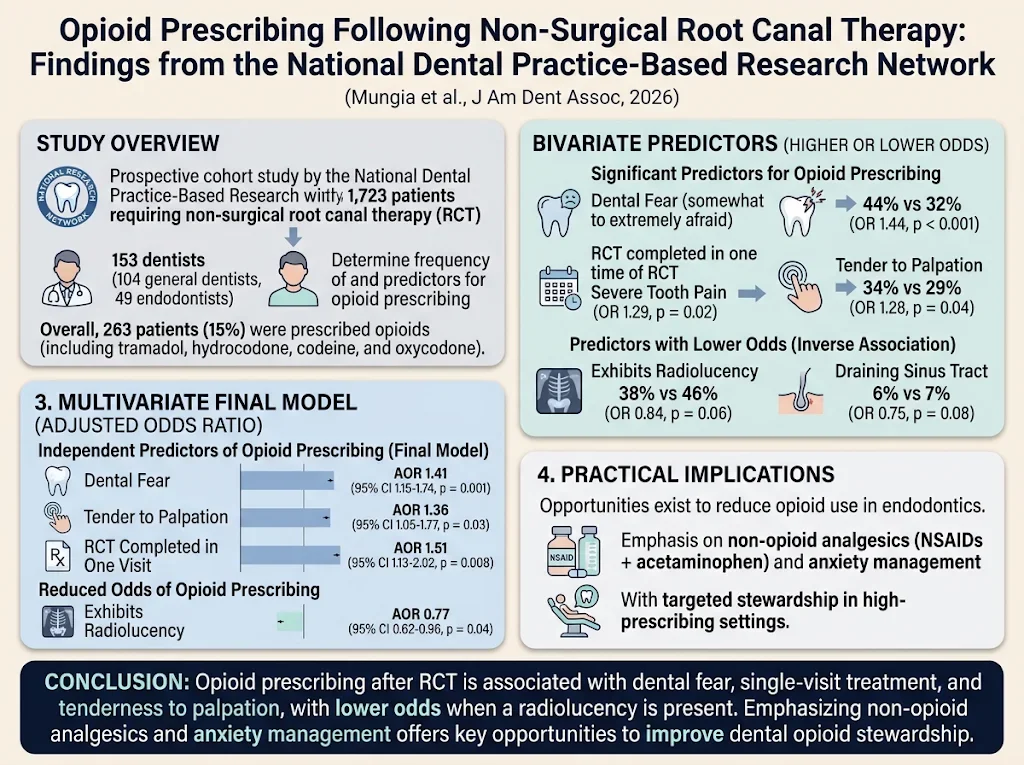
Opioids were prescribed to 15% of patients after nonsurgical root canal therapy (RCT), contrary to guidelines discouraging routine use for localized dental infections. Factors increasing opioid prescriptions included patient-reported dental fear, tenderness to palpation, and the completion of treatment in a single visit. Conversely, the presence of radiolucency on imaging was associated with lower opioid prescribing. These findings underscore opportunities to optimize pain management in endodontics by addressing anxiety and favoring nonopioid analgesics.
Study Background
Nonsurgical root canal therapy (RCT) is a common dental procedure performed to treat localized endodontic infections. Despite professional guidelines advising against routine opioid use for pain associated with such localized infections, opioids remain frequently prescribed in dental settings. This practice contributes to the wider opioid epidemic, given the potential for opioid misuse and dependency. Understanding prescribing patterns and their drivers is essential for developing targeted interventions to promote evidence-based pain management and limit unnecessary opioid exposure in dental patients.
Study Design
This observational study was conducted through The National Dental Practice-Based Research Network, involving 153 dentists across a variety of settings in the United States, including 104 general dentists and 49 endodontists. A total of 1,723 patients requiring nonsurgical RCT were enrolled. Dentists collected standardized clinical, radiographic, and demographic data at baseline and immediately following the treatment. The primary endpoint was whether an opioid analgesic was prescribed post-treatment. Multivariable generalized estimating equation models, accounting for clustering within dentists, assessed associations between prescribing and patient, clinical, and provider characteristics.
Key Findings
Of the 1,723 patients receiving RCT, 263 (15%) were prescribed opioids despite existing guidelines advocating nonopioid analgesics as first-line therapy for pain management in endodontic infections. The multivariable analysis revealed several significant predictors of opioid prescribing:
- Dental Fear: Patients reporting being somewhat to extremely afraid of the RCT had 41% higher odds of receiving an opioid prescription (odds ratio [OR], 1.41; 95% confidence interval [CI], 1.15 to 1.74; P = .001). This suggests that perceived anxiety may influence both patient pain experience and dentist prescribing behavior.
- Tenderness to Palpation: Presence of tenderness on palpation around the treated tooth increased the odds of opioid prescribing by 36% (OR, 1.36; 95% CI, 1.05 to 1.77; P = .030), reflecting clinical indicators of acute pain that could prompt opioid use.
- Single-Visit Treatment Completion: Patients whose RCT was completed in one visit had a 51% higher likelihood of receiving opioids compared to multi-visit treatments (OR, 1.51; 95% CI, 1.13 to 2.02; P = .008). This may indicate greater anticipated or reported pain with expedited treatment protocols.
- Radiolucency Presence: Paradoxically, having a radiolucency on preoperative imaging, often indicating chronic pathology, was associated with 23% lower odds of opioid prescribing (OR, 0.77; 95% CI, 0.62 to 0.96; P = .040), possibly reflecting less acute pain in these cases.
These findings provide a nuanced understanding of clinical and psychological factors influencing opioid use after RCT.
Expert Commentary
This study offers important epidemiological insights into opioid prescribing patterns following nonsurgical RCT across diverse U.S. dental practices. The finding that dental fear significantly increases opioid prescribing aligns with established literature documenting the impact of anxiety on pain perception and analgesic demand. This advocates for enhanced anxiety management protocols in dental care, such as cognitive-behavioral strategies, sedation techniques, or patient education to mitigate fear-related pain amplification.
The elevated prescribing associated with single-visit treatments deserves careful consideration. While single-visit RCT can improve convenience and reduce infection risk, it might provoke greater procedural discomfort or anxiety leading dentists to preemptively prescribe opioids. Dentists could mitigate this by optimizing procedural techniques and emphasizing multimodal nonopioid analgesia.
The paradoxical association of lower opioid prescribing with radiographically evident chronic lesions may reflect lower acute nociceptive input, supporting more conservative pain management. These data justify tailored prescribing strategies based on clinical presentation rather than routine opioid use.
Study limitations include its observational design, which precludes causal inference, and potential unmeasured confounding factors such as individual dentist prescribing habits or patient pain thresholds. Furthermore, the data do not address actual opioid consumption or longer-term outcomes like pain control efficacy or misuse risk.
Conclusion
This large, multicenter analysis delineates factors associated with opioid prescribing after nonsurgical root canal therapy, highlighting patient fear and exam findings as key drivers. Despite recommendations favoring nonopioid analgesics for endodontic pain, opioids remain prescribed in a significant minority of cases. Targeted interventions focusing on anxiety reduction, optimized pain management protocols, and provider education could reduce unnecessary opioid exposure and its associated risks in dental practice.
Future research should explore the impact of prescribing guidelines, dentist and patient education programs, and alternative analgesic regimens on opioid use and patient outcomes after endodontic procedures to facilitate evidence-based, safer dental pain management.
Funding and Trial Registration
The study was conducted under the auspices of The National Dental Practice-Based Research Network Collaborative Group. Specific funding sources were not detailed in the abstract. No clinical trial registration number was reported.
References
- Mungia R, Funkhouser E, Law AS, et al. Opioid prescribing after nonsurgical root canal therapy: Findings from The National Dental Practice-Based Research Network. J Am Dent Assoc. 2026;157(11):1284-1295.e1. PMID: 42287275.
- American Dental Association. Statement on the Use of Opioid Analgesics in Dentistry. ADA Center for Evidence-Based Dentistry. (Latest update accessed 2023).
- Lockhart PB, Brennan MT, Kent ML, et al. Evidence-based clinical recommendations for the use of analgesics in dentistry. J Am Dent Assoc. 2010;141(12):1580-9.
Specialty calculators
For clinical reference; use professional judgment.