Highlight
This phase 2b randomized trial assessed the efficacy and safety of the novel glucagon-like peptide-1 receptor agonist (GLP-1 RA) bofanglutide compared with semaglutide in Chinese adults with type 2 diabetes mellitus (T2DM). Key findings include significant HbA1c reduction with bofanglutide, especially at 18 and 24 mg dosages, both weekly and biweekly. Gastrointestinal adverse events were more frequent with bofanglutide but generally mild and manageable. No severe hypoglycemia occurred.
Study Background
Type 2 diabetes remains a global clinical challenge, especially in Asian populations where disease progression and treatment responses can differ from Western cohorts. GLP-1 receptor agonists have revolutionized T2DM management by improving glycemic control and offering weight benefits. Semaglutide is a widely used GLP-1 RA with established safety and efficacy. Bofanglutide, a novel GLP-1 RA under development, offers alternative dosing regimens including weekly and biweekly administration, potentially improving patient adherence and convenience. Evaluating bofanglutide’s clinical profile against semaglutide in the Chinese population fills an important gap, enhancing knowledge for optimized diabetes care in this demographic.
Study Design
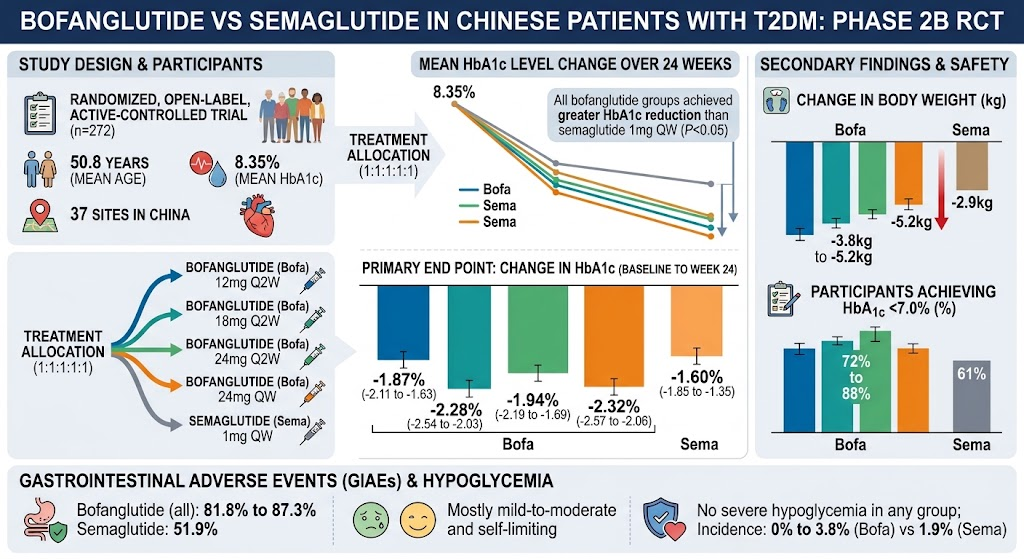
This multicenter, open-label, phase 2b trial enrolled 272 adults across 37 centers in China. Eligible patients had T2DM with baseline glycated hemoglobin A1c (HbA1c) levels between 7.0% and 11.0%, were drug-naive or on stable oral antidiabetic regimens. Participants were randomized 1:1:1:1:1 into five arms: bofanglutide titrated to 12 mg, 18 mg, or 24 mg biweekly (once every 2 weeks, Q2W), bofanglutide 24 mg once weekly (QW), or semaglutide 1 mg QW (active comparator). The primary endpoint was HbA1c change from baseline to week 24. Secondary endpoints included safety assessments and other efficacy parameters documented over the study period.
Key Findings
Baseline participant characteristics reflected a mean age of 50.8 years, mean HbA1c of 8.35%, and mean BMI of 27.9 kg/m². After 24 weeks, significant reductions in HbA1c were observed in all treatment groups compared to baseline:
- Bofanglutide 12 mg Q2W: −1.87% (95% CI, −2.11% to −1.63%)
- Bofanglutide 18 mg Q2W: −2.28% (95% CI, −2.54% to −2.03%)
- Bofanglutide 24 mg Q2W: −1.94% (95% CI, −2.19% to −1.69%)
- Bofanglutide 24 mg QW: −2.32% (95% CI, −2.57% to −2.06%)
- Semaglutide 1 mg QW: −1.60% (95% CI, −1.85% to −1.35%)
Notably, the reductions with bofanglutide at 18 mg Q2W and 24 mg QW doses were greater than with semaglutide, with treatment differences versus semaglutide of −0.68% (95% CI, −1.04% to −0.33%) and −0.72% (95% CI, −1.08% to −0.36%), respectively. These differences suggest clinically meaningful superiority in glycemic control.
Regarding safety, gastrointestinal adverse events (GIAEs), predominantly mild to moderate nausea, vomiting, and diarrhea, were reported in 81.8% to 87.3% of bofanglutide-treated participants compared to 51.9% in the semaglutide group. Hypoglycemia episodes were rare, occurring in 0% to 3.8% of bofanglutide groups and 1.9% in the semaglutide group, with no severe cases reported.
Interpretation of Efficacy
The data indicate that bofanglutide, particularly at higher doses and weekly administration, can achieve superior reductions in HbA1c compared with semaglutide 1 mg QW. The results are encouraging for bofanglutide’s efficacy as a GLP-1 RA for T2DM treatment in Chinese patients, supporting its potential role in clinical practice.
Safety Considerations
The increased incidence of gastrointestinal side effects with bofanglutide underscores the importance of patient counseling and careful dose titration to improve tolerability. The absence of severe hypoglycemia aligns with the known glucose-dependent mechanism of GLP-1 RAs, affirming the safety profile.
Expert Commentary
While the open-label design and limited ethnicity restrict broad generalizability, this trial addresses a critical population-specific evidence gap. The short duration (24 weeks) provides preliminary but solid evidence necessitating longer-term studies to evaluate sustained efficacy, safety, and cardiovascular outcomes. The comparative design with semaglutide, a current standard, strengthens the relevance of findings. Future investigations could explore patient-reported outcomes and real-world adherence data, as less frequent dosing schedules like biweekly regimens may enhance convenience and compliance.
Mechanistically, bofanglutide’s improved HbA1c lowering might relate to pharmacokinetics or receptor affinity differences requiring further pharmacodynamic studies. Integrating such novel GLP-1 RAs may help tailor diabetes therapy based on individual patient profiles and preferences.
Conclusion
Bofanglutide demonstrated meaningful glycemic improvements with manageable side effects in Chinese adults with type 2 diabetes, with weekly and biweekly regimens offering flexibility. Its superiority over semaglutide 1 mg QW observed in this phase 2b trial supports continued clinical development and evaluation in broader populations. Effective management of T2DM demands diverse, well-tolerated therapeutic options, and bofanglutide emerges as a promising candidate to meet this need.
Funding and Trial Registration
The trial was funded by Gan & Lee Pharmaceuticals and registered at ClinicalTrials.gov under identifier NCT06256549.
Reference
Liu M, Cheng Z, Lu L, Cai H, Liu J, Liu J, Zheng Y, Wang S, Zhao J, Yang W, Xie T, Li Y, He A, Rodbard HW, Chen W. Weekly and Biweekly Treatment With Bofanglutide Versus Semaglutide in Chinese Patients With Type 2 Diabetes : A Phase 2b Randomized Clinical Trial. Ann Intern Med. 2026 Aug;179(8):1107-1116. doi: 10.7326/ANNALS-25-04623. Epub 2026 Jun 30. PMID: 42372276.