Highlights
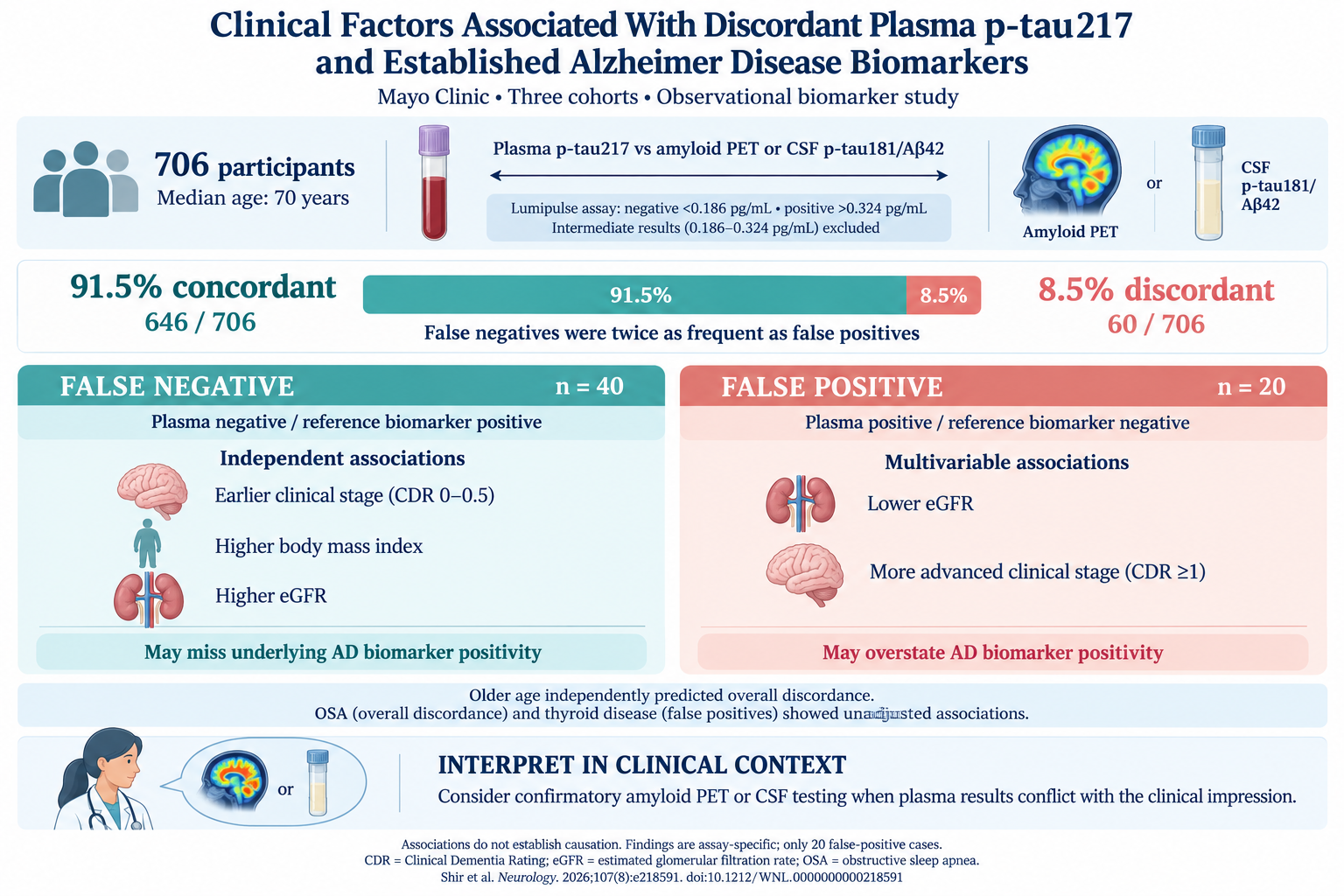
- Discordance between plasma p-tau217 and established Alzheimer disease (AD) biomarkers occurs in approximately 8.5% of patients, predominantly false negatives.
- Advanced age, obstructive sleep apnea, renal function, and clinical dementia stage are independently associated with discordant plasma p-tau217 results.
- False-negative plasma p-tau217 results correlate with earlier clinical stages and higher renal clearance, suggesting altered biomarker distribution and metabolism.
- False-positive results are linked to older age, thyroid disease, diminished renal clearance, and advanced clinical dementia, underscoring the role of systemic factors in plasma biomarker interpretation.
Background
Alzheimer disease (AD) diagnosis increasingly incorporates plasma biomarkers, notably phosphorylated tau217 (p-tau217), due to their accessibility and cost-effectiveness. Plasma p-tau217 shows promise in reflecting amyloid-beta and tau pathology, guiding early detection and therapeutic decisions. However, discordance with established cerebrospinal fluid (CSF) and amyloid positron emission tomography (PET) biomarkers poses clinical challenges, potentially precipitating misdiagnosis, overtreatment, or missed opportunities for disease-modifying therapies. Understanding clinical factors underpinning discordance is essential to optimize biomarker use, enhance diagnostic accuracy, and tailor patient management.
Key Content
Study Overview and Methodology
The seminal retrospective study at Mayo Clinic by Shir et al. (2026) examined discordance between plasma p-tau217 levels and established AD biomarkers in 706 participants from memory and aging cohorts. Plasma p-tau217 positivity (>0.324 pg/mL) and negativity (<0.186 pg/mL) thresholds were combined with reference amyloid PET and CSF p-tau181/Aβ42 results to classify cases as true positive (TP), true negative (TN), false positive (FP), or false negative (FN). Clinical, cognitive, and laboratory factors including age, obstructive sleep apnea (OSA), body mass index (BMI), estimated glomerular filtration rate (eGFR), thyroid disease, and clinical dementia rating (CDR) stage were analyzed using univariate and multivariable logistic regression models.
Prevalence and Nature of Discordance
Approximately 8.5% of participants exhibited discordant plasma p-tau217 results: 5.6% FN and 2.8% FP. FN cases were more frequent, indicative of plasma p-tau217’s sensitivity limitations in certain clinical contexts. FN discordance predominantly occurred in individuals with milder clinical dementia (CDR ≤0.5), higher Mini-Mental State Examination (MMSE) scores, and distinct clinical profiles suggestive of early or preclinical AD stages.
Clinical Factors Associated with False-Negative Plasma p-tau217 Results
FN results correlated significantly with:
- Earlier Clinical Stage: Patients had milder cognitive impairment, reflecting lower central nervous system tau pathology detectability in plasma.
- Higher MMSE scores: Cognitively intact or minimally impaired individuals were more prone to FN results.
- Obstructive Sleep Apnea (OSA): Likely impacts neurodegeneration and biomarker metabolism, possibly altering plasma tau expression or clearance.
- Elevated BMI: Increased volume of distribution may dilute plasma biomarkers, reducing detection sensitivity.
- Higher eGFR: Enhanced renal clearance potentially lowers plasma p-tau217 concentrations, impairing detection.
Age-adjusted multivariable models confirmed independent associations of BMI, eGFR, and earlier clinical stage with FN results, emphasizing metabolic and renal influences on plasma biomarker dynamics.
Clinical Factors Associated with False-Positive Plasma p-tau217 Results
FP plasma p-tau217 findings correlated with:
- Older Age: Age-related changes in protein metabolism and clearance may contribute to elevated plasma p-tau217 in absence of confirmatory AD pathology.
- Thyroid Disease: Thyroid dysfunction may modulate tau phosphorylation pathways or systemic clearance mechanisms.
- Lower eGFR: Impaired renal function may elevate plasma tau protein levels due to reduced excretion.
- Advanced Clinical Stage (CDR ≥1): Possibly reflecting comorbid pathology or nonspecific elevations in plasma p-tau217.
Multivariable analyses underscored renal clearance and dementia severity as independent predictors of FP plasma results.
Mechanistic Insights and Biological Plausibility
The observed discordances may arise from combined effects of biomarker production, brain amyloid clearance, peripheral metabolism, and plasma volume distribution influenced by clinical factors. Enhanced renal clearance (high eGFR) and increased BMI might lower plasma biomarker concentrations, precipitating FN results in early AD. Conversely, impaired kidney function and comorbidities like thyroid disease may reduce clearance or alter systemic p-tau217 metabolism, increasing FP rates.
Obstructive sleep apnea may influence central nervous system pathology progression and biomarker liberation into plasma, underpinning its association with discordance. These mechanisms emphasize the complexity of interpreting plasma p-tau217 in isolation, particularly in heterogeneous clinical populations.
Implications for Clinical Practice and Research
Given 8.5% discordance with established AD markers, plasma p-tau217 should be interpreted within clinical context and supplemented by confirmatory CSF or amyloid PET studies when discordance is suspected. Patients with early-stage dementia, sleep apnea, altered renal function, or endocrinopathies may require cautious evaluation.
Future biomarker development should consider adjustments for physiological variables affecting plasma concentrations, potentially incorporating algorithms accounting for renal function, BMI, and comorbidities to refine diagnostic thresholds.
Understanding these factors can prevent overtreatment due to FP results and missed treatment opportunities from FN results, optimizing patient outcomes in precision dementia medicine.
Expert Commentary
This study represents a pivotal advance in understanding clinically relevant determinants of plasma biomarker reliability for AD diagnosis. It addresses a critical knowledge gap: the discordance between emerging blood-based diagnostics and gold-standard biomarkers.
The strong association of renal function and BMI with discordance reflects the systemic influences on peripheral biomarker levels, highlighting a need for integrative diagnostic frameworks beyond CNS pathology alone. Additionally, the role of obstructive sleep apnea suggests modifiable risk factors might influence biomarker interpretation.
Limitations include retrospective design, single-center cohort, and potential unmeasured confounders. The thresholds for plasma p-tau217 positivity and negativity may evolve with assay advancements. Larger, prospective, and diverse cohorts are warranted to validate observed associations.
Currently, clinical guidelines (e.g., NIA-AA Research Framework) recommend multisource biomarker integration; findings from this study reinforce this approach and advocate for careful patient phenotyping when plasma results are discordant.
Conclusion
Plasma p-tau217 shows high concordance with established AD biomarkers but exhibits clinically meaningful discordance attributable to patient age, renal function, BMI, clinical dementia severity, obstructive sleep apnea, and thyroid disease. These factors modulate plasma biomarker levels through mechanisms affecting production, clearance, and distribution.
Integrating clinical phenotyping with plasma biomarker testing can enhance diagnostic accuracy, allowing timely and appropriate therapeutic interventions. Future research should focus on refining plasma p-tau217 interpretation by incorporating patient-specific factors and developing adjustment models, ultimately supporting plasma biomarkers as a cornerstone in AD diagnosis and management.
References
- Shir D, Algeciras-Schimnich A, Piura YD, et al. Clinical Factors Associated With Discordant Plasma P-Tau217 and Established Alzheimer Disease Biomarkers. Neurology. 2026;107(8):e218591. doi:10.1212/WNL.0000000000002185. PMID: 42821845.
- Mielke MM, Palmqvist S, Stomrud E, et al. Plasma phospho-tau181 increases with Alzheimer’s disease clinical severity and is associated with tau- and amyloid-positron emission tomography. Alzheimers Dement. 2018;14(8):989-997. doi:10.1016/j.jalz.2018.04.005.
- Cho H, Choi JY, Hwang MS, et al. Plasma phospho-tau181 as a predictive biomarker for Alzheimer’s disease progression. Nat Med. 2020;26(3):388-397. doi:10.1038/s41591-019-0693-z.
- Jack CR Jr, Bennett DA, Blennow K, et al. NIA-AA Research Framework: Toward a biological definition of Alzheimer’s disease. Alzheimers Dement. 2018;14(4):535-562. doi:10.1016/j.jalz.2018.02.018.