Highlight
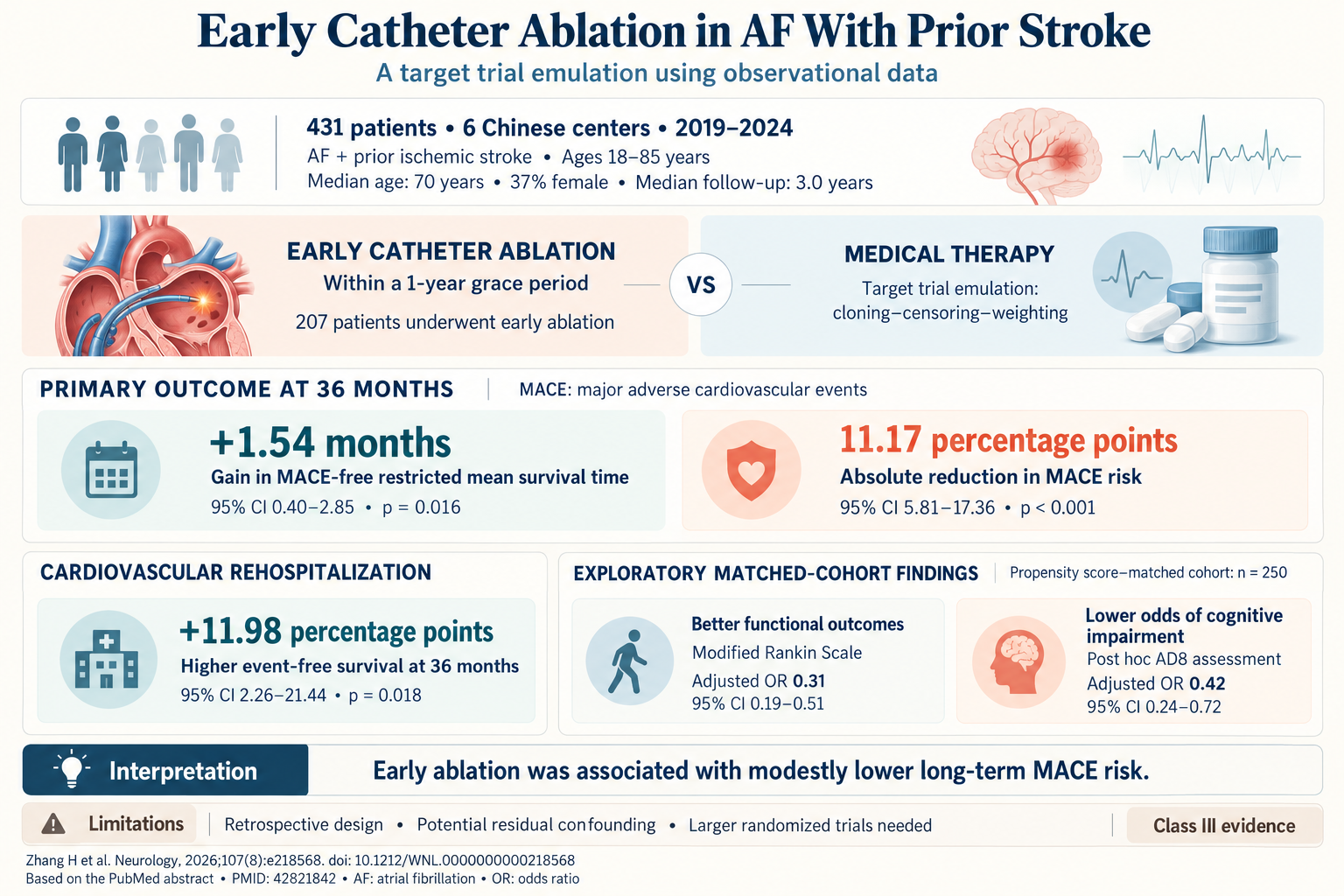
This multi-center observational study emulated a target trial comparing early catheter ablation with medical therapy in patients with atrial fibrillation (AF) and prior ischemic stroke, showing that early ablation reduced long-term major adverse cardiovascular events (MACEs) and cardiovascular rehospitalization. Additionally, ablation was linked to better neurological function and reduced cognitive impairment. Limitations include retrospective design and potential residual confounding, underscoring the need for prospective randomized trials.
Study Background
Atrial fibrillation is the most common sustained cardiac arrhythmia and significantly increases the risk of ischemic stroke and other adverse cardiovascular outcomes. In patients with a history of stroke, AF markedly elevates the risk of recurrent cerebrovascular events and mortality. Catheter ablation has been established as an effective rhythm control strategy in AF; however, its benefit specifically in patients with prior stroke remains insufficiently studied. Prior trials on AF ablation have largely underrepresented this high-risk subgroup, limiting evidence on whether early ablation can improve clinical and neurological outcomes in stroke survivors with AF.
This unmet medical need is clinically important because AF-associated strokes tend to be severe, and recurrence prevention is paramount. Furthermore, preservation of neurological function and cognitive abilities are critical goals in this population. Clarifying whether early catheter ablation confers additional benefits beyond guideline-directed medical therapy could influence management decisions and improve long-term patient outcomes.
Study Design
The authors conducted a retrospective observational study from January 2019 to December 2024, enrolling 431 patients aged 18-85 years diagnosed with AF and a previous ischemic stroke from six Chinese tertiary centers. The aim was to emulate a pragmatic target trial comparing early catheter ablation—defined as ablation occurring within one year of AF diagnosis or study inclusion—with medical therapy as standard care.
Primary endpoint was a composite of major adverse cardiovascular events (MACEs), encompassing stroke, systemic embolism, myocardial infarction, and cardiovascular death. Secondary endpoints included all-cause and cardiovascular-specific rehospitalizations, all-cause mortality, and neurological and cognitive function measured using the modified Rankin Scale (mRS) and the AD8 dementia screening instrument, respectively.
To address biases from observational data and time-dependent treatment assignment, the investigators applied a sophisticated cloning-censoring-weighting approach to mimic randomized allocation, analyzed with weighted Kaplan-Meier curves. When the proportional hazards assumption was violated, restricted mean survival time (RMST) was employed. Propensity score matching adjusted for baseline differences in neurological and cognitive outcomes between treatment groups.
Key Findings
The cohort had a median age of 70 years, with 37% female representation. Among them, 207 patients underwent early catheter ablation, and the remainder received medical therapy. Median follow-up was 3.0 years.
Regarding the primary outcome, early ablation was associated with a statistically significant increase of 1.54 MACE-free months over 36 months compared to medical therapy (95% CI, 0.40 to 2.85 months, p=0.016). The absolute risk reduction in MACEs at 3 years was 11.17% (95% CI, 5.81%-17.36%, p < 0.001), favoring ablation.
For secondary outcomes, cardiovascular rehospitalization rates showed a higher event-free survival of 11.98% (95% CI 2.26%-21.44%, p=0.018) in the ablation group at 36 months, highlighting a meaningful reduction in cardiac-related admissions.
In the propensity-matched cohort (n=250), patients undergoing ablation exhibited significantly better functional outcomes with an adjusted odds ratio (OR) of 0.31 (95% CI, 0.19-0.51; p < 0.001) for favorable mRS scores, suggestive of less disability. Cognitive assessment demonstrated lower odds of impairment (adjusted OR 0.42; 95% CI, 0.24-0.72; p=0.002) in ablated individuals, implying preservation or improvement of cognitive function.
No significant differences were reported for all-cause death or all-cause rehospitalization, indicating safety comparability between strategies within the observation period.
Expert Commentary
This study advances the understanding of catheter ablation’s role in stroke survivors with AF by leveraging a target trial emulation design, which enhances causal inference beyond traditional retrospective analyses. The findings suggest that early rhythm control via ablation can modestly but importantly reduce long-term cardiovascular events and rehospitalizations, aligning with emerging evidence supporting early ablation’s benefits in broader AF populations.
The improvements in neurological disability and cognitive outcomes post ablation are particularly compelling, underscoring the potential for ablation to positively modulate cerebral perfusion and reduce AF-related embolic risk, beyond anticoagulation. Such benefits warrant thorough validation since stroke-related disability and cognitive decline significantly impact quality of life and healthcare burden.
However, residual confounding remains a possibility given the observational design despite advanced statistical adjustment. Patients selected for ablation might have differed subtly in unmeasured factors, including socioeconomic status, frailty, or comorbidities influencing outcomes. Additionally, the study cohort from Chinese centers may limit generalizability to other ethnicities or healthcare systems.
Ongoing randomized controlled trials with adequately powered samples are required to definitively establish the magnitude and durability of ablation benefits in this vulnerable patient group and to evaluate optimal timing and patient selection criteria.
Conclusion
This multi-center target trial emulation study offers Class III evidence that early catheter ablation in adult patients with AF and prior ischemic stroke confers a clinically meaningful reduction in major adverse cardiovascular events and cardiovascular rehospitalizations when compared with guideline-directed medical therapy alone. The associated improvements in functional disability and cognitive status highlight potential neurologic advantages of rhythm control strategies in stroke survivors.
While these findings provide important hypotheses generating insights, the retrospective design and possible confounding necessitate prospective randomized trials to guide clinical practice. Until then, clinicians should individualize AF management in stroke patients, integrating patient preferences, comorbidities, and bleeding risks when considering early ablation.
Funding and Clinical Trials Registration
The article does not specify funding sources or clinical trial registration details. Future confirmatory studies should ensure prospective registration and transparent reporting.
References
Zhang H, Gu Y, Shang C, Cui E, Guo H, Bian Q, Shen Y, Gu Z, Ding X, Wang L, Huang B, Zhu X, Li M, Chen H, Ju W, Yang G, Gu K, Liu H, Chen M. Early Catheter Ablation for Patients With Atrial Fibrillation and a Stroke History: A Target Trial Emulation Analysis. Neurology. 2026 Oct 27;107(8):e218568. doi: 10.1212/WNL.0000000000218568. Epub 2026 Oct 1. PMID: 42821842.