Highlight
- Immediate implant loading with additively manufactured resin interim fixed complete dental prostheses (IFCDPs) shows high early implant survival (99.06% at 6 months).
- Prosthesis-level framework fractures occurred in 19.5% of IFCDPs, with frequent recurrence after reprinting from original CAD files.
- Male sex was associated with a higher risk of prosthesis fracture.
- Mechanical complications did not significantly correlate with implant failure, but structural design reconsideration is necessary to improve prosthesis durability.
Study Background
The increasing adoption of digital workflows and additive manufacturing (3D printing) in implant dentistry has transformed provisionalization processes. Immediate implant loading with fixed complete dental prostheses (IFCDPs) offers patients immediate esthetics and function post-implant placement, reducing treatment time and improving patient satisfaction. Interim prostheses serve as essential transitional devices supporting function while implants osseointegrate. However, the mechanical reliability of interim prostheses produced by additive manufacturing, especially under immediate loading of multiple implants in complete-arch scenarios, remains a clinical challenge. Framework fractures can compromise prosthetic function, increase chairside time, and elevate costs. Understanding the fracture risk and implant survival associated with these digitally fabricated interim prostheses is crucial for refining clinical protocols and prosthetic design standards.
Study Design
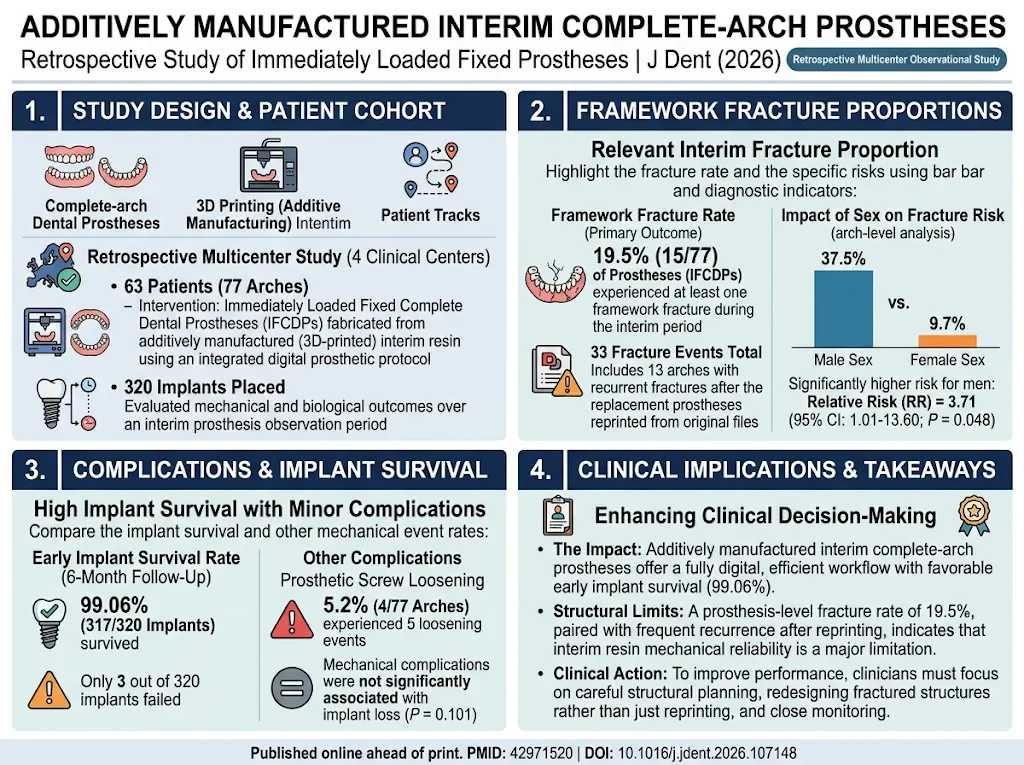
This retrospective multicenter observational study analyzed 63 patients (77 complete arches) treated at four clinical centers. A total of 320 implants were placed following a fully digital protocol where interim IFCDPs were fabricated using additively manufactured resin for immediate loading at implant placement. The study’s primary outcome was the prosthesis-level framework fracture rate during the interim observation period. Secondary outcomes included prosthetic screw loosening events and early implant failures, assessed over a 6-month follow-up after loading. The statistical approach employed generalized estimating equation (GEE) models to relate framework fracture occurrence to patient and prosthetic variables considering clustering effects. Additionally, multinomial logistic regression evaluated associations between mechanical complications and implant failure, with subgroup analysis comparing fracture incidence across arch types.
Key Findings
The study revealed that 15 of 77 interim prostheses (19.5%) suffered at least one framework fracture during the observation period, totaling 33 fracture events. Notably, recurrent fractures happened in 13 arches even after reprinting replacement prostheses from the original digital designs, suggesting that re-fabrication alone may not resolve structural weaknesses. Analysis indicated a statistically significant higher fracture risk among male patients compared to females (37.5% vs. 9.7%; relative risk 3.71; 95% CI: 1.01-13.60; p=0.048), an exploratory finding warranting further research.
Prosthetic screw loosening was relatively infrequent, occurring in 5 screw-loosening events across 4 IFCDPs (5.2%). Importantly, early implant failure was rare, with only 3 of 320 implants failing during the retrospective 6-month follow-up, corresponding to a high implant survival rate of 99.06%. Statistical analyses showed no significant association between mechanical complications—encompassing framework fractures and screw loosening—and implant loss (p=0.101), suggesting prosthesis fractures did not necessarily compromise implant osseointegration in the short term.
Expert Commentary
The study underscores the promising early implant survival associated with additively manufactured interim resin IFCDPs, affirming the clinical feasibility of immediate loading using a fully digital workflow. However, the nearly 20% fracture proportion at the prosthesis level highlights mechanical durability as a critical limitation with current resin materials and designs. Recurrent fractures post-reprinting emphasize that replication of a flawed digital design fails to ensure enhanced strength, calling for systematic structural redesign and validation before subsequent manufacturing.
Sex-related differences in fracture rates raise intriguing questions about biomechanical loading variations, patient behavior, or anatomical factors affecting prosthesis stress distribution. This preliminary finding should be interpreted cautiously and explored in controlled prospective cohorts.
Current resin materials and additive manufacturing protocols may not yet fully replicate the mechanical robustness of traditional interim materials or final prostheses. As interim prostheses serve as load-bearing transitional devices during the sensitive osseointegration phase, their mechanical failure may jeopardize patient comfort and treatment timelines despite the negligible impact on implant survival noted here.
Future research priorities include prospective clinical trials comparing design modifications, material innovations, and process parameters; biomechanical testing to identify fracture-prone regions; and integrating digital finite element analysis within prosthetic workflows to predict stress concentrations.
Conclusion
Additively manufactured interim resin complete-arch dental prostheses for immediate implant loading demonstrate excellent early implant survival but exhibit substantial rates of framework fracture at the prosthetic level. The fracture incidence and recurrence after reprinting highlight the necessity for rigorous structural reassessment of interim prosthesis designs rather than simple replication.
Careful mechanical planning, optimized digital design protocols, and close clinical monitoring are recommended to minimize mechanical complications. While male patients may present higher fracture risks, this observation remains exploratory. Controlled prospective studies are essential to establish validated prosthetic design criteria, optimize additive manufacturing parameters, and improve mechanical reliability of interim complete-arch prostheses in immediate loading scenarios.
Funding and Clinical Trial Registration
No funding or clinical trial registration information was provided.
References
1. Tirone F, Rolando E, Rodi D, Pozzatti L, Salzano S. Clinical performance of additively manufactured interim complete-arch dental prostheses for immediate implant loading: A retrospective observational study. J Dent. 2026 Nov 2;107148. PMID: 42971520.
2. Mangano FG, et al. Digital Dentistry and Immediate Loading in Implant Prosthodontics: State of the Art. Eur J Prosthodont Restor Dent. 2018;26(3):104-109.
3. Kim MJ, et al. Mechanical Properties of Interim Resin Materials for Implant Prostheses: Resin-Based 3D Printing Compared to Conventional Techniques. J Prosthet Dent. 2022;127(1):74-80.
4. Sailer I, et al. Digital workflows in dentistry: Recent advances and clinical implications. Quintessence Int. 2021;52(3):266-276.
Specialty calculators
For clinical reference; use professional judgment.