Highlight
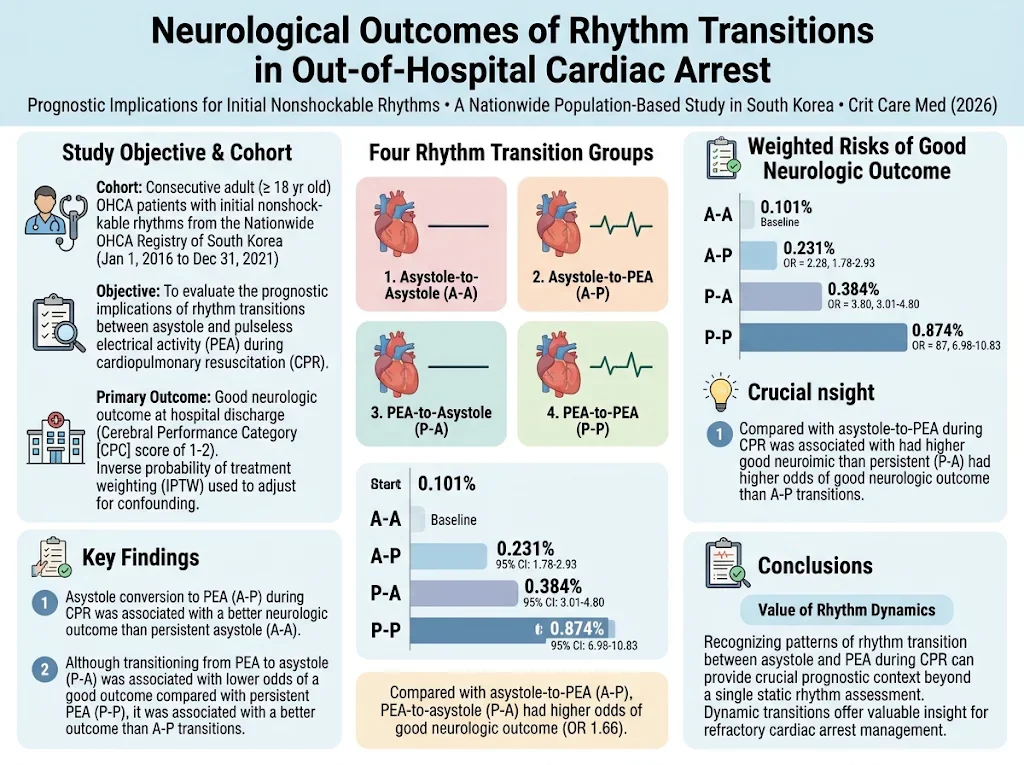
This nationwide Korean observational study investigated prognostic implications of rhythm transitions during CPR in out-of-hospital cardiac arrest (OHCA) patients with initial nonshockable rhythms. The study analyzed outcomes in four rhythm transition groups: asystole-to-asystole, asystole-to-PEA, PEA-to-asystole, and PEA-to-PEA, revealing that patients with rhythm transitions involving PEA generally had better neurological outcomes. Notably, persistence of PEA (P-P) was associated with the highest likelihood of favorable neurological recovery at hospital discharge.
Study Background
Out-of-hospital cardiac arrest (OHCA) remains a major cause of mortality worldwide, with low survival and poor neurological outcomes, particularly among patients exhibiting nonshockable initial rhythms such as asystole and pulseless electrical activity (PEA). Prognostication in this subset of patients is challenging due to the typically poor outcomes and heterogeneous clinical courses. While rhythm is a cornerstone in guiding resuscitation efforts, many studies focus on initial rhythms without considering dynamic changes during CPR, which may carry important prognostic information. Given the clinical uncertainty, understanding how rhythm transitions between asystole and PEA relate to neurological outcomes could refine prognostic models and influence resuscitative strategies.
Study Design
This was a nationwide population-based observational cohort study utilizing the South Korean OHCA registry, administered by the Korea Disease Control and Prevention Agency. The study encompassed adult patients (≥18 years) experiencing OHCA with initial nonshockable rhythms (asystole or PEA) from January 1, 2016, through December 31, 2021.
No interventions beyond usual clinical practice were involved, reflecting real-world resuscitation patterns. During CPR, rhythm transitions were categorized into four groups based on changes between asystole and PEA: asystole-to-asystole (A-A), asystole-to-PEA (A-P), PEA-to-asystole (P-A), and PEA-to-PEA (P-P).
The primary outcome was a good neurological status at hospital discharge, defined as a Cerebral Performance Category (CPC) score of 1 or 2, indicating normal or moderate cerebral performance. Inverse probability of treatment weighting (IPTW) was applied to balance measured confounders among groups and reduce bias in outcome comparisons.
Key Findings
Among the cohort, the weighted risk of a good neurological outcome was lowest in the A-A group (0.101%) and highest in the P-P group (0.874%), with the A-P and P-A groups having intermediate outcomes (0.231% and 0.384%, respectively). Compared with persistent asystole (A-A), rhythm transitions involving PEA had markedly increased odds of favorable neurological outcomes:
- A-P: odds ratio (OR) 2.28, 95% confidence interval (CI) 1.78-2.93, risk difference (RD) 0.13 percentage points.
- P-A: OR 3.80, 95% CI 3.01-4.80, RD 0.283 percentage points.
- P-P: OR 8.70, 95% CI 6.98-10.83, RD 0.773 percentage points.
Of note, P-A (transition from PEA to asystole) yielded better neurological outcomes than A-P (asystole to PEA), with OR 1.66 (95% CI 1.39-1.99) and RD 0.153 percentage points. However, P-A outcomes were inferior to persistent PEA (P-P).
These findings suggest that conversions involving PEA rhythms during CPR correspond with incremental improvements in neurological survival, while persistent asystole represents the worst prognosis. The data imply that dynamic rhythm assessment during resuscitation can add prognostic value beyond a single initial rhythm evaluation.
Expert Commentary
Nonshockable rhythms, particularly asystole, have traditionally been associated with dismal outcomes. The nuanced findings from this large nationwide registry provide compelling evidence that rhythm dynamics during CPR — specifically transitions between asystole and PEA — carry meaningful prognostic information. The observation that persistent PEA yields the most favorable neurological outcomes highlights the potential for intra-resuscitation rhythm monitoring to inform clinical decision-making and family counseling.
Biologically, PEA may reflect residual organized electrical activity amenable to ROSC (return of spontaneous circulation), whereas persistent asystole indicates complete electrical inactivity. Transition from PEA to asystole may represent deterioration but paradoxically was associated with better outcomes than asystole-to-PEA transitions, which might reflect variability due to factors like transient myocardial response or measurement artefact. Nevertheless, the clinical implications merit further study to corroborate these rhythm trajectories and optimize resuscitation guidelines.
Study strengths include the large sample size, comprehensive national registry data, and use of robust adjustment methods. Limitations include reliance on observational data susceptible to unmeasured confounding, potential misclassification of rhythms during prehospital care, and modest absolute outcome probabilities reflecting the generally poor prognosis in nonshockable OHCA.
Conclusion
This nationwide Korean study underscores the clinical value of monitoring rhythm transitions during CPR in patients with initial nonshockable rhythms. Conversions involving PEA, particularly persistent PEA, are linked to higher odds of good neurological recovery compared with persistent asystole. Recognizing these dynamic patterns may aid clinicians in prognostication and tailoring resuscitative efforts to improve outcomes in this challenging patient population.
Future prospective studies and integration of rhythm transition data into advanced ALS (advanced life support) algorithms might refine resuscitation strategies and support more individualized care in OHCA with nonshockable rhythms.
Funding and Clinical Trials Registration
The study was supported by the Korea Disease Control and Prevention Agency. No clinical trial registration was applicable for this observational study.
References
- Kim D, Park H, Kwon H, Kim SM, Kim JS, Kim YJ, Kim WY. Neurological Outcomes of Rhythm Transitions in Out-of-Hospital Cardiac Arrest With Initial Nonshockable Rhythms: A Nationwide Population-Based Study. Crit Care Med. 2026 Nov 12. PMID: 43018417.
- Neumar RW, et al. Part 8: Adult Advanced Cardiovascular Life Support. 2020 American Heart Association Guidelines for CPR and ECC. Circulation. 2020;142(16_suppl_2):S366–S468.
- Meaney PA, et al. Epidemiology of Cardiac Arrest and Resuscitation Outcomes. Anesthesiology. 2016;124(1):e9–e18.
- Wright JL, et al. Prognostic value of PEA during out-of-hospital cardiac arrest. Crit Care Resusc. 2017;19(4):261–268.
Specialty calculators
For clinical reference; use professional judgment.