Introduction
Chronic knee pain, often associated with osteoarthritis, is a prevalent condition among adults aged 45 years and older, leading to significant functional impairment and reduced quality of life. Physical therapy is a cornerstone of conservative management, traditionally delivered in-person. However, advancements in digital health have enabled telerehabilitation — the remote delivery of rehabilitation services using telecommunication technologies. While this approach offers increased accessibility and convenience, acceptance by patients remains critical for its success.
This article examines whether direct personal experience of receiving physical therapy through telerehabilitation affects patients’ preferences and their willingness to pay for such services compared to traditional in-person therapy. It presents findings from a discrete choice experiment nested within a randomized controlled trial involving Australian adults with chronic knee pain due to osteoarthritis.
Background and Rationale
Osteoarthritis-related knee pain is a leading cause of disability worldwide. Physical therapy focusing on strength training, joint mobilization, and patient education is effective for symptom management and function improvement.
Telerehabilitation promises to overcome barriers like travel time, geographic distance, and pandemic-related restrictions, yet questions about patient trust, interaction quality, and technology usability persist. Importantly, patient preferences impact therapy adherence and outcomes.
Study Design and Methodology
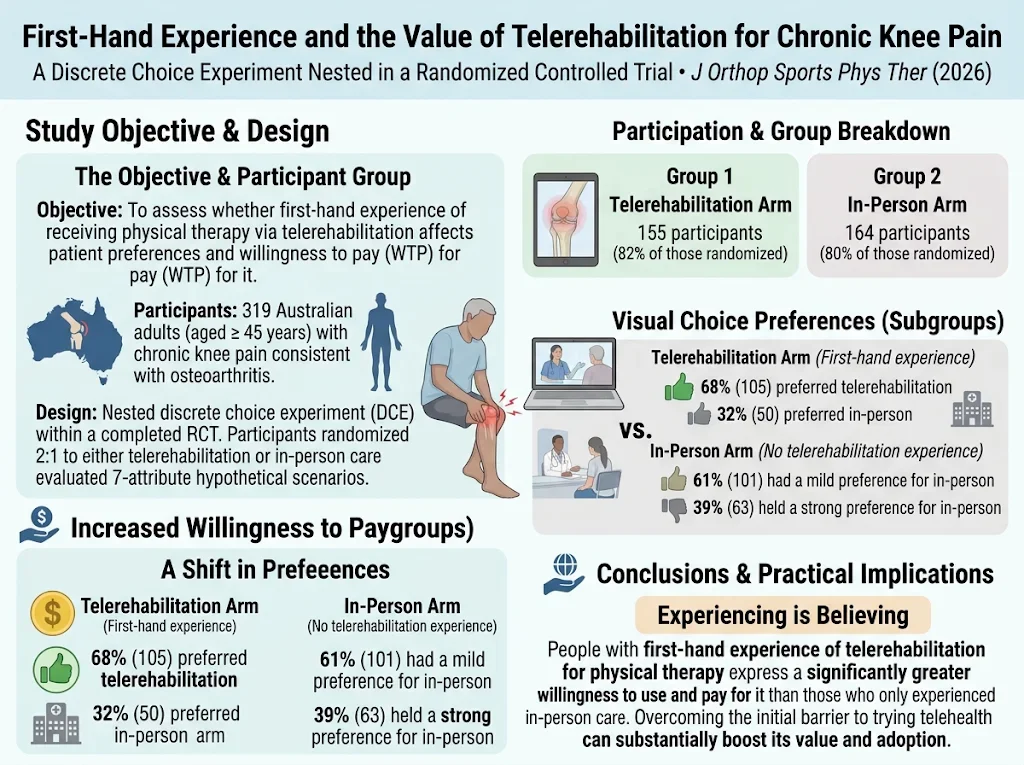
The study enrolled 319 Australian adults aged 45 or above, all diagnosed with chronic knee pain consistent with osteoarthritis. These participants had recently completed a randomized controlled trial where they were allocated to either telerehabilitation-based physical therapy or traditional in-person physical therapy.
Subsequent to the clinical trial, participants took part in a discrete choice experiment (DCE). In this experimental framework, patients were presented with hypothetical consultation scenarios that varied across seven attributes related to the treatment process, such as mode of consultation (telerehabilitation vs. in-person), cost, therapist interaction quality, convenience, and others.
Participants were then asked to choose their preferred option in each scenario, revealing their priorities and trade-offs in therapy selection. Statistical analysis using generalized multinomial logit and latent class models explored patterns in preferences and valuation.
Key Findings
Of the 319 participants, 164 were from the in-person therapy group and 155 from the telerehabilitation group, with high retention rates in both arms (80% and 82%, respectively).
Critically, those with firsthand experience of telerehabilitation were willing to pay an average of 87.49 Australian dollars more for telerehabilitation consultations than those who had only experienced in-person therapy, reflecting greater acceptance and perceived value of remote care.
Four distinct preference subgroups emerged across participants:
- In the telerehabilitation-experienced group, 68% strongly preferred telerehabilitation, while 32% still favored in-person visits.
- Within the in-person group, 39% expressed a strong preference for face-to-face sessions, and 61% a mild preference, indicating a generally lower enthusiasm for telerehabilitation among those without direct exposure.
Implications for Practice and Policy
The data indicate that firsthand experience with telerehabilitation fosters greater willingness to use and invest in this form of therapy. This highlights a potential initial barrier to adoption which can be addressed through trial opportunities and patient education.
Healthcare providers and policymakers should consider strategies to increase exposure to telerehabilitation, for example through pilot programs and technology demonstrations, to enhance patient comfort and acceptance.
Moreover, understanding patient subgroups allows tailoring of approaches: some patients may benefit from hybrid models combining in-person and remote sessions based on preference, clinical need, and accessibility.
Limitations and Future Directions
While the randomized trial design and DCE provide robust insights, the study population was limited to Australian adults aged 45 and over, which may limit generalizability to younger populations or other cultural contexts.
Future research should explore longitudinal outcomes related to patient satisfaction, functional improvement, and cost-effectiveness comparing telehealth and traditional physical therapy. Additionally, qualitative studies could deepen understanding of patient concerns and facilitators regarding telerehabilitation.
Conclusion
This study demonstrates that experience matters: patients who have personally engaged in telerehabilitation for chronic knee osteoarthritis pain show greater preference and higher willingness to pay than those with in-person experience alone.
As digital health technologies continue to advance, integrating patient-centered approaches that increase exposure and comfort with telerehabilitation may improve uptake, adherence, and ultimately outcomes for individuals living with chronic knee pain.
References
Woode ME, Hinman RS, Harris A, Bennell KL, Campbell PK, Lawford BJ. First-Hand Experience and the Value of Telerehabilitation for Chronic Knee Pain: A Discrete Choice Experiment Nested in a Randomized Controlled Trial. J Orthop Sports Phys Ther. 2026 Nov;56(11):735-744. doi:10.2519/jospt.2026.14073.
Specialty calculators
For clinical reference; use professional judgment.