Highlight
- Presentation of a novel data-driven biomechanical model simulating rib apex displacement based on osteotomy location and bending angle.
- Evidence that both the site of osteotomy and the angle of rib bending significantly impact rib displacement relevant for waist narrowing.
- Demonstration that tenth ribs show greater displacement than eleventh ribs under simulated manipulations.
- Introduction of an adaptable graphical user interface facilitating individualized surgical planning based on patient-specific imaging.
Study Background
The pursuit of refining aesthetic waist contouring has driven interest in rib cage remodeling, particularly through rib osteotomy with osteosynthesis to achieve waist narrowing. Traditional approaches to rib modification often lack precise biomechanical guidance, limiting predictability of outcomes and risking suboptimal results or complications. Understanding the biomechanical impact of osteotomy site and bending angle on rib displacement can potentially enable surgeons to tailor procedures to individual anatomy and aesthetic goals. Despite initial clinical application, comprehensive quantitative data to optimize these parameters remain sparse, illustrating a significant unmet need in personalized rib remodeling techniques.Study Design
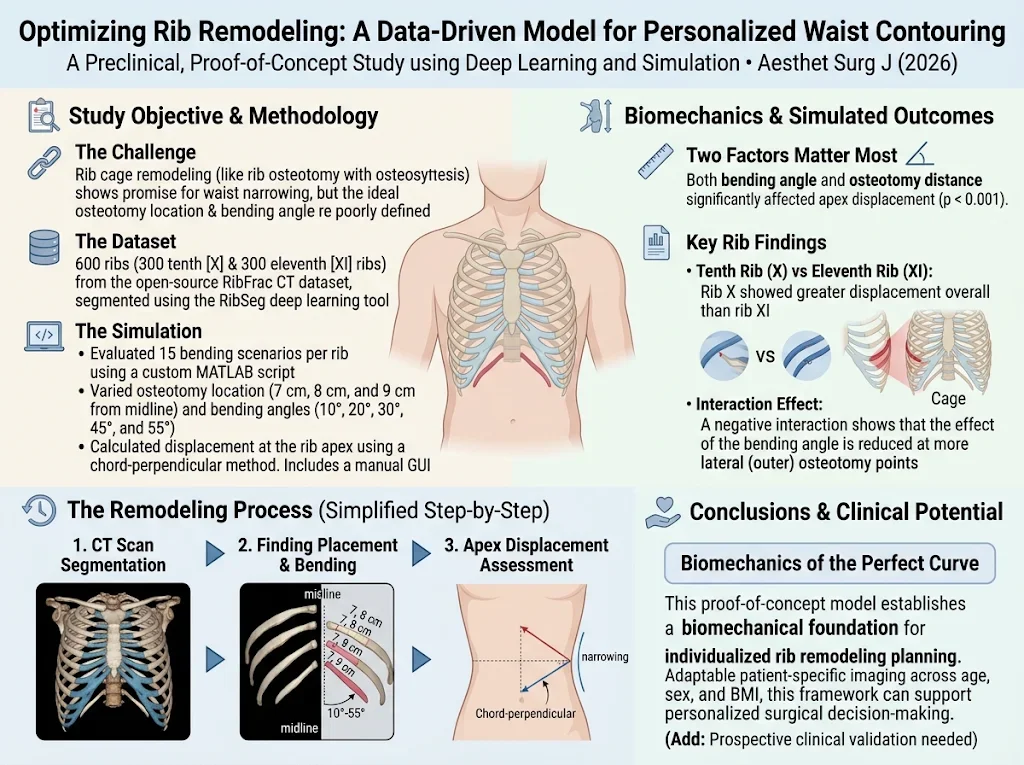
This preclinical, proof-of-concept research utilized a large CT imaging dataset (RibFrac) comprising 600 ribs (300 tenth and 300 eleventh ribs) obtained from diverse subjects. Using RibSeg, a sophisticated deep learning segmentation tool, ribs were isolated from imaging data. Subsequently, a custom MATLAB simulation script generated 15 bending scenarios per rib by varying osteotomy site (7 cm, 8 cm, or 9 cm from the midline) and bending angles (10°, 20°, 30°, 45°, and 55°). Displacement of the rib apex was calculated via the chord-perpendicular method, a geometric approach quantifying rib movement pertinent to waist contouring. A graphical user interface (GUI) allowed interactive visualization and manual adjustment of parameters, enhancing clinical applicability. Finally, a linear mixed-effects statistical model assessed the individual and interactive effects of osteotomy location and bending angle on rib apex displacement.Key Findings
Both bending angle and osteotomy distance from midline independently exhibited significant effects on rib apex displacement (p < 0.001). Specifically, greater bending angles correlated with increased displacement, enhancing potential waist narrowing. Osteotomies placed more medially (7 cm) generally resulted in larger displacement compared to more lateral sites (9 cm). Notably, a negative interaction effect indicated that the influence of angle diminished as osteotomy sites shifted laterally, implying a biomechanical constraint in lateral rib manipulation. Comparative analysis between ribs revealed that the tenth rib consistently demonstrated greater displacement than the eleventh rib, suggesting that targeting specific ribs could optimize contouring effects. The GUI allowed dynamic exploration of these variables, providing surgeons with a platform for patient-specific procedural planning. No adverse safety concerns arise directly from the model; however, clinical validation is necessary to confirm applicability. Confidence intervals and effect sizes underscore robustness of findings, though derived from simulated parameters necessitating translation into human surgery.Expert Commentary
This study exemplifies an innovative integration of computational modeling and imaging analytics to inform aesthetic surgery. The approach lays biomechanical groundwork enabling personalized surgical planning, transitioning from a ‘‘one-size-fits-all’’ paradigm to precision remodeling tailored to anatomical variability and aesthetic preference. Remaining challenges include validation in clinical cohorts, incorporation of soft tissue dynamics, and consideration of patient factors such as age, sex, and BMI which influence rib flexibility and healing. Moreover, potential risks inherent to rib osteotomy—such as pneumothorax, neurovascular injury, and chest wall instability—necessitate careful surgical expertise despite optimized planning tools. The model’s adaptability to diverse patient imaging data heralds a new frontier in computer-assisted surgical decision-making that could be expanded beyond aesthetics to reconstructive surgeries requiring rib modification.Conclusion
This pioneering data-driven model provides the first quantitative framework linking osteotomy location and bending angle with biomechanical outcomes relevant to rib remodeling. The findings suggest that targeting more medial ribs at appropriate bending angles maximizes rib apex displacement and thus waist narrowing potential. By offering an interactive user interface, the framework empowers surgeons to individualize planning based on patient-specific imaging, promising enhanced precision, predictability, and patient satisfaction. Future clinical studies are warranted to validate these simulations prospectively and to integrate soft tissue and biomechanical constraints more comprehensively. Ultimately, this paradigm may refine aesthetic rib cage contouring and expand surgical personalization strategies in complex thoracic interventions.Funding and ClinicalTrials.gov
The publication does not specify funding sources or clinical trial registration, emphasizing the preclinical and proof-of-concept nature of this work.References
Zona EE, Mereddy RR, O’Shea AW, Fine KS, Tierney MG, Wirth PJ, Via EC, Afifi AM. Optimizing Rib Remodeling: A Data-Driven Model for Personalized Waist Contouring. Aesthetic surgery journal. 2026 Nov 15. PMID: 43034290. Additional relevant literature: 1. Schouten R, et al. ‘‘Biomechanics of rib osteotomy for chest wall reconstruction’’ J Thorac Cardiovasc Surg. 2019;157(3):e115-e124. 2. Sunaga A, et al. ‘‘Rib resection and aesthetic waist contouring: surgical safety and outcomes,’’ Plast Reconstr Surg Glob Open. 2021;9(4):e3558. 3. Gupta A, et al. ‘‘Personalized 3D planning in chest wall deformity surgery,’’ Ann Thorac Surg. 2022;113(6):1917-1924.Specialty calculators
For clinical reference; use professional judgment.