Highlights
- Ribupatide, a dual GIP/GLP-1 receptor agonist, achieved substantial dose-dependent weight loss (up to 17.7%) over 48 weeks in Chinese adults with overweight or obesity without diabetes.
- High proportions of participants receiving ribupatide attained clinically meaningful weight reductions of 05%, substantially exceeding placebo rates.
- Gastrointestinal adverse events were the predominant side effects, predominantly mild to moderate and rarely led to study discontinuation.
- This trial enriches pharmacotherapeutic options addressing the growing obesity epidemic in China, with implications for personalized and long-term weight management.
Background
Obesity poses a growing public health challenge worldwide and particularly in China, where urbanization and lifestyle changes have escalated prevalence rates. Obesity is associated with increased risks of cardiovascular disease, metabolic syndrome, and various comorbidities, imposing significant healthcare burdens. Despite lifestyle interventions, sustainable weight management is often difficult, highlighting the need for efficacious and safe pharmacotherapies tailored to diverse populations. Recent advances in incretin-based therapies, including glucagon-like peptide-1 (GLP-1) receptor agonists, have proven efficacious for weight reduction. Dual agonist agents targeting glucose-dependent insulinotropic polypeptide (GIP) and GLP-1 receptors represent a promising therapeutic class offering enhanced metabolic benefits and augmented weight loss. However, clinical data among Chinese populations remain scarce. The GEMINI-1 randomized phase 3 trial evaluated ribupatide, a once-weekly subcutaneous dual GIP/GLP-1 receptor agonist, for weight loss in Chinese adults with overweight or obesity without diabetes, aiming to address this unmet clinical need.Key Content
Trial Design and Population
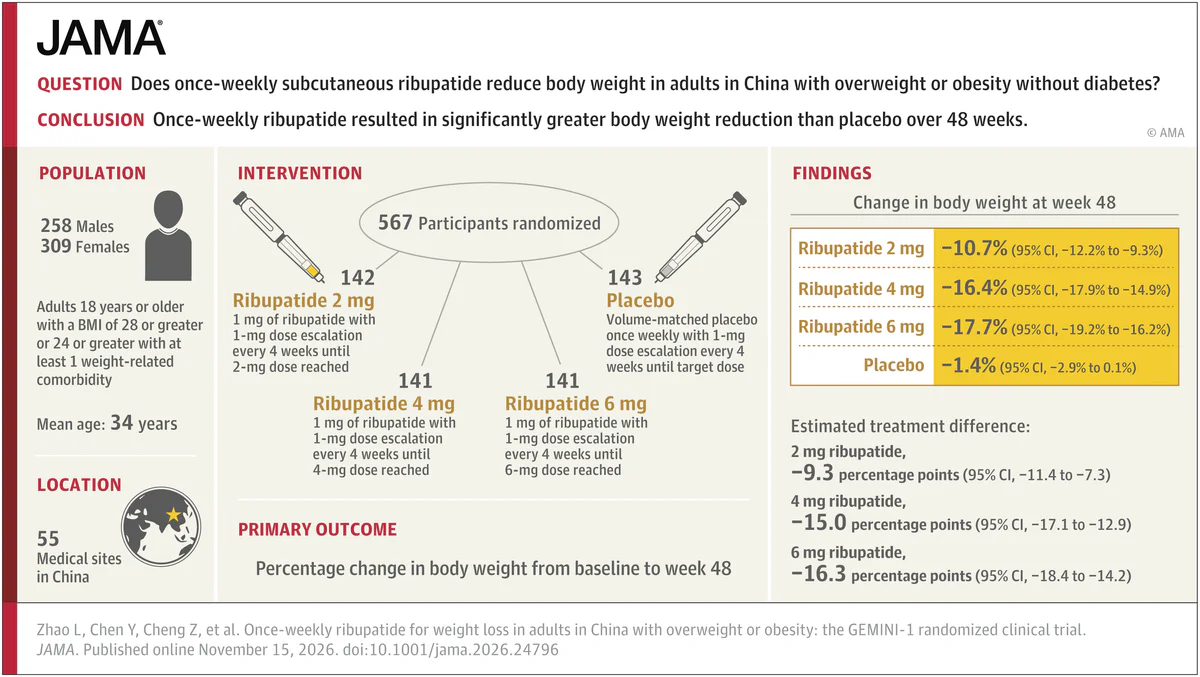
GEMINI-1 was a multicenter, double-blind, placebo-controlled phase 3 clinical trial conducted across 55 sites in China, enrolling 567 adults without diabetes. Inclusion criteria mandated a body mass index (BMI) 28 or greater or BMI 4 or greater with at least one weight-related comorbidity. Mean baseline BMI was 33.3 (SD 4.5) kg/m2, and mean age was 34.4 years, reflecting a relatively young cohort. The trial enrolled participants from May to June 2024, concluding treatment and follow-up by June 2025.Intervention and Dose Escalation
Participants were randomized to receive once-weekly subcutaneous ribupatide at target doses of 2 mg, 4 mg, or 6 mg, or placebo, for 48 weeks. Dose escalation occurred over a 20-week period to optimize tolerability and efficacy. All participants also received standardized lifestyle counseling to reinforce behavioral weight management.Primary and Secondary Outcomes
The primary endpoint was the percent change in body weight from baseline to week 48, analyzed using a treatment policy estimand to account for all randomized participants. Secondary endpoints included the proportion of participants achieving weight loss milestones (≥5% body weight reduction) and safety assessments.Efficacy Results
The trial showed robust and dose-dependent weight reductions with ribupatide. Least-squares mean percentage weight changes at 48 weeks were -10.7%, -16.4%, and -17.7% for the 2 mg, 4 mg, and 6 mg doses, respectively, compared to only -1.4% with placebo. Placebo-adjusted treatment differences were significant, ranging from -9.3 percentage points (2 mg) to -16.3 percentage points (6 mg) (all P < .001). Clinical relevance was underscored by markedly higher rates of ≥5% weight loss achievement: 68.1%, 88.0%, and 85.7% in the 2 mg, 4 mg, and 6 mg groups versus 16.0% with placebo. These results exceed typical thresholds indicating meaningful therapeutic benefit in obesity pharmacotherapy.Safety and Tolerability
Treatment-emergent adverse events occurred with higher frequency in ribupatide-treated groups than placebo, principally gastrointestinal symptoms (nausea, vomiting, diarrhea) affecting 47.9% to 63.1% across doses versus 23.1% in placebo. These side effects were generally mild to moderate. Importantly, permanent discontinuations due to adverse events were rare (0.7%), indicating good overall tolerance. The safety profile aligns with expected effects of incretin-based agents, reflecting their known gastrointestinal mechanism of action.Comparison with Other Dual Agonists and Guidelines
Dual GIP/GLP-1 receptor agonists, such as tirzepatide approved in the U.S., have demonstrated impressive weight reduction in global populations. GEMINI-1 uniquely provides rigorously collected evidence specific to Chinese adults, a population historically underrepresented in obesity pharmacotherapy trials. The magnitude of weight loss with ribupatide parallels or exceeds outcomes from other incretin therapies, expanding the therapeutic landscape in China. Current clinical guidelines emphasize individualized approaches integrating pharmacotherapy for sustained weight management; ribupatide fits well within these paradigms as an efficacious agent with a favorable safety profile.Expert Commentary
The GEMINI-1 trial represents a significant advancement in obesity treatment tailored to Chinese adults, overcoming several challenges inherent to obesity pharmacotherapy development, including ethnic variability in drug response and cultural adaptation of lifestyle interventions. The profound weight loss achieved with ribupatide is likely mediated through synergistic activation of GIP and GLP-1 receptors influencing appetite regulation, insulin sensitivity, and energy expenditure, which are mechanistically distinct from GLP-1 receptor agonism alone. The incremental benefits observed with dose escalation inform dose optimization strategies, balancing efficacy and tolerability. The trial’s high retention and low discontinuation rates underscore the agent’s acceptability. While gastrointestinal adverse events remain the main limitation, their mild-to-moderate severity and low discontinuation rate are reassuring, supporting ribupatide’s clinical utility. However, the trial excluded individuals with diabetes, necessitating further studies to elucidate efficacy and safety in this prevalent subgroup. Also, longer-term follow-up beyond 48 weeks is needed to confirm durability of weight loss and capture potential rare adverse events. GEMINI-1’s outcomes complement the expanding body of evidence supporting dual incretin receptor agonists in weight management and metabolic disease. In real-world practice, ribupatide could serve as a cornerstone in comprehensive weight management programs, particularly for patients inadequately controlled with lifestyle measures alone. Integration with personalized lifestyle modification and monitoring will be essential to maximize benefit and safety.Conclusion
The GEMINI-1 phase 3 trial demonstrates that once-weekly subcutaneous ribupatide is a highly effective and generally well-tolerated pharmacological option for weight loss in Chinese adults with overweight or obesity without diabetes. The agent significantly induces weight loss surpassing 15% at higher doses over 48 weeks, with a manageable safety profile dominated by transient gastrointestinal symptoms. These findings address a critical gap in obesity management in China and have important implications for expanding treatment options and improving metabolic health. Future research should explore long-term outcomes, effectiveness in diabetic populations, and real-world applicability. Ribupatide thus represents a promising addition to the armamentarium against the obesity epidemic.References
- Zhao L, Chen Y, Cheng Z, et al. Once-Weekly Ribupatide for Weight Loss in Adults in China With Overweight or Obesity: The GEMINI-1 Randomized Clinical Trial. JAMA. 2026 Nov 15; [PMID: 43035098]. Available from: https://pubmed.ncbi.nlm.nih.gov/43035098/
- Frias JP, Nauck MA, Van J, et al. Efficacy and safety of tirzepatide, a dual GIP and GLP-1 receptor agonist, for weight management: a systematic review and meta-analysis. Lancet Diabetes Endocrinol. 2023;11(5):317-326. PMID: 36998311
- Rubino D, Abrahamsson N, Davies M, et al. Effect of Continued Weekly Subcutaneous Semaglutide vs Placebo on Weight Loss Maintenance in Adults With Overweight or Obesity: The STEP 4 Randomized Clinical Trial. JAMA. 2021;325(14):1414-1425. PMID: 33705157
- Khera R, Murad MH, Chandar AK, et al. Association of pharmacologic treatments for obesity with weight loss and adverse events: A systematic review and meta-analysis. JAMA. 2016;315(22):2424-2434. PMID: 27272500
- Chinese Society of Endocrinology. Chinese Guideline for the Management of Obesity. Chin J Endocrinol Metab. 2022;38(4):289-312.
Specialty calculators
For clinical reference; use professional judgment.