Highlight
This feasibility randomized controlled trial (RCT) investigated a virtual reality (VR)-enhanced cycling intervention in individuals with painful knee osteoarthritis (OA), demonstrating high feasibility, excellent adherence, minimal technical issues, and improved clinical outcomes, supporting progression to a full-scale trial.
Key takeaways include VR’s potential to mitigate exercise barriers in knee OA such as pain and boredom, the intervention’s high acceptability and credibility among participants, and comparable improvements in pain, function, and exercise capacity across VR and traditional cycling groups.
Study Background
Knee osteoarthritis is a prevalent degenerative joint disease characterized by chronic pain, diminished function, and reduced quality of life. Current clinical guidelines consistently recommend exercise as a foundational treatment due to its efficacy in improving pain and mobility. However, exercise uptake remains suboptimal, often hindered by pain during activity, perceptions of exercise as overly strenuous, and boredom that reduces motivation and adherence.
Virtual reality technologies have emerged as promising tools to enhance engagement and reduce perceived barriers in rehabilitation by providing immersive environments that distract from pain and monotony. Despite this potential, evidence regarding the feasibility, acceptability, and preliminary efficacy of VR-enhanced exercise in knee OA populations, particularly within supervised physical therapy settings, has been limited.
Study Design
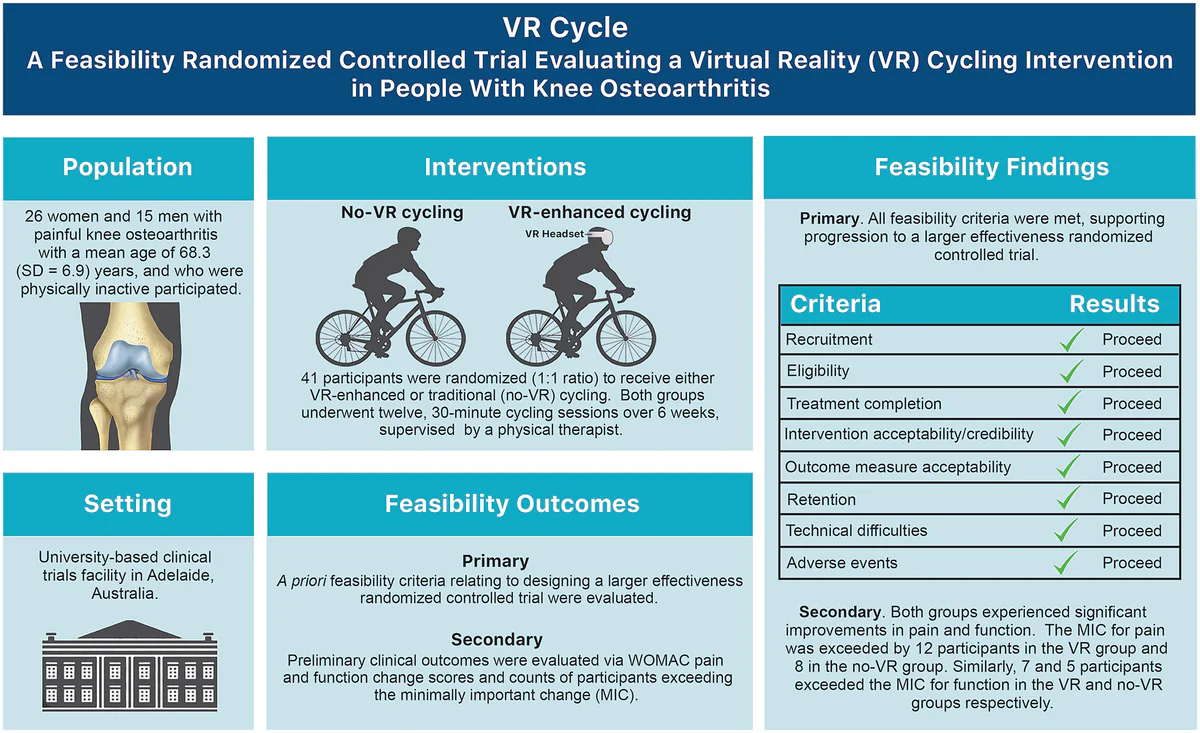
This study was a prospectively registered (ACTRN12624000122550), two-arm feasibility RCT conducted at a clinical trials facility. Forty-one adults suffering from painful knee OA were randomly assigned in a 1:1 ratio to either a VR-enhanced cycling intervention or a traditional, non-VR cycling control. Both groups participated in twelve supervised 30-minute cycling sessions over 6 weeks under physical therapist guidance.
The primary outcomes were feasibility indices including recruitment and enrollment rates, adherence to intervention sessions, incidence of technical difficulties, retention rates, and participant experience assessments encompassing acceptability, credibility, and adverse event monitoring. Secondary exploratory outcomes included clinical measures of pain and function assessed at baseline, post-intervention, and 1-month follow-up, alongside exercise capacity measured by a perceptually regulated exercise test. Process variables were also collected to evaluate within-session engagement including exercise work, duration, perceived exertion, and affective response.
Key Findings
All pre-specified feasibility criteria were met or exceeded. An average of 6.8 eligible participants were identified weekly, with a 73% enrollment rate demonstrating strong recruitment capability. Participants showed high adherence, attending 91% of intervention sessions, and retention was excellent with 90% completing all follow-ups.
Technical issues related to VR equipment were rare, documented in only 3% of sessions. Adverse events were infrequent and none were attributable to the VR intervention, underscoring safety. Participant feedback highlighted high acceptability and credibility of the VR-enhanced cycling experience.
Clinically, both VR and traditional cycling groups exhibited improvements in knee pain, physical function, and exercise capacity post-intervention, which were maintained at one month. Although this pilot trial was not powered to demonstrate superiority of VR over traditional cycling, the observed within-group changes suggest both modalities can confer meaningful clinical benefits.
Process measures of exercise engagement indicated comparable work output and session durations between groups. Ratings of perceived exertion and affect were also similar, implying that VR did not increase or decrease subjective exercise difficulty but may have improved engagement via immersive distraction.
Expert Commentary
Incorporating VR technology into exercise programs for knee OA appears promising as an innovative strategy to enhance adherence by addressing common barriers such as pain-related avoidance and boredom. The high feasibility and acceptability observed in this trial align with evolving evidence supporting VR’s role in pain modulation and rehabilitation.
Limitations include the small sample size inherent in feasibility studies, and lack of blinding. Future larger trials should be powered to detect differential efficacy, explore long-term adherence, and assess cost-effectiveness. Additionally, investigating subgroups who derive maximal benefit or mechanistic insights into how VR modulates pain perception during exercise would further optimize intervention design.
Conclusion
VRCycle demonstrates that a VR-enhanced cycling intervention is a feasible, acceptable, and safe adjunct to traditional rehabilitation in people with knee osteoarthritis. Both VR and non-VR cycling led to clinical improvements in pain, function, and exercise capacity. These findings provide a strong rationale to proceed with fully powered randomized trials to establish the efficacy and implementation potential of VR exercise interventions in this population.
Funding and Trial Registration
The trial was prospectively registered with the Australian New Zealand Clinical Trials Registry (ACTRN12624000122550). Specific funding sources were not detailed in the abstract.
References
MacIntyre E, Jordán-López J, Kasai D, García-Lucas C, Van Der Laan D, Smith AE, Parfitt G, Stanton TR. VRCycle: A Feasibility Randomized Controlled Trial Evaluating a Virtual Reality Cycling Intervention in People With Knee Osteoarthritis. Physical Therapy. 2026 Nov 12. PMID: 43016107.
Bannuru RR, Osani MC, Vaysbrot EE, et al. OARSI guidelines for the non-surgical management of knee, hip, and polyarticular osteoarthritis. Osteoarthritis Cartilage. 2019 Nov;27(11):1578-1589.
Barclay L, Murnane A, Menzies RA, McIntyre A, Haines TP. Digital health interventions for managing pain and improving function among people with knee osteoarthritis: a systematic review. J Orthop Sports Phys Ther. 2022.
Specialty calculators
For clinical reference; use professional judgment.