Highlight
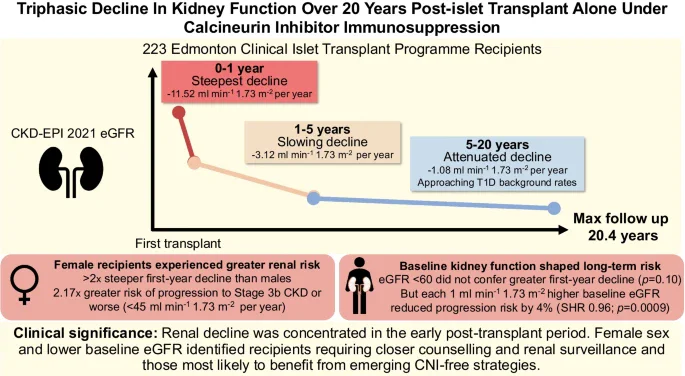
1. Kidney function after islet transplantation exhibits a triphasic decline: rapid decrease in the first year, followed by slowing over 20 years.
2. Female recipients experience a significantly greater early drop in eGFR and higher progression to stage 3b CKD than males.
3. Lower baseline kidney function and female sex independently predict long-term chronic kidney disease progression.
4. Findings underscore the clinical importance of developing calcineurin inhibitor-free immunosuppression protocols to preserve kidney health post-transplant.
Study Background
Islet transplantation alone (ITA) is an established therapeutic option for type 1 diabetes patients with severe hypoglycaemia unresponsive to conventional therapies. By delivering insulin-producing islets, it aids glycemic control and mitigates hypoglycaemic episodes. However, ITA mandates ongoing immunosuppression, commonly based on calcineurin inhibitors such as tacrolimus, which are known for nephrotoxic effects. Chronic kidney disease (CKD) remains a significant concern in this population, as immunosuppressive regimens can accelerate renal functional decline, thus limiting long-term benefits. Understanding the trajectory of kidney function post-ITA and identifying factors impacting renal outcomes are essential to optimize patient care and inform safer immunosuppressive strategies. The University of Alberta Hospital maintains the world’s largest and longest-running ITA program, offering a valuable cohort for longitudinal kidney outcome assessment over nearly 20 years.
Study Design
This retrospective cohort study included 223 adults (41% male) who underwent ITA at the University of Alberta Hospital between 1999 and 2018. Inclusion criteria consisted of adult recipients of islet transplantation alone, with baseline kidney function measured by estimated glomerular filtration rate (eGFR). The study used mixed-effects models to analyze eGFR decline rates longitudinally, stratified by sex and baseline eGFR values. Acute changes in kidney function within 3 months of each islet infusion were also assessed. Cox proportional hazards and competing risk regression models identified predictors of progression to moderate-severe CKD, defined by eGFR dropping below 45 ml/min/1.73 m^2 (stage 3b CKD). Variables adjusted in multivariable analyses included sex, baseline eGFR, and tacrolimus exposure.
Key Findings
The analysis revealed a triphasic pattern of kidney function decline after ITA under calcineurin inhibitor immunosuppression:
– The first year exhibited a rapid eGFR decline averaging -11.52 ml/min/1.73 m^2 per year (95% CI -13.92, -9.00).
– From years 1 to 5, decline slowed significantly to -3.12 ml/min/1.73 m^2 per year (95% CI -3.84, -2.28).
– Beyond 5 years (up to 20 years), the decline reduced further to -1.08 ml/min/1.73 m^2 per year (95% CI -1.80, -0.36).
Sex-based differences were pronounced:
– Female recipients experienced a more substantial first-year decline (-14.79 ml/min/1.73 m^2 per year) than males (-6.75 ml/min/1.73 m^2 per year; p=0.0012).
– Despite similar baseline eGFR and tacrolimus dosing between sexes, females had double the risk of progressing to stage 3b CKD (sub-distribution hazard ratio [HR] 2.17; 95% CI 1.15, 4.17).
Baseline eGFR significantly influenced outcomes:
– Lower baseline eGFR predicted faster CKD progression (HR 0.96 per ml/min/1.73 m^2; 95% CI 0.94, 0.98; p=0.0009).
– Those with baseline eGFR <60 ml/min showed trends for similar early declines compared to those with preserved function.
Long-term follow-up (median 6.4 years) demonstrated that 21% (47/222) progressed to moderate-severe CKD.
Acute renal effects post-infusion supported rapid early nephrotoxic impact of calcineurin inhibitors, but the subsequent slowing suggests potential renal adaptation or stabilization over time.
Expert Commentary
This comprehensive two-decade study offers valuable insights into the natural history of kidney function following islet transplantation under calcineurin inhibitor immunosuppression. The triphasic eGFR decline pattern aligns with plausible mechanistic stages: initial acute nephrotoxicity, followed by partial renal functional stabilization possibly due to clinical management adjustments or self-limiting injury.
The pronounced sex difference is intriguing and biologically plausible, reflecting possible interplay of sex hormones, renal hemodynamics, and immune responses. The absence of baseline eGFR or drug exposure differences implies sex-specific susceptibility to calcineurin inhibitor nephrotoxicity, warranting focused mechanistic investigation.
While this study confirms the nephrotoxic risk profile of calcineurin inhibitors, it establishes essential benchmarks against which emerging calcineurin inhibitor-free regimens can be compared. Early-phase clinical trials of such novel immunosuppressive strategies are underway, aiming to avert or minimize renal impairment while preserving islet allograft survival.
Limitations include its single-center observational design and the potential influence of unmeasured confounders. However, the large cohort size, long follow-up, and robust statistical modeling enhance the validity and clinical relevance of findings.
Conclusion
This landmark 20-year study delineates a triphasic, sex-dependent decline in kidney function in patients undergoing islet transplantation with calcineurin inhibitor-based immunosuppression. Females and patients with preexisting lower kidney function exhibit greater vulnerability to progressive CKD. These data underscore the urgent need for personalized approaches and safer immunosuppressive protocols, particularly calcineurin inhibitor-free regimens, to optimize renal outcomes and extend the benefits of islet transplantation for type 1 diabetes. Future research should elucidate sex-specific mechanisms to guide tailored nephroprotection strategies in this growing patient population.
Funding and Clinical Trial Information
Details regarding funding sources and trial registrations for this study were not specified in the provided abstract.
References
1. Carr ALJ, Marfil-Garza BA, Ling Y, et al. Triphasic decline in kidney function after islet transplantation: sex-based differences and the impact of calcineurin inhibitor immunosuppression in a 20 year single-centre cohort. Diabetologia. 2026 Nov 14. PMID: 43034240.
2. Shapiro AMJ, et al. Clinical islet transplantation: advances and challenges. Nat Rev Endocrinol. 2017.
3. Naesens M, et al. Calcineurin inhibitor nephrotoxicity. Clin J Am Soc Nephrol. 2009.
4. Haller MC, et al. Sex differences in chronic kidney disease progression: a systematic review. Nephrol Dial Transplant. 2020.
Specialty calculators
For clinical reference; use professional judgment.