Cardiac Resynchronization Therapy With or Without Defibrillator in Nonischemic Cardiomyopathy: Evidence Synthesis and Clinical Implications from DECIDE-CRT and Related Studies

Cardiac Resynchronization Therapy With or Without Defibrillator in Nonischemic Cardiomyopathy: Evidence Synthesis and Clinical Implications from DECIDE-CRT and Related Studies

Highlights

  • The DECIDE-CRT nationwide cohort study found no statistically significant survival advantage of adding a defibrillator (CRT-D) over CRT pacing alone (CRT-P) in patients with nonischemic cardiomyopathy (NICM) over 5 years.
  • Meta-analyses and randomized trial subanalyses show mixed results—with some evidence suggesting CRT-D reduces all-cause mortality especially in younger NICM patients, though benefits attenuate in older populations.
  • Emerging risk stratification tools, including cardiac magnetic resonance (CMR) scar imaging and periodic repolarization dynamics (PRD), help identify NICM patients more likely to benefit from ICD therapy.
  • Sex-specific and etiology-dependent differences affect arrhythmic risk and device efficacy, underscoring personalized approaches in device selection for NICM patients.

Background

Nonischemic cardiomyopathy (NICM) constitutes a substantial proportion of heart failure with reduced ejection fraction (HFrEF) cases. Cardiac resynchronization therapy (CRT) improves symptoms, reverse remodeling, and survival in select patients with wide QRS complex and impaired left ventricular function. The adjunctive use of implantable cardioverter-defibrillators (ICDs) with CRT (CRT-D) is well established in ischemic cardiomyopathy; however, the incremental benefit of CRT-D over CRT pacing alone (CRT-P) in NICM remains controversial. This is partly due to a potentially lower burden of ventricular arrhythmias, heterogeneity in myocardial substrate, diverging trial outcomes, and evolving heart failure medical therapy.

Key Content

Evidence from DECIDE-CRT and Complementary Cohort Studies

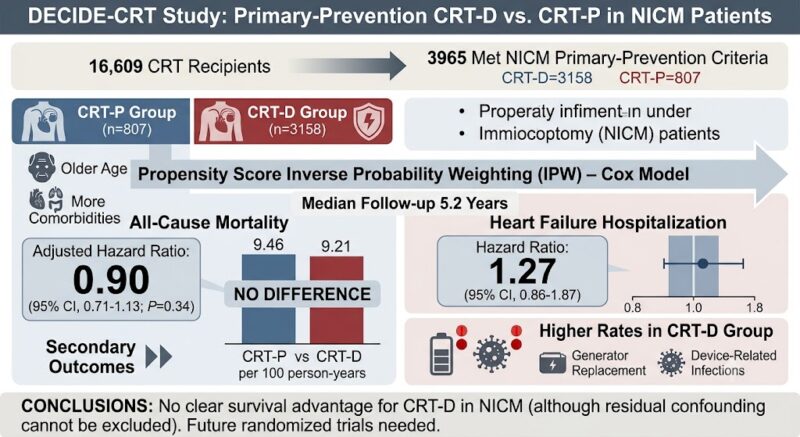
The DECIDE-CRT study (Selvaganesan et al., 2026) is a large multicenter cohort study conducted across 170 US Veterans Affairs hospitals, enrolling 3,965 NICM patients receiving primary-prevention CRT-D (n=3,158) or CRT-P (n=807) between 2006 and 2020. Propensity score inverse probability of treatment weighting balanced baseline imbalances such as older age and comorbidities in the CRT-P group. Median follow-up was 5.2 years. Mortality rates were statistically comparable (adjusted HR for all-cause mortality 0.90, 95% CI 0.71-1.13, P=0.34). No differences were observed in heart failure hospitalizations. CRT-D carriers incurred higher rates of generator replacement and device-related infections.

Additional real-world registry analyses (e.g., National Readmissions Database 2016-2020) similarly found no significant mortality reduction with CRT-D versus CRT-P in NICM, with trends even favoring CRT-P in some short-term outcomes, though limitations of observational design and residual confounding persist.

Meta-Analyses and Randomized Evidence

A 2025 systematic review and meta-analysis by Wang et al. analyzed 12 studies (including two RCTs) with 62,145 NICM patients. Pooled data indicated a significant reduction in all-cause mortality with CRT-D compared to CRT-P (OR 0.72; 95% CI 0.61-0.85; P75 years, highlighting age and comorbidities as important modifiers of ICD benefit in NICM.

The COMPANION trial subgroup analyses also demonstrated that CRT-D conferred mortality benefit over CRT-P in NICM (adjusted HR 0.54), contrasting with ischemic cardiomyopathy patients, who derived no significant survival advantage.

Risk Stratification and Biomarkers

Refined patient selection based on arrhythmic risk is critical. Risk scores developed from MADIT trials incorporate variables such as left ventricular ejection fraction ≤25%, male sex, absence of CRT-D indication, and race to predict ventricular tachyarrhythmia (VTA) risk in NICM.

Cardiac magnetic resonance imaging (CMR) identifying late gadolinium enhancement (LGE) myocardial fibrosis has emerged as a strong prognostic biomarker. Absence of LGE portends lower arrhythmia risk and better CRT response, favoring CRT-P strategy, while LGE presence correlates with higher arrhythmia incidence and may justify CRT-D.

The ongoing BRITISH randomized trial (NCT04139460) is prospectively evaluating CMR scar-based patient selection to optimize ICD implantation decisions in NICM.

Similarly, the DANISH trial PRD substudy identified periodic repolarization dynamics as a marker to help identify NICM patients who derive mortality benefit from ICD implantation.

Sex and Etiology-Specific Considerations

Data from BIO-LIBRA and MADIT report sex-based disparities—women with NICM show significantly lower risks of ventricular arrhythmias and mortality after ICD/CRT-D implantation compared to men. This underlines the need for personalized risk assessment incorporating sex differences.

Etiology-dependent prognostic studies highlight that atrial fibrillation worsens outcomes more in NICM than ischemic cardiomyopathy (ICM) populations, reflecting distinct myocardial remodeling patterns.

Long-Term Outcomes and Device Therapy Trends

Mayo Clinic data show NICM patients have longer survival post-CRT-D (>16 years on average) compared to ICM (~9 years), affirming durable benefits of CRT in NICM.

Observational registries reveal increasing CRT and CRT-D use over time, with variable practice patterns and underutilization in women, emphasizing equity gaps.

Expert Commentary

The DECIDE-CRT study provides valuable real-world evidence suggesting no clear survival advantage of CRT-D over CRT-P in NICM, challenging routine routine ICD addition in this population. However, residual confounding and selection bias limit definitive conclusions.

Meta-analyses and RCT data point to a modest survival benefit in selected NICM patients, particularly younger cohorts without significant comorbidity burden. Older patients derive less clear benefit due to competing mortality risks.

Risk stratification integrating advanced imaging (CMR), electrocardiographic markers (PRD), and clinical variables could individualize ICD deployment, potentially sparing low-risk NICM patients from device-related morbidity.

Sex-specific analyses reveal lower arrhythmic burden in women, suggesting nuanced ICD decisions by sex are warranted.

Pending results from prospective randomized trials such as BRITISH and CRT-REALITY are critical to inform guideline revisions and clinical practice.

Mechanistically, arrhythmic risk in NICM is heterogeneous, linked to myocardial fibrosis burden and autonomic instability rather than extensive scar as in ICM, modulating ICD utility.

Conclusion

The integration of current evidence from DECIDE-CRT and other studies calls for a personalized approach in deciding CRT with or without defibrillator therapy in NICM. While CRT-D may improve survival in younger, higher-risk patients, its routine use in all NICM individuals remains unsupported by conclusive data.

Advanced risk stratification using imaging and electrophysiologic biomarkers is essential for optimizing device therapy. Sex and age are important clinical modifiers.

High-quality randomized controlled trials targeting well-defined NICM subgroups are urgently needed to resolve uncertainties and refine device therapy recommendations.

Clinicians should weigh benefits against risks of device-related complications and patient preferences.

References

  • Selvaganesan P, Karnib M, Helmy I, et al. Cardiac Resynchronization With or Without Defibrillator in Nonischemic Cardiomyopathy: A Nationwide Cohort Study (DECIDE-CRT). Circ Heart Fail. 2026 Aug 7:e014213. PMID: 42565236.
  • Wang XY, Dai ZH, Zhang YL. Adding implantable cardioverter-defibrillator to cardiac resynchronization therapy in patients with non-ischemic cardiomyopathy: A systematic review and meta-analysis with focus on elderly subpopulation. J Geriatr Cardiol. 2025 Sep 28;22(9):775-783. PMID: 41143163.
  • Bhatia GS, Klein HU, et al. Cardiac MRI Scar as a Predictor of ICD Benefit in NICM: BRITISH Trial rationale and design. Am Heart J. 2023;266:149-158. PMID: 37777041.
  • Yoshida K, Reddy V, et al. Risk stratification for ventricular tachyarrhythmia in patients with nonischemic cardiomyopathy. J Cardiovasc Electrophysiol. 2025 Jan;36(1):188-197. PMID: 39533482.
  • Cleland JGF, Cowie MR, et al. The Addition of a Defibrillator to Resynchronization Therapy Decreases Mortality in Patients With Nonischemic Cardiomyopathy. JACC Heart Fail. 2021 Jun;9(6):439-449. PMID: 33992570.
  • Balsam LB, Parikh A, et al. Sex Differences in the Risk of First and Recurrent Ventricular Tachyarrhythmias Among Patients Receiving an ICD for Primary Prevention. JAMA Netw Open. 2022 Jun 1;5(6):e2217153. PMID: 35699956.

Comments

No comments yet. Why don’t you start the discussion?

Leave a Reply