Introduction
Intimate partner violence (IPV) remains a profound public health concern characterized by physical, emotional, and legal challenges that adversely affect survivors’ health and well-being. Survivors often grapple with multiple social determinants of health such as housing instability, financial strain, and legal complications, which exacerbate health outcomes. The Veterans Health Administration (VHA) presents a unique clinical environment where many veterans experience IPV amid complex psychosocial issues. Medical-legal partnerships (MLPs), which integrate legal professionals into healthcare teams, offer an evidence-based approach to address these intersecting needs by facilitating access to civil legal services including eviction prevention, custody disputes, and benefits advocacy. Despite promising evidence, implementation of MLPs specifically tailored for IPV survivors remains underexplored. This article critically examines a qualitative study investigating the implementation challenges and enablers of MLPs within the VHA to optimize care delivery for this vulnerable population.
Study Design and Methods
This qualitative multi-site study employed semi-structured interviews and ethnographic document analysis guided by the revised Consolidated Framework for Implementation Research (CFIR). Twenty-five VHA clinical staff—including clinicians, social workers, and frontline team members involved in IPV care coordination and MLP referrals—were purposively sampled to capture diverse perspectives on MLP service delivery. Interviews explored existing MLP practices, perceived implementation outcomes, barriers, facilitators, and strategies used in managing IPV survivor needs within the legal-health nexus. Collected documents supplemented understandings of procedural workflows and implementation contexts.
Key Findings
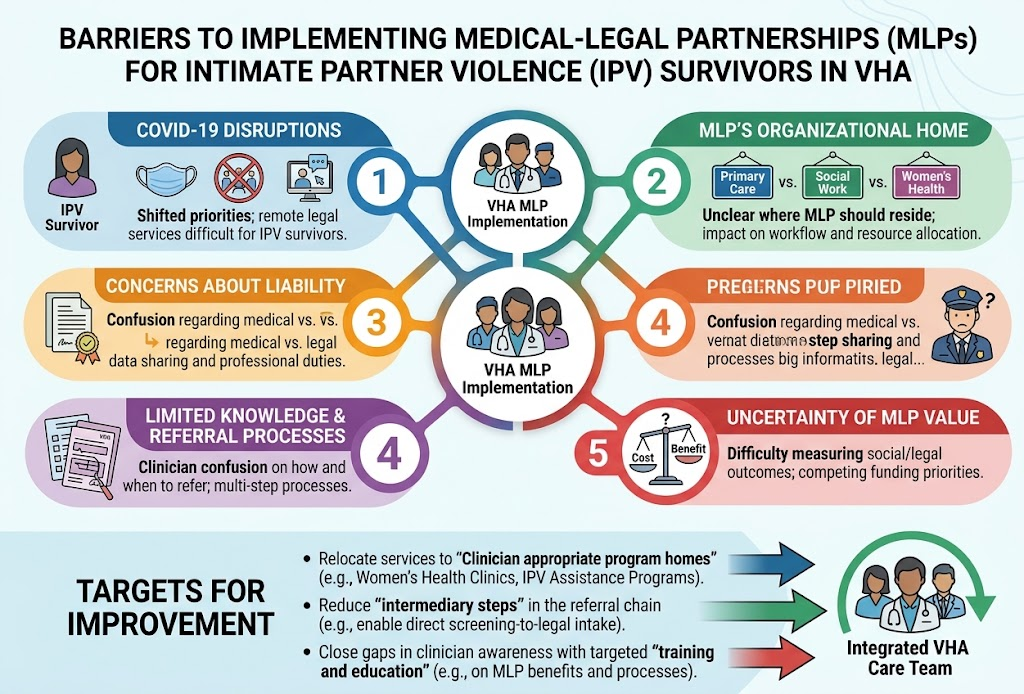
Analysis revealed five major cross-cutting factors influencing MLP implementation for IPV survivors within the VHA.
1. COVID-19-Related Disruptions
The pandemic substantially disrupted operational workflows, reducing face-to-face interactions and complicating referrals to legal partners. Virtual care models introduced both barriers and novel opportunities, underscoring the need for adaptive strategies to maintain connectivity between clinical and legal services.
2. Organizational Placement of MLPs
The “home” or departmental location of MLP services within the VHA significantly impacted access and integration. Services housed in clinically relevant programs—such as primary care or social work—experienced greater visibility and utilization compared to those located in administrative or peripheral units.
3. Liability Concerns
Clinicians expressed apprehension regarding liability when referring patients to legal services, which sometimes hindered willingness to engage with MLPs. Clarifying roles and protections for healthcare staff emerged as a potential facilitator to enhance referral confidence.
4. Knowledge Gaps on Legal Services and Referral Processes
Limited clinician awareness of available legal resources and appropriate referral pathways constituted a critical barrier. Participants emphasized the need for systematic education and simplified protocols to streamline interdisciplinary collaboration.
5. Uncertainty About MLP Value
Skepticism regarding the tangible benefits of MLP involvement, particularly in demonstrating measurable health outcomes or legal resolutions, reduced investment and advocacy from clinical teams. Robust evaluation and dissemination of positive outcomes are needed to strengthen perceived value.
Several of these barriers are rooted in outer setting conditions—such as funding constraints and systemic resource limitations—that are challenging to modify directly. However, modifiable factors were identified, including re-siting MLPs within integrated clinical programs, reducing intermediary steps in referral chains, and enhancing clinician education about legal service impacts.
Expert Commentary
The findings affirm previous literature recognizing IPV survivors’ multifaceted needs and the promise of MLPs as a multidisciplinary response. Implementing MLPs effectively requires not only infrastructural support but also cultural alignment within healthcare teams. Addressing liability concerns and bridging knowledge gaps align with best practices in implementation science and promote sustainability. Additionally, the COVID-19 pandemic’s influence on hybrid care delivery models offers a compelling impetus to innovate referral processes and interprofessional communication.
Nevertheless, the study has limitations inherent to qualitative designs, including limited generalizability beyond the VHA context and reliance on participant self-report. Future research incorporating quantitative outcome measures and patient perspectives would enrich understanding of MLP effectiveness and scalability.
Conclusions and Implications for Practice
This study underscores critical implementation challenges for embedding legal services within VHA clinical settings to support veterans experiencing IPV. Targeted efforts to relocate MLPs into clinically appropriate departments, simplify referral pathways, and enhance clinician knowledge hold promise for increasing access and uptake. Successful integration of MLPs could substantially mitigate adverse legal and social determinants impacting IPV survivors’ health. These insights provide a valuable framework for other healthcare systems aiming to implement scalable medical-legal collaborations tailored to survivors’ unique needs, ultimately advancing a holistic model of care that bridges health and justice sectors.
Funding and Trial Registration
This qualitative study did not involve clinical trial registration or external funding disclosures.
References
1. Bodkin, A. W., & S. M. Luna. “Medical-Legal Partnerships: A Model for Integrating Medical and Legal Care.” Journal of General Internal Medicine, vol. 32, no. 8, 2017, pp. 920–925.
2. Dichter, M. E., et al. “Addressing Intimate Partner Violence Among Veterans: Perspectives from the Veterans Health Administration.” Journal of Interpersonal Violence, vol. 34, no. 13, 2019, pp. 2703-2727.
3. Institute of Medicine. “Clinical Prevention Services for Women: Closing the Gaps.” National Academies Press, 2011.
4. Borrero, S., et al. “Implementation Science in Addressing Intimate Partner Violence in Healthcare Settings.” Implementation Science, vol. 15, 2020, 14.
5. Quinn, D., et al. “Barriers to Implementing Medical-Legal Partnerships for Survivors of Intimate Partner Violence: Qualitative Perspectives from the Veterans Health Administration.” Journal of General Internal Medicine, 2026.