Introduction and Context
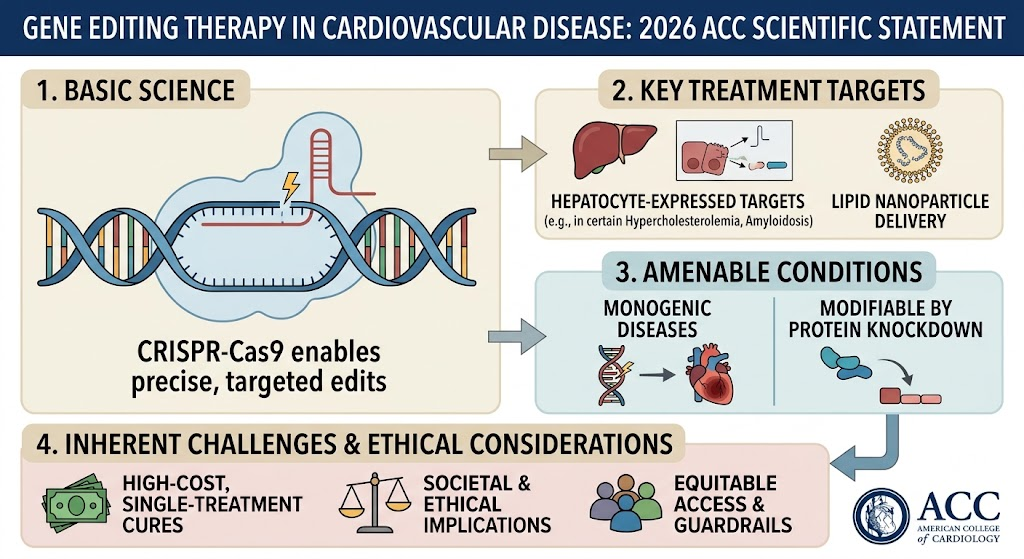
Cardiovascular diseases long regarded as the product of environment, lifestyle, and aging are increasingly recognized to have a strong genetic component. Advances in genomic sequencing, falling costs of testing, and greater clinical uptake of genetic diagnosis have identified patient subsets whose disease is driven by single-gene defects or by liver-produced proteins that drive systemic disease. In parallel, laboratory advances — most notably CRISPR-related genome editing and efficient RNA-interference strategies delivered by lipid nanoparticles (LNPs) — have moved from concept to early human trials.
Against this rapidly changing scientific landscape, the American College of Cardiology (ACC) issued a 2026 Scientific Statement titled “Gene Editing Therapy in Cardiovascular Disease” (Ambardekar AV et al., J Am Coll Cardiol. 2026). The statement is not a prescriptive therapeutic guideline but instead is an expert consensus designed to equip clinicians with the biology, indications, patient-selection framework, safety considerations, and ethical guardrails needed as gene editing therapies begin to enter clinical use for cardiovascular conditions.
Why this statement matters now: first-in-human in vivo editing trials targeting liver-expressed disease proteins (notably transthyretin) have demonstrated proof of concept for single-dose curative intent therapies. LNP delivery has lowered a major barrier for liver-targeted editing, and protein knockdown approaches (e.g., PCSK9, TTR) show durable clinical promise. The ACC statement synthesizes these advances and provides practical recommendations for cardiologists and cardiovascular teams who will increasingly be asked to evaluate, refer, and co-manage patients being considered for gene editing treatments.
New Guideline Highlights
Major themes and high-level recommendations from the 2026 ACC Scientific Statement:
– Scope of applicability: The statement identifies three domains most immediately amenable to gene editing in cardiovascular care: liver-expressed protein disorders (e.g., transthyretin amyloidosis variants and certain familial hypercholesterolemia targets), monogenic cardiomyopathies where somatic editing of cardiomyocytes becomes feasible, and systemic metabolic drivers of atherosclerotic disease amendable to durable protein knockdown (e.g., PCSK9).
– Standardize candidate evaluation: The ACC urges routine genetic confirmation before any gene editing intervention. Multidisciplinary evaluation (cardiology, medical genetics, genetic counseling, hepatology when relevant, and a specialized gene therapy team) is recommended.
– Safety and monitoring infrastructure: Center designation, standardized informed consent (covering known and unknown risks), long-term follow-up (multi-decade), and mandatory registry enrollment for treated patients are core recommendations.
– Ethical and societal safeguards: The statement strongly supports strict prohibition of germline editing, robust equitable access planning, pricing transparency discussions, and public reporting.
Key takeaways for clinicians:
– Gene editing is near clinical reality for a narrow set of cardiovascular conditions but remains investigational for most.
– Referral pathways to specialized centers are essential; primary cardiologists should focus on diagnosis, patient education, and longitudinal follow-up.
– A new standard of care is emerging around pre-treatment genetic confirmation and structured, long-term surveillance for efficacy and off-target effects.
Updated Recommendations and Key Changes
The ACC 2026 Scientific Statement represents a new, focused consensus rather than a traditional update to earlier practice guidelines. However, it advances and formalizes clinician responsibilities compared with prior communications:
– From experimental to clinical-readiness framing: Earlier reviews framed in vivo editing as preclinical; the 2026 statement places certain liver-targeted approaches in a “clinical translation” category based on human trial data and FDA-regulated investigational programs.
– From general monitoring to mandated registry follow-up: Previous guidance recommended long-term surveillance for gene therapies; the ACC statement recommends mandatory enrollment in national registries and standardized monitoring intervals (baseline, 1 month, 6 months, 12 months, then annually for at least 15 years or longer depending on therapy).
– From soft ethical cautions to concrete policy recommendations: The statement provides actionable recommendations on informed consent content, prohibiting germline editing in clinical practice, and promoting equitable access frameworks.
Table: Selected changes or emphasis areas in the ACC 2026 Scientific Statement (summary)
– Clinician requirement: Prior — awareness recommended; Now — clinicians must ensure genetic confirmation and counseling before referral.
– Safety surveillance: Prior — suggested; Now — mandatory registry enrollment and specified monitoring schedule.
– Scope of therapy: Prior — theoretical for many disorders; Now — clinical translation endorsed for liver-targeted protein knockdown approaches (conditional).
Topic-by-Topic Recommendations
The statement provides topic-specific guidance relevant to diagnosis, candidate selection, treatment strategies, monitoring, and special populations.
1) Diagnostic confirmation and pre-treatment evaluation
– Mandatory genetic diagnosis: For monogenic conditions or when a therapeutic edit targets a specific gene product (e.g., pathogenic TTR variant), the statement recommends molecular confirmation by a CLIA-certified laboratory prior to any editing therapy.
– Baseline phenotyping: Detailed cardiac evaluation (echocardiography, cardiac MRI when indicated), biomarkers (troponin, NT-proBNP), liver function tests, viral serologies (especially when using viral vectors historically), and immunologic profiling where relevant.
– Genetic counseling: Patients and families must receive counseling on the implications of somatic editing (scope, permanence, potential heritability issues are limited because somatic editing does not alter germline) versus germline editing (disallowed clinically).
2) Disease targets judged most appropriate in the near term
– Transthyretin (TTR) amyloidosis (hereditary ATTR cardiomyopathy): The statement identifies TTR as the leading near-term target because (a) disease protein is synthesized in the liver, (b) LNPs and in vivo editing strategies have demonstrated substantial TTR knockdown in early human trials, and (c) there are already effective RNAi therapies (patisiran, vutrisiran) that provide comparative benchmarks for safety and efficacy.
– Familial hypercholesterolemia and PCSK9: For patients with severe heterozygous or homozygous familial hypercholesterolemia driven by hepatic production of atherogenic pathways, permanent or long-lived knockdown of PCSK9 or other hepatic targets is identified as an attractive approach. The statement emphasizes strict selection criteria for the earliest patients — those with refractory severe disease despite maximal medical therapy and/or with contraindications to existing therapies.
– Monogenic cardiomyopathies: The statement notes potential future applicability for sarcomere gene mutations (e.g., MYH7, MYBPC3) but highlights current technical challenges in delivering editing machinery to cardiomyocytes safely and efficiently; thus somatic cardiomyocyte editing remains investigational and is recommended only in controlled clinical trials at specialized centers.
3) Treatment strategy and delivery platforms
– Liver-targeted LNP delivery: ACC highlights LNPs as the leading delivery vehicle for hepatocyte-directed editing (for TTR, PCSK9), given their clinical track record with siRNA and the recent in vivo CRISPR trials.
– Viral vectors vs nonviral systems: Adeno-associated virus (AAV) vectors have been central to ex vivo and some in vivo gene therapies but carry risks (immune response, insertional effects) and size constraints; LNPs and CRISPR base-editors or prime editors are rising alternatives for select targets.
– Editing modality: Gene knockdown (via RNAi or editing to inactivate a gene) is currently the most clinically ready approach for cardiovascular applications. Precision correction of point mutations in cardiomyocyte genes (gene repair) remains a research priority but is not yet recommended outside trials.
4) Safety monitoring and adverse event surveillance
– Short-term monitoring: post-procedure monitoring for infusion reactions, hepatic transaminase elevations, and acute immune responses.
– Long-term surveillance: annual clinical and biochemical follow-up with specific attention to off-target editing detection strategies (where feasible), oncogenic surveillance if integrating vectors were used historically, and functional cardiac endpoints for disease-specific efficacy.
– Registry participation: All treated patients should be entered into national registries to track outcomes, durability, rare late adverse events, and real-world effectiveness.
5) Special populations
– Pediatric patients: The committee recommends exceptional caution. For disorders with severe pediatric-onset phenotypes and no alternatives, editing may be considered in highly controlled programs; otherwise, pediatric application should be delayed until more long-term adult data are available.
– Pregnancy and reproductive-age patients: Avoid administration during pregnancy. The statement recommends contraception for a defined period pre- and post-treatment and explicit counseling about reproductive considerations.
6) Ethical, legal, and societal recommendations
– No clinical germline editing: The ACC endorses a strict prohibition on clinical germline genome editing.
– Equity and affordability: Developers, payors, and health systems are urged to develop payment models and access programs to avoid inequitable concentration of benefits among wealthier patients and health systems.
– Informed consent: Must explicitly discuss unknown long-term risks, potential for off-target effects, and the experimental nature of many applications.
Recommendation Grades and Practical Summary
The ACC statement is a scientific statement and offers consensus-based recommendations rather than class/level guideline directives. For clinical clarity, the document provides suggested action categories:
– Strong consensus (recommended):
– Confirm pathogenic genetic diagnosis prior to editing referral.
– Multidisciplinary evaluation and genetic counseling.
– Enrollment in registries and defined long-term surveillance.
– Prohibition of germline editing in clinical practice.
– Conditional consensus (consider in specialized centers or trials):
– Somatic hepatocyte-directed editing for TTR and PCSK9 in patients who meet strict eligibility.
– Inclusion of pediatric patients only in exceptional circumstances and controlled trials.
– Not recommended outside trials:
– Somatic cardiomyocyte editing in routine clinical practice.
Expert Commentary and Insights
The ACC committee — a multidisciplinary group including clinical cardiologists, geneticists, molecular biologists, ethicists, and patient-representative stakeholders — offers several recurring perspectives:
– Optimism tempered by prudence: Many panelists voiced excitement about the prospect of single-dose therapies that could be curative, particularly for TTR amyloidosis, but uniformly cautioned that enthusiasm must be matched by rigorous safety surveillance.
– The central role of cardiologists: Cardiology teams will play critical roles in diagnosis, timing of therapy (for instance, whether a patient with ATTR cardiomyopathy should receive editing therapy early or after standard therapies), and long-term outcome assessment.
– Regulatory and payment challenges: Experts highlighted the need for coordinated regulatory standards and novel payment models (outcome-based contracts, annuity payments) to ensure access while sharing financial risk.
– Controversies and open questions:
– How to balance early access for severely affected patients with the need for robust long-term safety data.
– Whether single-dose curative intent therapies should be prioritized over chronic, less expensive treatments in health systems with finite resources.
– Methods for meaningful, equitable patient selection and distribution of limited initial treatment slots.
Practical Implications for Clinical Practice
Actionable steps for clinicians based on the ACC statement:
– Ensure timely genetic testing: Use CLIA-certified labs and standardized variant interpretation (e.g., ACMG criteria) before considering editing therapies.
– Build referral pathways: Identify regional or national centers offering clinical trials or approved editing therapies and streamline referrals.
– Integrate genetic counseling early: Counseling should cover alternatives (e.g., RNAi agents such as patisiran for ATTR), risks, monitoring commitments, and reproductive implications.
– Enroll patients in registries and research protocols whenever possible to contribute to the evidence base.
– Discuss cost and access up front: Prepare patients for discussions about potential out-of-pocket costs, insurance coverage uncertainty, and available patient assistance programs.
Clinical vignette (illustrative)
– John is a 62-year-old man with progressive heart failure and concentric left ventricular thickening. Genetic testing identified a pathogenic TTR variant consistent with hereditary ATTR cardiomyopathy. He has symptomatic disease despite tafamidis and is concerned about slow progression. After multidisciplinary evaluation and counseling, John is referred to a center offering an investigational in vivo CRISPR-based TTR knockdown trial. He undergoes baseline liver and cardiac evaluation, consents to registry enrollment, and receives a single LNP-delivered editing dose. Short-term monitoring shows expected transient transaminase rise; at 6 months his serum TTR is markedly reduced and functional status is improved. John remains in annual follow-up and contributes outcome data to the registry.
Future Directions and Research Needs
The ACC statement identifies key knowledge gaps and research priorities:
– Larger, longer-term studies to define durability, rare adverse events, and comparative effectiveness against existing agents (e.g., siRNA therapies).
– Improved delivery platforms for nonhepatic tissues, especially cardiomyocytes.
– Standardized assays for detecting off-target edits and harmonized registry data elements to enable pooled safety analyses.
– Socioeconomic research on access models and health-system implementation strategies.
References
(Selected key sources cited in the ACC statement and relevant foundational literature)
– Ambardekar AV, Bhatt A, Hoekstra M, Kelly MA, Musunuru K, Natarajan P. Gene Editing Therapy in Cardiovascular Disease: 2026 ACC Scientific Statement: A Report of the American College of Cardiology. J Am Coll Cardiol. 2026 Mar 26;88(10):1157-1173. PMID: 41885675. https://pubmed.ncbi.nlm.nih.gov/41885675/
– Jinek M, Chylinski K, Fonfara I, Hauer M, Doudna JA, Charpentier E. A programmable dual-RNA–guided DNA endonuclease in adaptive bacterial immunity. Science. 2012;337(6096):816–821.
– Adams D, González-Duarte A, O’Riordan WD, et al. Patisiran, an RNAi therapeutic, for hereditary transthyretin amyloidosis. N Engl J Med. 2018;379:11–21.
– Gillmore JD, et al. In vivo CRISPR-Cas9 gene editing for transthyretin amyloidosis — early human data supporting a single-dose approach. N Engl J Med. 2023; (see published trial reports for NTLA-2001 and related programs).
– National Academies of Sciences, Engineering, and Medicine. Human Genome Editing: Science, Ethics, and Governance. Washington, DC: The National Academies Press; 2017.
– Selected reviews on delivery platforms and clinical translation: see recent reviews in Nature Reviews Drug Discovery and Circulation Research for up-to-date technology discussions and safety considerations.
Bottom Line
The 2026 ACC Scientific Statement places gene editing for cardiovascular disease at a pivotal moment: certain liver-expressed, protein-driven cardiovascular conditions are now clinically approachable with editing strategies, while other important cardiac targets await better delivery technologies and safety data. For practicing clinicians, the statement offers a pragmatic roadmap: confirm diagnoses genetically, use multidisciplinary evaluation, prioritize enrollment in registries, and adopt cautious patient selection. As gene editing therapies evolve from promise to practice, cardiologists will be central to ensuring these powerful new tools are used safely, effectively, and equitably.