Highlight
- Baseline plasma metabolites can predict glycemic outcomes after lifestyle intervention (LI) in prediabetes.
- Elevated 2-hour plasma glucose (2hrPG) and ceramide C18:0/C18:1 ratio at baseline are associated with persistent prediabetes despite LI.
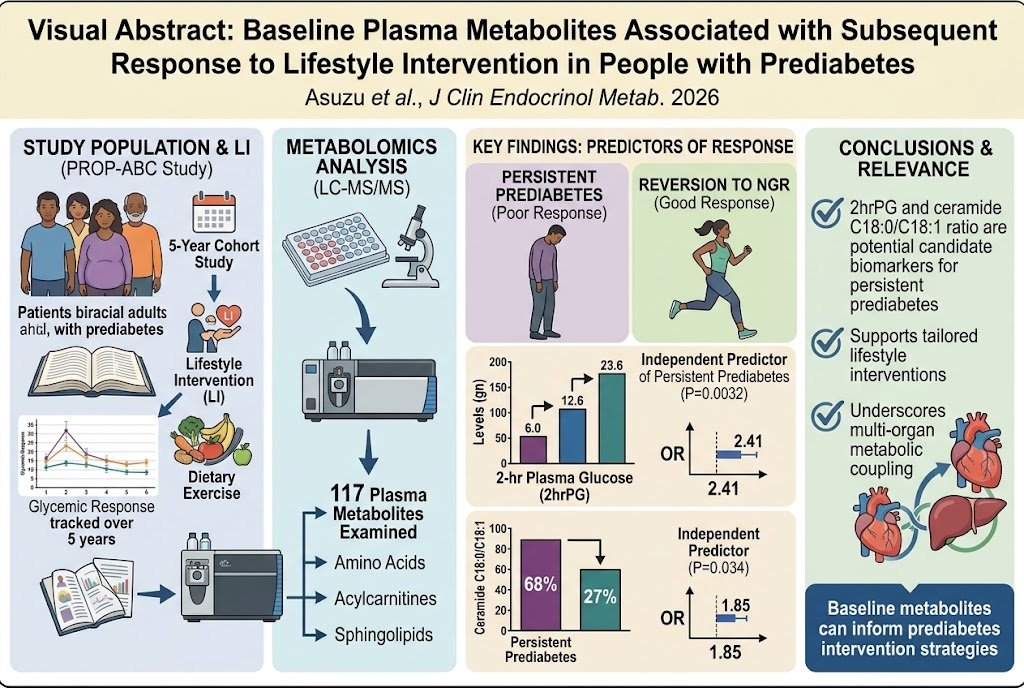
- The study analyzed 117 plasma metabolites, including amino acids, acylcarnitines, and sphingolipids, in 5-year follow-up of the PROP-ABC cohort.
- Adjustment for confounders such as age, sex, race, adiposity, insulin metrics, and weight changes strengthened metabolite-outcome associations.
Background
Prediabetes represents a critical metabolic state that precedes the development of type 2 diabetes (T2D) and increased cardiovascular risk. The progressive nature of prediabetes emphasizes the need for effective identification of individuals most likely to benefit from lifestyle interventions (LI) aimed at preventing diabetes onset. However, response variability to LI remains a challenge, and current clinical predictors fail to fully discriminate who will revert to normal glucose regulation (NGR) versus those who maintain persistent dysglycemia. Recent metabolomic profiling approaches have proposed plasma metabolites as potential biomarkers for predicting diabetes risk, reflecting underlying pathophysiological mechanisms such as insulin resistance and beta-cell dysfunction. Among metabolites, sphingolipids, including ceramides, have garnered attention for their role in insulin signaling and metabolic health. Identifying specific baseline metabolic signatures predictive of LI response would enable personalized prevention strategies and better allocation of healthcare resources.
Study Design
This longitudinal cohort study analyzed data from the Pathobiology and Reversibility of Prediabetes in a Biracial Cohort (PROP-ABC), enrolling adults with prediabetes. PARTICIPANTS underwent a 5-year lifestyle intervention focusing on diet, physical activity, and weight management. The study excluded 10 participants who developed T2D during follow-up to focus on glycemic response outcomes—persistent prediabetes or reversion to NGR. Extensive metabolic phenotyping was conducted at baseline, including anthropometric measurements, fasting plasma glucose (FPG), 2-hour plasma glucose (2hrPG) during oral glucose tolerance tests, insulin sensitivity and secretion indices, and plasma metabolite profiling.
Metabolite quantification employed liquid chromatography-tandem mass spectrometry (LC-MS/MS) to measure 18 amino acids, 45 acylcarnitines, and 54 sphingolipids. The primary outcome was glycemic status after 5 years of LI, classified as remaining prediabetic or returning to normal glycemia.
Statistical analyses included logistic regression models adjusting for confounders: age, sex, race, adiposity measures, insulin sensitivity and secretion, and percent changes in weight and waist circumference during follow-up.
Key Findings
Among the 117 baseline metabolites studied, two stood out as significant predictors of persistent prediabetes despite LI: baseline 2-hour plasma glucose (2hrPG) and the ratio of saturated to monounsaturated ceramide species (C18:0/C18:1).
Participants who maintained prediabetes after 5 years had significantly higher baseline levels of 2hrPG and an elevated ceramide C18:0/C18:1 ratio compared to those who reverted to NGR. The odds of persistent prediabetes increased 2.4-fold per standard deviation increase in 2hrPG (OR 2.405, 95% CI 1.341–4.312, P=0.0032) and 1.85-fold per SD increase in ceramide ratio (OR 1.850, 95% CI 1.047–3.271, P=0.034), adjusting for multiple confounders.
Notably, these associations persisted after controlling for insulin sensitivity and secretion, suggesting an independent contribution of ceramide profiles beyond traditional glycemic and insulin metrics. The saturated/monounsaturated ceramide ratio may reflect altered sphingolipid metabolism linked to lipotoxicity and impaired insulin signaling.
Other metabolites, including amino acids and acylcarnitines, did not show consistent predictive value for glycemic outcomes. The study highlights the value of metabolomic markers, especially sphingolipids, as novel biomarkers for stratifying prediabetes prognosis.
Clinical Significance
These findings indicate that baseline metabolic profiling can augment traditional clinical assessment to identify individuals with prediabetes less likely to respond favorably to lifestyle modification alone. Elevated 2hrPG as a predictor aligns with known glucose tolerance abnormalities. The novel implication of ceramide species ratios offers potential mechanistic insight linking lipid metabolism dysregulation to glucose homeostasis failure.
These metabolite biomarkers could inform risk stratification, personalized intervention intensity, and monitoring strategies in prediabetes management, potentially prompting earlier or adjunctive pharmacotherapy in patients with unfavorable metabolic profiles.
Expert Commentary
This study innovatively integrates comprehensive metabolomic profiling with longitudinal clinical outcomes, advancing personalized medicine in diabetes prevention. The significant role of ceramide metabolism supports accumulating evidence implicating sphingolipids in insulin resistance and beta-cell dysfunction. Targeting sphingolipid pathways may emerge as a therapeutic avenue to enhance LI efficacy.
Study limitations include the moderate sample size and exclusion of T2D converters, possibly limiting generalizability. While the biracial cohort improves diversity, external validation in larger and varied populations is warranted. Additionally, causality cannot be confirmed; altered metabolites might be markers rather than mediators.
Nevertheless, this research adds valuable insight into metabolic determinants of LI response and lays groundwork for metabolomics-driven clinical decision-making in prediabetes.
Conclusion
Baseline 2-hour plasma glucose and the saturated/monounsaturated ceramide C18:0/C18:1 ratio are promising plasma metabolite biomarkers predicting persistent prediabetes after lifestyle intervention. These findings underscore the potential of metabolomic profiling to refine risk prediction and guide personalized diabetes prevention strategies. Future research should focus on validating these markers, elucidating underlying mechanisms, and integrating metabolite assessment into standard clinical practice to optimize outcomes.
Funding and Registration
This study was conducted at an academic health center as part of the PROP-ABC study, supported by institutional and possibly federal funding as indicated in the original publication. (Specific funding sources were not detailed in the summary.) 10 participants developing T2D were excluded from analyses to focus on prediabetes outcomes.
References
Asuzu P, Stentz F, Chiu CY, Wan J, Mandal N, Dagogo-Jack S. Baseline Plasma Metabolites Associated with Subsequent Response to Lifestyle Intervention in People with Prediabetes. J Clin Endocrinol Metab. 2026 Oct 1:dgag403. doi: 10.1210/clinem/dgag403. Epub ahead of print. PMID: 42816959.