Highlight
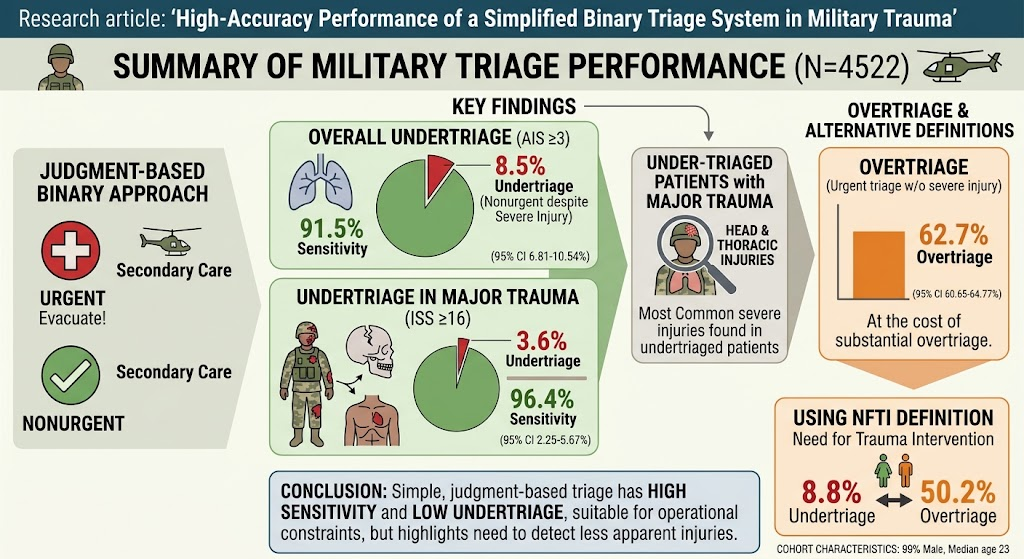
- A judgment-based binary triage system achieved a low undertriage rate of 8.5% for severe injuries and 3.6% for major trauma (ISS ≥16) in a military combat setting.
- The triage sensitivity for identifying major trauma was notably high at 96.4%, facilitating prompt prioritization for urgent evacuation and intervention.
- Overtriage rates were substantial, exceeding 50%, reflecting a trade-off favoring sensitivity and patient safety at the expense of resource utilization.
- Severe head and thoracic injuries predominated in undertriaged patients, indicating a need for improved detection protocols for less overt critical injuries.
Study Background
Accurate and rapid triage of trauma casualties in military combat zones is paramount for optimizing evacuation priorities and allocating limited medical resources. The chaos, operational constraints, and diagnostic uncertainty inherent in battlefield environments challenge the feasibility of complex triage algorithms. Existing multi-tiered triage systems may hinder compliance and timely decision-making, potentially compromising patient outcomes. Consequently, simplified, binary triage approaches relying on clinical judgment have been proposed to enhance usability and adherence in the field. However, robust evidence validating these simplified systems under real-world combat conditions has been limited.
Study Design
This prospective cohort study involved 4522 military trauma casualties treated by the Israel Defense Forces Medical Corps from October 27, 2023, to January 19, 2025. The simplified triage system assigned casualties to one of two categories: urgent or nonurgent. The primary endpoints were undertriage—patients classified as nonurgent despite having severe injuries—and overtriage—the inverse scenario. Injury severity was measured using the Abbreviated Injury Scale (AIS) and Injury Severity Score (ISS), with major trauma defined as ISS ≥16. The study also evaluated the need for trauma intervention (NFTI) as a secondary clinical endpoint. Performance metrics included sensitivity, and the rates of undertriage and overtriage, with corresponding 95% confidence intervals.
Key Findings
The study population was predominantly young adult males (median age 23; 99% male). Among casualties with any injury scoring AIS≥3, the binary triage system demonstrated an undertriage rate of 8.5% (95% CI, 6.81%-10.54%), representing false negatives in urgent care allocation. When focusing on major trauma patients (ISS ≥16), undertriage decreased to 3.6% (95% CI, 2.25%-5.67%), indicating effective identification of critically injured patients. Sensitivity values were correspondingly high: 91.5% (95% CI, 89.46%-93.19%) in the broader severe injury category and 96.4% (95% CI, 94.33%-97.75%) for major trauma.
Overtriage, defined as urgent triage assignment without corresponding severe injury, was considerable: 62.7% (95% CI, 60.65%-64.77%) for AIS-based injury criteria and 50.2% (95% CI, 48.06%-52.32%) using NFTI as the comparator. This reflects a deliberate bias towards sensitivity to minimize missed critical injuries in the field.
Detailed analysis of undertriaged major trauma cases revealed that severe head and thoracic injuries were most frequently overlooked by the binary system. This suggests that while gross injury detection is robust, subtle or non-apparent high-risk injuries remain diagnostic challenges, potentially due to limited assessment tools or clinical signs in austere environments.
Expert Commentary
The findings align with established trauma triage principles emphasizing the avoidance of undertriage to reduce mortality risk, even at the cost of high overtriage. Undertriage results in missed opportunities for timely life-saving interventions, whereas overtriage impacts resource utilization but is safer from a patient outcome perspective. The very low undertriage rates for major trauma support operational reliance on the simplified binary triage system in combat settings characterized by extreme constraints.
Nonetheless, the substantial overtriage highlights the need for refinement to reduce unnecessary resource burden without compromising sensitivity. Particular attention is warranted for improving detection of severe head and thoracic injuries, potentially through adjunct diagnostic aids such as portable ultrasound, enhanced training, or decision-support tools integrated into triage protocols. Additionally, the generalizability of these findings may be limited by the predominantly young male military cohort and specific combat theatre dynamics.
Conclusion
This large cohort study demonstrates that a simplified judgment-based binary triage system achieves high sensitivity with low undertriage rates for major trauma in a military combat environment. The associated substantial overtriage reflects a necessary safety margin under operational constraints. These results endorse the pragmatic use of simple triage systems in austere settings but underscore the ongoing need to enhance injury detection accuracy, particularly for less overt critical injuries. Future research should explore augmentation strategies and validation across diverse trauma populations and settings.
Funding and ClinicalTrials.gov
The original study did not specify external funding sources or clinical trial registration numbers. Further inquiries may refer to the Israel Defense Forces Medical Corps or the corresponding publication for additional details.
References
1. Gelman D, Gelman R, Dym I, et al. High-Accuracy Performance of a Simplified Binary Triage System in Military Trauma. JAMA Surg. 2026;161(8):823-831. PMID: 42307942.
2. Champion HR, Sacco WJ, Copes WS, et al. The Major Trauma Outcome Study: Establishing national norms for trauma care. J Trauma. 1990;30(11):1356-1365.
3. Lerner EB, Moscati RM. The Golden Hour: Scientific Fact or Medical “Urban Legend”? Acad Emerg Med. 2001;8(7):758-760.
4. Thames MD, Snyder J, Brice JH, et al. Understanding and Improving Military Prehospital Trauma Care. J Trauma Acute Care Surg. 2020;89(6S Suppl 2):S121-S125.