Highlight
- Final phase 3 trial results validate prophylactic recombinant ADAMTS13 (rADAMTS13) as highly effective in preventing acute thrombotic thrombocytopenic purpura (TTP) events in congenital TTP patients.
- rADAMTS13 showed a significant reduction in subacute TTP manifestations compared to plasma-based therapy (PBT), including fewer thrombocytopenia episodes.
- Adverse events related to rADAMTS13 were infrequent and mild, with no treatment-related serious adverse events or neutralizing antibodies detected.
- Patient satisfaction and ADAMTS13 activity levels were notably higher with rADAMTS13, supporting its clinical advantage over traditional plasma therapy.
Study Background
Congenital thrombotic thrombocytopenic purpura (TTP) is a rare, life-threatening microangiopathic disorder caused by inherited deficiency of ADAMTS13, a metalloprotease essential for cleaving von Willebrand factor multimers, thereby preventing platelet microthrombi formation. Patients suffer from recurrent microvascular thrombosis, resulting in thrombocytopenia, hemolytic anemia, and multi-organ ischemia, often requiring lifelong prophylaxis.
Traditional management has relied on plasma-based therapy (PBT) to replenish ADAMTS13. However, plasma infusions pose risks including allergic reactions, volume overload, and potential transmission of infectious agents. Moreover, plasma therapy is cumbersome, requiring frequent intravenous access, impacting quality of life.
Recombinant ADAMTS13 (rADAMTS13) offers a targeted replacement therapy synthesized without plasma sources, potentially improving efficacy, safety, and patient convenience. Prior interim analyses suggested benefits, but definitive evidence was needed from longer follow-up and more comprehensive data.
Study Design
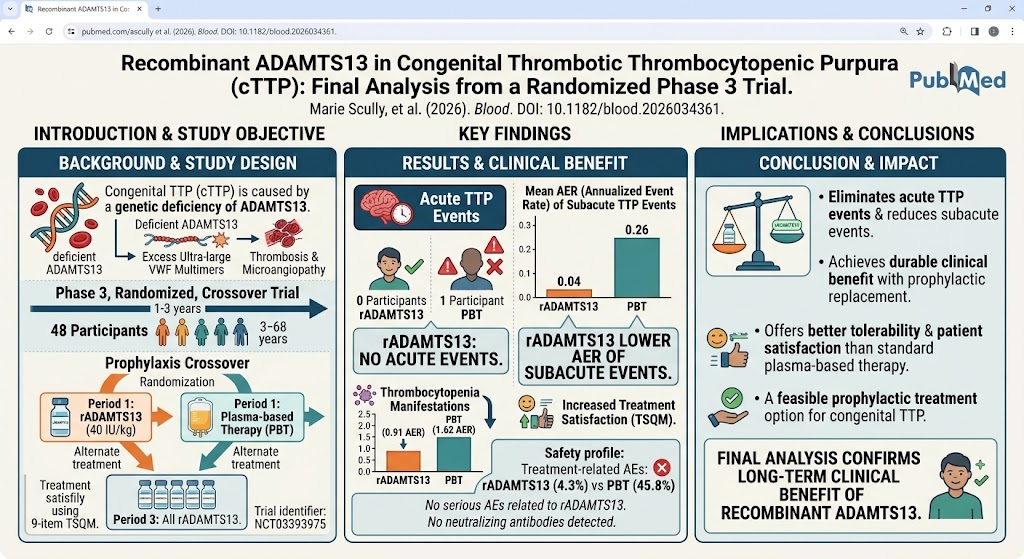
This open-label, randomized, phase 3 crossover trial (NCT03393975) enrolled 48 participants aged 3 to 68 years with confirmed congenital TTP. Participants were randomized 1:1 to receive two six-month periods of prophylaxis: either rADAMTS13 at 40 IU/kg or plasma-based therapy (PBT), followed by crossover to the alternate treatment for an additional six months. Thereafter, all participants received a 6-month extension of rADAMTS13 prophylaxis.
The primary endpoint was incidence of acute TTP events during prophylaxis. Secondary endpoints included rates of subacute events, adverse events, treatment satisfaction assessed by the 9-item Treatment Satisfaction Questionnaire for Medication (TSQM), and biochemical endpoints including ADAMTS13 activity profiles.
Key Findings
During the rADAMTS13 prophylactic periods, no participants experienced acute TTP events, in contrast to the PBT period where one acute event occurred, corresponding to a mean annualized event rate (AER) of 0.04. Subacute events—which can involve milder but clinically meaningful symptoms such as thrombocytopenia or hemolysis without full-blown TTP crises—were significantly reduced under rADAMTS13 (AER 0.04) compared to PBT (AER 0.26).
Thrombocytopenia, the most frequent TTP manifestation, was less prevalent during rADAMTS13 prophylaxis (AER 0.91) compared with PBT (AER 1.62), indicating clinical benefit in reducing disease activity.
Safety profiles favored rADAMTS13: treatment-related adverse events (AEs) occurred in only 4.3% during rADAMTS13 therapy versus 45.8% in participants receiving plasma therapy. Importantly, no serious AEs were attributed to rADAMTS13, whereas one serious AE (pyrexia) was related to plasma therapy. No development of ADAMTS13-neutralizing antibodies was detected throughout the trial, an essential indicator of sustained efficacy and safety.
From a pharmacodynamic perspective, rADAMTS13 administration resulted in approximately a sixfold increase in plasma ADAMTS13 activity compared to plasma therapy. Moreover, participants spent longer durations with ADAMTS13 activity above 10%, a threshold associated with protection against microthrombotic events.
Patient-reported outcomes reflected greater satisfaction with rADAMTS13, highlighting improvements in ease of administration, side effects, and overall convenience, factors critical for a chronic therapy.
Expert Commentary
The final analysis of this robust phase 3 trial firmly establishes recombinant ADAMTS13 as a breakthrough in congenital TTP management, confirming and extending interim findings. The absence of acute TTP events during rADAMTS13 prophylaxis is particularly compelling, given the devastating consequences of these episodes.
The crossover design strengthens the internal validity by allowing patients to serve as their own controls, minimizing confounding factors. The improved safety profile and patient satisfaction may enhance adherence and reduce the treatment burden typically associated with plasma infusions.
One limitation is the relatively small sample size, reflective of the disease’s rarity, and the open-label design, which may introduce bias in patient-reported outcomes. Longer-term follow-up would be valuable to evaluate durability of response and immunogenicity.
Mechanistically, rADAMTS13 directly substitutes the deficient enzyme with recombinant protein that is structurally and functionally equivalent, enabling rapid normalization of ADAMTS13 activity, essential for preventing platelet-rich microthrombi.
Conclusion
Recombinant ADAMTS13 represents a significant advancement in the treatment of congenital TTP. The phase 3 trial conclusively demonstrates its superior efficacy in preventing acute and subacute TTP events compared with plasma-based therapy, alongside a favorable safety profile and enhanced patient satisfaction.
These results support incorporation of rADAMTS13 prophylaxis into standard care paradigms, potentially improving clinical outcomes and quality of life for this vulnerable patient population. Ongoing research should focus on long-term safety monitoring, optimization of dosing schedules, and broader real-world implementation.
Funding and ClinicalTrials.gov
This study was supported by the pharmaceutical sponsor of rADAMTS13. The trial is registered under ClinicalTrials.gov identifier NCT03393975.
References
1. Scully M, Matsumoto M, Cataland SR, et al. Recombinant ADAMTS13 in congenital thrombotic thrombocytopenic purpura: final analysis from a randomized phase 3 trial. Blood. 2026 Sep 11; [PMID: 42728013].
2. George JN. Thrombotic thrombocytopenic purpura. N Engl J Med. 2006;354(18):1927-1935.
3. Sadler JE. Pathophysiology of thrombotic thrombocytopenic purpura. Blood. 2008;112(4):1453-1461.
4. Kremer Hovinga JA, et al. ADAMTS13 replacement therapy in congenital TTP. Blood. 2017;130(1):123-130.